Sign in. It’s quick, free and it’s up to you.
An account is an optional way to support the work we do. Find out more.
Sign in. It’s quick, free and it’s up to you.
An account is an optional way to support the work we do. Find out more.
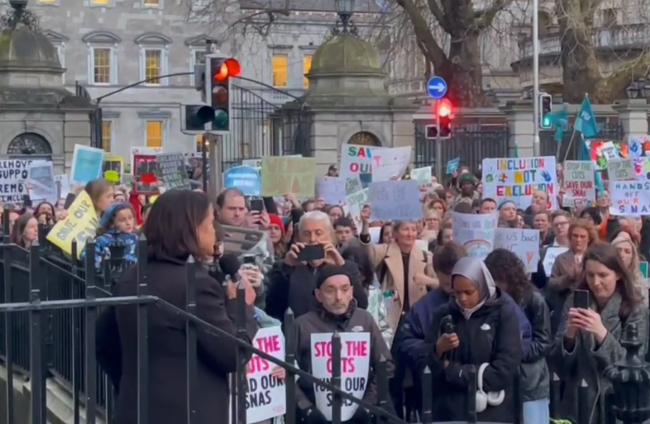
HUNDREDS OF PEOPLE gathered in Dublin and Galway today to protest mooted cuts to special needs assistant (SNA) allocations.
An estimated 180 schools across the country were told earlier this month that their SNA allocations would be reduced in September.
Outrage prompted the government to roll back the plans, with Minister for Education Hildegarde Naughton promising that no cuts would be made for the next school year.
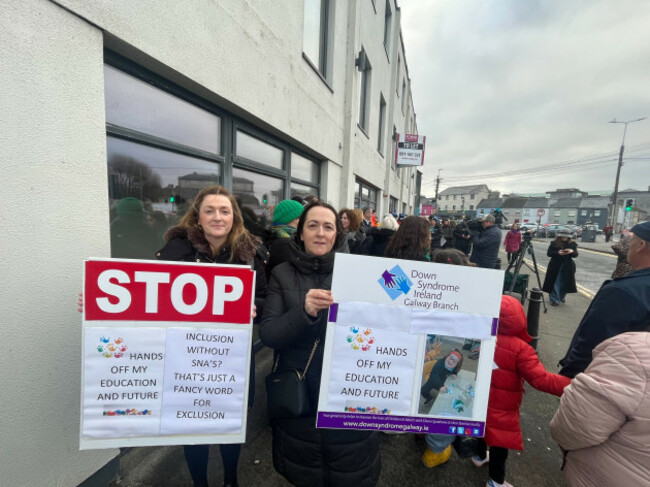
Demonstrations were held today outside Leinster House in Dublin and Naughton’s constituency office in Galway.
Signs read “early support changes lives” and “children deserve permanent SNA support”.
Dozens of parents, SNAs and supporters protesting outside Education Minister Hildegarde Naughton’s constituency office in Galway city this evening.
— Eoghan Dalton (@EoghanDalton) February 25, 2026
Many very unhappy over the uncertainty on schools’ SNA roles
- @thejournal_ie pic.twitter.com/ouOTWthghq
Louise, who has been an SNA for 11 years, said she has seen children’s need for support increase every year.
“The Department of Education wants the inclusion model to work, but they are not putting in the facilities,” she said.
“If a child is having a regulation issue … if that SNA is gone, the only other person who can help that child regulate is the teacher,” she said.
“Once that teacher is on that child, all teaching stops. So the entire class then is delayed.
Every child in the country will suffer if the SNAs are reduced.
Michelle Harold, who attended the protest in Galway, said hearing the news of possible cuts “was gutwrenching”. She is “extremely worried” about her daughter Kate (6), who has Down Syndrome and is currently attending a mainstream school.
“Her future is being taken away from her if she does not have SNA support in the classroom,” she said.
“I want my daughter to be independent, live independently … If we tick those boxes that she no longer needs a “care need” like toileting or feeding, she will not get her SNA.”
Harold says children should be supported to remain in a mainstream classroom.
One mother, Emily, who protested outside Leinster House, said if the proposed plans had gone ahead, three out of five SNAs at her son Finn’s school would have been let go.
Finn is autistic and, while he is able to keep up academically, he struggles with focus.
“I thought the government’s idea was to try and move as many into mainstream (schools) and give them as much support there. But because he doesn’t have medical needs, he is not deemed as worthy.”
Emily welcomes the pause on the cuts, but worries they’ll still be implemented “by stealth” down the line.
“What that will mean for Finn is he will end up going into a special class, taking him completely out of mainstream,” she explained.
Lisa Fitzgerald, another SNA in Dublin, said she felt the government showed a “lack of respect” for staff and children in how it decided to make cuts without consulting those who’d be affected.
She said there is a “misunderstanding” of the role of SNAs. Their ability to support a child’s “secondary needs”, such as emotional regulation, is important, she says.
“I had a child with DLD (Developmental Language Disorder). Even with his peers, he needed me to help him explain things so he didn’t get frustrated or left behind. And now they’re saying that will be taken away,” Fitzgerald said.
The National Council for Special Education (NCSE) , which is responsible for the delivery of special education, allocates SNA posts based on reviews of care needs in each school.
These allocations can change due to student numbers, care needs, or pupils moving between school levels.
There are over 23,000 SNAs in the system, so the department and government ministers had been at pains to point out that “only 1%” had been identified by the NCSE as “surplus in schools”.
However, this still meant that hundreds of SNA posts would have been affected in the shakeup.
Sinn Féin leader Mary Lou McDonald also attended the demonstration in Dublin.
She told SNAs in the crowd that they “are so much more than the treatment you receive from the government”.
Minister Naughton yesterday conceded that “something obviously went wrong” with how the proposed SNA cuts were communicated.
“This was poorly communicated, and there is a collective responsibility here on this. I’m not happy with the way it played out, but I want to make sure now that we get this right,” she said.
“But the communications around it, and the sequencing of the communications, was not done correctly, and I absolutely accept and I’m going to rectify that now.”
McDonald said today: “This wasn’t an accident. This wasn’t a communication or a sequencing failure. This is government policy in action.”
The NCSE will again review SNA allocations at schools for the academic year starting September 2027, and the minister has said she’ll have more detail on the longer-term plan once she receives certain documents, including a review of the technical role of SNAs.
With reporting by Kate Henshaw and Eoghan Dalton

To embed this post, copy the code below on your site













have your say