We need your help now

Support from readers like you keeps The Journal open.

You are visiting us because we have something you value. Independent, unbiased news that tells the truth. Advertising revenue goes some way to support our mission, but this year it has not been enough.

If you've seen value in our reporting, please contribute what you can, so we can continue to produce accurate and meaningful journalism. For everyone who needs it.

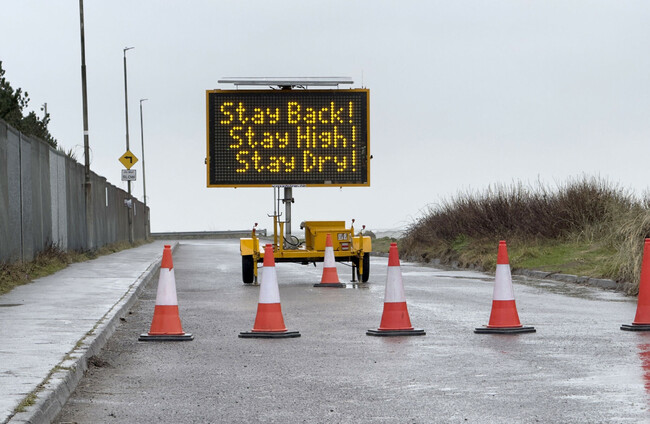
Road cones and warning signs during a high tide near Poolbeg during Storm Chandra in February. Sasko Lazarov/© RollingNews.ie

From extreme storms to rising premiums, Ireland is paying the price for climate inaction

A new report by the Climate Change Advisory Council looks at climate trends and how Ireland can strengthen preparedness for climate impacts.

STORM ÉOWYN WAS the most expensive storm-related insurance event in Irish history, with claims in excess of €301m – but these weather events are growing more frequent and Ireland is not prepared.

This is one of the conclusions of a new report by the Climate Change Advisory Council which looks at how Ireland can strengthen preparedness for climate impacts.

It states the need for Ireland to diversify its energy sourcing from a reliance on fossil fuel, a subject that arose recently as oil and fuel prices shot up in response to the war in Iran.

The report also examines the economic impacts of these extreme weather events.

The report, which analyses 2025, also includes a reflection of Storm Chandra, which caused extreme flooding in communities in the east and south-east at the end of January this year.

More frequent weather events and rising temperatures, driven by climate change, are growing risks to Ireland’s infrastructure, essential services, communities and the economy, it said.

Crucially, the report is the first from the Council that determines how much more likely and to what extent extreme weather events were worsened by climate change.

To this effect, it found rainfall during Storm Claudia in November 2025 was made twice as likely and nearly 12% more intense than it would’ve been in a pre-industrial climate.

And now, the weather

Put briefly, Ireland’s climate is warming and growing more volatile: drier summers, heavier rainfall, stronger winds.

We’ve seen this through higher temperatures; 2025 was the second-warmest year on record. Seven of the ten warmest years have occurred since 2005.

Our storms are growing stronger and we’re seeing heavier downpours, testing our infrastructure. Six of the ten wettest autumns have occurred since 2001 and Storm Éowyn broke record wind speeds.

In the summer last year, a drought was declared across 49 water supplies in 15 counties by Uisce Éireann as Ireland saw record-breaking warm conditions in the spring and summer.

These swings between extremes are the direct result of climate change as a result of greenhouse gas emissions.

Economic impacts

Climate change is also having an economic impact that is only set to worsen if urgent intervention is not made, the council said.

Speaking to The Journal, the chair of the council’s Adaptation Committee Prof Peter Thorne said the high insurance claims paid out after Storm Éowyn are only a small part of the economic impact.

“[Storms Éowyn and Chandra] are costing a huge amount. The affected individuals, if they are insured, it’s falling on the insurance companies, which obviously pushes up premiums for everybody,” Thorne said.

“But the real challenge is that many of these people will not have been insured, either because they chose not to be or because they were uninsurable for the types of events that occurred, and that then ultimately falls on the taxpayer, because the State comes in and helps.”

Thorne said it’s certain there will be more frequent and more extreme weather events that will cause repeated damage if there is no investment in infrastructure and preventative measures. 

What to do?

The Climate Change Advisory Council is calling on the government to coordinate its action to combat Ireland’s lack of resilience to these extreme weather events through investment and the strengthening of infrastructure. 

Years of inaction and a failure to plan have also led to increased exposure to the elements, which has continued to worsen.

These problems include approval being granted for homes to be built on flood plains, despite warnings against doing so. 

In Portrane in north county Dublin, residents of The Burrow have watched their homes slowly be eaten by the sea due to eroding shorelines. T

hese coastal properties are more vulnerable to extreme weather events – and even those near river banks further inland are at risk when faced with heavy rainfall. 

Asked what government should prioritise to reduce risk and harm as efficiently as possible, Thorne said: “It’s turning plans into actions.”

The danger of climate change was long flagged with the government and it failed to adequately invest in alternative energy like renewables, he said.

He added that better planning and assessment of risks of new developments will lighten the future harm caused by climate change.

“These [extreme weather events] are not accidents. These are the result of climate change, of our historical emissions. And it’s a real wake up call that we need now to take action, because we know these things are being made more frequent, more likely, by climate change, and therefore we need to build a plan and take action.”

Readers like you are keeping these stories free for everyone...
A mix of advertising and supporting contributions helps keep paywalls away from valuable information like this article. Over 5,000 readers like you have already stepped up and support us with a monthly payment or a once-off donation.

View 24 comments
Close
24 Comments
This is YOUR comments community. Stay civil, stay constructive, stay on topic. Please familiarise yourself with our comments policy here before taking part.
Leave a Comment
    Submit a report
    Please help us understand how this comment violates our community guidelines.
    Thank you for the feedback
    Your feedback has been sent to our team for review.

    Leave a commentcancel

     
    JournalTv
    News in 60 seconds