We need your help now

Support from readers like you keeps The Journal open.

You are visiting us because we have something you value. Independent, unbiased news that tells the truth. Advertising revenue goes some way to support our mission, but this year it has not been enough.

If you've seen value in our reporting, please contribute what you can, so we can continue to produce accurate and meaningful journalism. For everyone who needs it.

Alamy Stock Photo

Explainer: What does a deleted US government report say about the politics of domestic terrorists?

Trump vowed retribution against left-wing groups, despite stats showing most political violence comes from elsewhere.

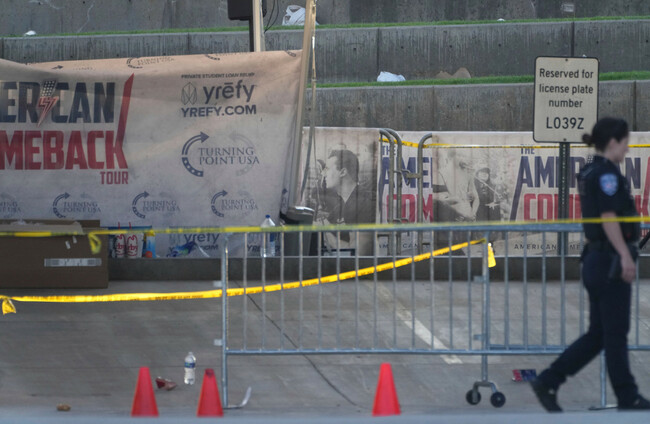
IN THE WAKE of the shooting of Charlie Kirk last week, Republican politicians in the US rushed not just to ascribe a left-wing motive to the attacker, but to blame the political left more generally for a rise in violence.

Within hours of the 10 September shooting, Donald Trump blamed “those on the radical left”, saying their rhetoric was “directly responsible for the terrorism that we’re seeing”.

“Violence and murder are the tragic consequence of demonising those with whom you disagree,” he said in a video posted on Truth Social, his own social media platform.

Within a day, a report that contradicted Trump’s weaponisation of the issue was taken down from a US Justice Department website.

Rhetoric from the White House also turned from blame to retribution, with Vice President JD Vance saying on a podcast that “we need to have an organised strategy to go after the left-wing organisations that are promoting violence in this country”.

Such a strategy appears to be forming, according to senior administration officials cited by The New York Times, which reported that left-wing organisations are being identified for punishment. On Tuesday, Trump posted on Truth Social that he was designating Antifa, a decentralised anti-fascist movement, as a terrorist organisation. 

The move would appear to be in contrast to research on the political motivations of domestic terrorists in the US.

What the research says

A now-removed report, whose disappearance from a government website was noted by the news website 404 Media, summarised findings by the National Institute of Justice (NIJ), the US Justice Department’s research arm.

However, archived copies of the report – titled What NIJ Research Tells Us About Domestic Terrorism – have remained accessible and can be downloaded in full here.

Published on the NIJ’s Journal in June 2024, the report appears to contradict the message that political violence is mainly spurred by far-left rhetoric.

“The number of far-right attacks continues to outpace all other types of terrorism and domestic violent extremism,” its opening paragraph reads.

“Since 1990, far-right extremists have committed far more ideologically motivated homicides than far-left or radical Islamist extremists, including 227 events that took more than 520 lives.”

The paper cites academic sources for these claims, which are still available online on non-government websites.

The report also tallies left-wing violence.

“In this same period, far-left extremists committed 42 ideologically motivated attacks that took 78 lives,” it says.

The report notes that, in additional to far left- and right-wing driven violence, hate crimes are also driven by single-issue ideologies, or Islamism, and routinely are committed by people across political spectrums.

The report also details that the internet is often a major tool used to recruit and encourage domestic terrorism, and it notes that while international terrorist groups remain a threat, “studies show that domestic extremists continue to be responsible for most terrorist attacks in the United States”.

Other stats

It should be noted that the FBI and Department of Homeland Security no longer designate terrorist threats as being motivated by left-wing or right wing politics.

A 2023 report to the US Congress outlined the ideological categories that are currently used as descriptors as “racially or ethnically motivated violent extremists, anti-government or anti-authority violent extremists [...] animal rights/environmental violent extremists, and abortion-related violent extremists”.

This government data means it’s not possible to discern how perpetrators’ motivations fall on the political spectrum, given how the government classifies these incidents. 

However, academic studies on the issue give more insight by using their own categorisation systems, including the studies cited by the now-deleted National Institute of Justice report.

These involved the creation of a “United States Extremist Crime Database (ECDB)” which listed violent incidents or illegal financial schemes in the US where a perpetrator subscribed to an extremist belief system.

A 2021 analysis of that database found that “over the past three decades, the overall prevalence and deadliness of far-right extremism far outweighs that of the far-left”.

Looking at ideologically motivated homicides from 1990 to 2020, the analysis found that “far-left homicide incidents accounted for 15.6% of these homicide events, and far-right homicides accounted for 84.4%”.

When it came to the number of fatalities, the numbers were even starker, 87% of deaths were caused by far-right violence.

The report also noted that “far-right incidents tend to have a stronger ideological association (62.6%) compared to the far-left (35.7%)”, meaning that political ideology was only a weak motivating factor in more of the far-left cases.

The report notes that there was a surge in the number of far-left driven violent incidents during the first Trump administration.

However, these were still outnumbered by far-right violent incidents during Trump’s entire term, as well as during any given administration back to George H. W. Bush.

Other surveys of violent crimes (not just homicides) from the 1960s to the 2000s also showed that right-wing ideology is a far larger driver than left wing ideology.  

More recent research shows similar patterns, including a report from the Anti-Defamation League that noted: “All the extremist-related murders in 2024 were committed by right-wing extremists of various kinds.”

The Journal’s FactCheck is a signatory to the International Fact-Checking Network’s Code of Principles. You can read it here. For information on how FactCheck works, what the verdicts mean, and how you can take part, check out our Reader’s Guide here. You can read about the team of editors and reporters who work on the factchecks here.

Readers like you are keeping these stories free for everyone...
It is vital that we surface facts from noise. Articles like this one brings you clarity, transparency and balance so you can make well-informed decisions. We set up FactCheck in 2016 to proactively expose false or misleading information, but to continue to deliver on this mission we need your support. Over 5,000 readers like you support us. If you can, please consider setting up a monthly payment or making a once-off donation to keep news free to everyone.

Close
JournalTv
News in 60 seconds