We need your help now

Support from readers like you keeps The Journal open.

You are visiting us because we have something you value. Independent, unbiased news that tells the truth. Advertising revenue goes some way to support our mission, but this year it has not been enough.

If you've seen value in our reporting, please contribute what you can, so we can continue to produce accurate and meaningful journalism. For everyone who needs it.


FactCheck: What does a price map tell us about energy costs in Ireland compared to Europe?

Is electricity five times more expensive in Ireland than Spain? Sometimes, it’s even more than that.

ENERGY PRICES HAVE jumped since the United States and Israel launched a war against Iran earlier this month, resulting in supplies of oil from the Middle East being strangled as Iran cut off a key transport waterway.

In Ireland, energy prices climbed by more than 11% in March alone and were up by more than 12% over the year.

This steep increase has largely been due to a surge in the price of oil and petrol, though trackers of electricity prices have also seen a significant rise, by about 7%.

However, anxiety over rising prices has also prompted some startling, if dubious, claims online.

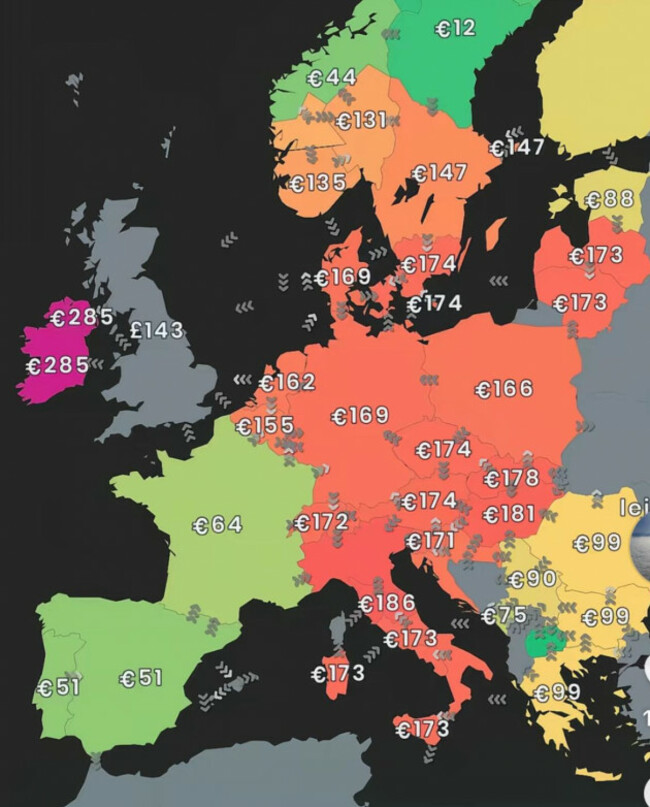
“Ireland is being ripped off (no surprise) on ESB pricing…have a look. It’s not just diesel,” reads a 23 March Facebook post, just one of many that use the same map of Europe with prices overlaid. 

Ireland map electricity

That image has the figure of €285 over Ireland, while €51 hovers over both Spain and Portugal, and France is given as €64.

These seem like startling figures. Are Irish people really paying more than five times for electricity than people in Spain and Portugal do?

Although there is little detail in the image, nor an indication of where it is from, it is an exact match for interactive dashboards given on the Danish-based data company Electricity Maps.

“The map you’ve seen is almost certainly from our platform,” Matthew Sutton of Electricity Maps told The Journal.

Their live map shows updated electricity prices updated to the current time, as well as stats on renewables and carbon generation. 

These are changing constantly, though sometimes in ways that make the discrepancy between Ireland and Spain seem even starker than in the image shared on Facebook.

At the time of writing, the live platform showed that Ireland’s price had dropped to €120, but Spain’s was at minus €2, less than zero.

So what do these figures actually show?

“The prices displayed on Electricity Maps are day-ahead wholesale electricity prices — the price at which generators sell electricity to suppliers on the open market,” Sutton told The Journal.

Despite what multiple online posts suggested, the prices shown on these maps are not specific to ESB.

Instead, they show the cost per MWh (1,000 KWh, or roughly what an average Irish house would use in three months) as they are sold to all Irish electricity companies.

“It is not what households or businesses actually pay on their energy bills,” Sutton noted.

“Retail prices include a significant stack of additional costs on top of the wholesale price — network charges, distribution fees, taxes, levies, and supplier margins.

“In Ireland, these additional components are substantial.”

Sutton said that these prices are changing all the time, and “swing significantly”.

“A single screenshot captures one specific hourly interval. It may represent an extreme — either unusually high or unusually low — and shouldn’t be read as the typical or average relationship between any two countries,” Sutton said.

So, if we can’t judge consumer prices based on a snapshot from the Electricity Maps platform, is it true to say that Ireland is more expensive than Spain in general?

“The underlying claim is broadly accurate,” Sutton said. “Ireland is genuinely one of the most expensive electricity markets in Europe, and Spain is one of the cheapest.

“ The gap at retail level is meaningful — roughly 20–25% or more — but nowhere near five times (400%).”

“A ratio like that would only appear at a specific wholesale market moment, such as a sunny afternoon in Spain when solar is flooding the market, compared to a high-demand evening hour in Ireland when gas generation is setting the price.

Natural gas

Even before the war in Iran, Irish households were paying about €360 more per year for electricity than the western European average.

This was included in an analysis from the Nevin Economic Research Institute, which laid blame for high prices on the disproportionate role natural gas plays in the Irish electricity system, as well as our dispersed population.

“The structural reason Ireland tends to be expensive is that it is relatively isolated — it has no direct electricity interconnection with continental Europe, only a single link to Great Britain — and relies heavily on gas-fired generation to meet demand.”

This lack of links means Ireland can’t benefit by importing cheap surpluses of renewable energy from the continent, like what was seen in Spain.

Spain, conversely, has been producing most of its energy using renewable energy, including wind and solar generators.

“Spain has rapidly expanded its solar and wind capacity — more than doubling it since 2019 — to the point where, on sunny or windy days, renewable generation can exceed demand,” Sutton told The Journal.

“When that happens, the wholesale price drops sharply, and can go negative: in those hours, generators are effectively paying to offload electricity onto the grid rather than curtail their output”

There were more than 20 days’ worth of negative wholesale prices in 2025.

“However,” Sutton cautioned, “negative wholesale prices do not mean consumers receive free electricity.”

Even when electricity companies get their supply for free, they still charge tax, as well as fixed fees to maintain the network. 

“The saving is partial, not total,” Sutton said.

A blackout in Spain last April was initially blamed by many on the push for renewable energy, as well as speculation it was due to a solar flare.

Results of the investigation into the blackout were released earlier this month and showed that it was largely caused by technical issues on the grid.

“The problem is not renewable energy, but voltage control,” the chair of the group that published the report said. “This isn’t about high technology; it’s something we’ve been able to do for decades.”

The Journal’s FactCheck is a signatory to the International Fact-Checking Network’s Code of Principles. You can read it here. For information on how FactCheck works, what the verdicts mean, and how you can take part, check out our Reader’s Guide here. You can read about the team of editors and reporters who work on the factchecks here.

Readers like you are keeping these stories free for everyone...
It is vital that we surface facts from noise. Articles like this one brings you clarity, transparency and balance so you can make well-informed decisions. We set up FactCheck in 2016 to proactively expose false or misleading information, but to continue to deliver on this mission we need your support. Over 5,000 readers like you support us. If you can, please consider setting up a monthly payment or making a once-off donation to keep news free to everyone.

Close
JournalTv
News in 60 seconds