Sign in. It’s quick, free and it’s up to you.
An account is an optional way to support the work we do. Find out more.
Sign in. It’s quick, free and it’s up to you.
An account is an optional way to support the work we do. Find out more.
IRELAND’S RENTAL MARKET is never far away from the headlines, with no shortage of stories or statistics highlighting the difficulties faced by renters.
One claim that sought to paint a picture of this recently was the suggestion by the Labour Party that Ireland is now experiencing evictions at a rate not seen since the Great Famine.
How true is this? Let’s take a closer look.
In a press release published on the Labour Party website on 19 March, Labour’s housing spokesperson Conor Sheehan claimed that the Irish government is now presiding over the highest level of evictions since the Famine.
He reiterated this point again in a Dáil debate on 26 March, saying:
“The cost-of-living emergency is getting worse. The measures the Government announced mean the cost of living will remain stubbornly high for workers and families who cannot make ends meet.
“Renters are not immune from this crisis and are in fact the worst hit… We are also seeing a growing wave of evictions – in fact, the highest rate of evictions since the Famine.”
In both the press release and Dáil debate, Sheehan noted a stark figure: the number of Notices of Termination (NoTs or eviction notices) issued rose by 41% in the fourth quarter of 2025 compared to the same period in 2024.
This same figure has been headline news across multiple publications.
The Journal contacted Conor Sheehan to ask about his sources for the claim, and received a response.
He cited the following an RTÉ Brainstorm article titled ‘We’re seeing eviction rates not seen in Ireland since the 1850s’, written by professor Eoin McLaughlin of Heriot-Watt University and Dr Richard McMahon of Mary Immaculate College in Limerick.
Although this is a secondary source of data, within the article we can see the primary source of Sheehan’s initial statistic: the Residential Tenancies Board (RTB).
The RTB is a public body that maintains a register of (most) rented residential properties in Ireland.
Private landlords are legally required to register their tenancies with the RTB, and as such, the data gathered by the RTB regarding eviction notices issued by private landlords can be considered fairly accurate.
However, there are also a number of landlords who operate outside the law.
In 2024 alone, there were an estimated 73,000 ‘rogue landlords’ who had failed to register their properties with the RTB.
This means that statistics regarding evictions will almost always be underrepresented as not all tenancies, and therefore evictions, are appropriately documented.
So, while the data provided by the RTB is the best data currently available to us, it is important to note that these numbers do not perfectly mirror reality.
Nevertheless, the statistics cited by Sheehan – a 41% increase in eviction notices in the last three months of 2025 compared to the same period in 2024 – coupled with comparisons to the Great Famine, paint an abysmal picture of the Irish rental market.
Are things really this dire? Let’s have a closer look at the available RTB data to see.
Picking apart the numbers
The chart below uses data lifted directly from the RTB website, and shows the number of eviction notices issued quarterly from the 3rd quarter of 2022 until the 4th quarter of 2025:
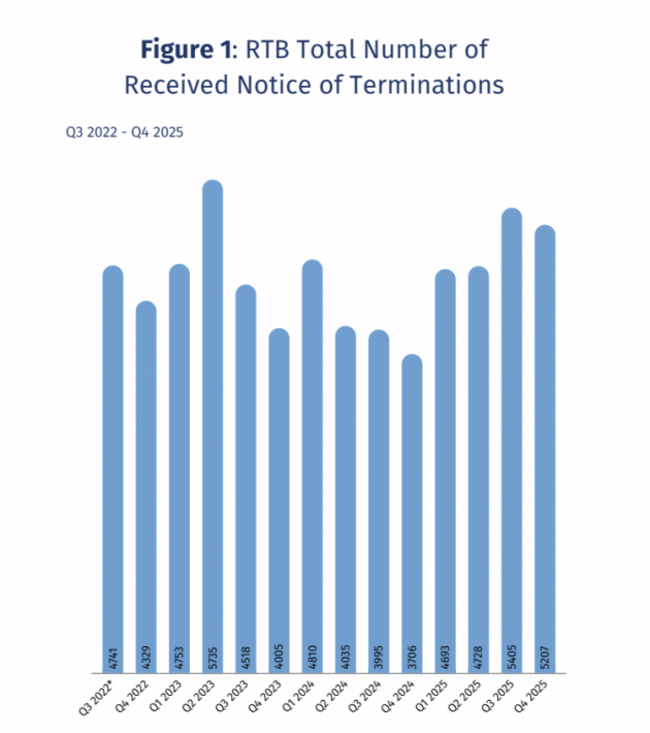
Here, we can see that over the last few years, the number of NoTs/eviction notices issued quarterly has fluctuated.
The number of eviction notices issued peaked in the second quarter of 2023, at 5,735 NOTs, following the lifting of the temporary eviction moratorium.
They were at their lowest point in the fourth quarter of 2024, at 3,706 NOTs.
It is this low point that has been used as the basis for comparison in the claim that the number of evictions issued rose by 41% in the fourth quarter of 2025 compared with the same period in 2024.
While the available RTB data demonstrates that the numbers behind this claim are true, in data analysis it can be considered misleading to use an extreme value (aka the lowest or highest value in a data set) as a point of comparison without disclosing its status as such.
More information regarding cherry-picking and selective data presentation can be accessed via the Global Fact Checking Network.
So yes, there was a 41% increase in the number of notices of termination issued in the fourth quarter of 2024 compared with the fourth quarter of 2025.
But to present this statistic without the broader context – ie that NoTs issued in the fourth quarter of 2024 were at a 3.5 year low – is misleading, as it implies a sudden spike in eviction notices being issued.
In reality, the number of eviction notices issued in 2025 was only marginally more than in 2023: 19,011 notices were issued in 2023 and 20,033 notices were issued in 2025).
Additionally, this specific data set provided by the RTB is quite small and only spans a couple of years, likely due to legislative changes that came into effect in 2022 regarding how eviction notices must be issued.
The smaller the data set, the more difficult it is to reliably identify trends over time.
But one thing is apparent: the 41% statistic that has been the subject of many news headlines misrepresents the current state of the Irish housing and rental market.
It is a selective presentation of data that muddies the waters.
Legacy of evictions
Shifting away from the selective reporting of statistics, let’s return to the main focus of this article: are eviction rates in Ireland the highest they have been since the Great Famine?
Right off the bat, evoking one of the bleakest moments in modern Irish history for comparative purposes is an interesting choice.
Emotive framing can be very helpful, as it can allow people understand the scale of a phenomenon by providing a somewhat familiar reference point.
It’s a common tactic used in the media, as the emotive framing of information is more likely to capture attention.
For example, in Northern Ireland in 2022, delays in hospital emergency departments led to threefold the number of conflict-related deaths during the worst year of the Troubles.
But emotive framing can also cause confusion, which may be the case in this instance.
When asked to provide sources for his claim that Ireland is now experiencing its highest rate of evictions since the Famine, Sheehan also shared another article: ‘”That diabolical system”: evictions in Famine Ireland’ by Irish historian Dr Ciarán Reilly.
This article opens with the following:
“Historians and others have long debated the exact number of people who were evicted during the Famine years, with some estimates suggesting between 250,000 and 500,000 families were removed.
“However, as the constabulary were only required to record eviction statistics from 1849, and many people were readmitted to holdings as caretakers, a definitive figure of how many were evicted during the Great Famine remains elusive.”
We will never know the exact number of people who were evicted during the famine. The further back in history we go, the more gaps appear in the historical record.
It is estimated that around one million died, and a further one million emigrated, and only now is the island of Ireland’s population returning to levels similar to those prior to the Great Famine.
But how do Irish eviction rates compare over time, from the famine until now?
Data compiled by professor Eoin McLaughlin in 2009 – based on returns made to the Inspector General of the then Royal Irish Constabulary – suggests that there were around 20,000 evictions in 1850.
This compares to the figure given by the RTB in 2025, when 20,033 NOTs were issued.
It should be noted that the 19th century figure peaked around 1850: it had increased from the previous year and declined in the years afterwards.
The Journal has not seen the specific figures, though the chart supplied by McLaughlin indicates that the number for 1850 was in the region of 20,000 evictions.
The Famine is deemed to have started in 1845, but a consistent and reliable record of rental market related data from the 1840s does not exist.
Even if it did, the social and political situations then and now are so vastly different that the statistics aren’t entirely comparable.
Famine-era Ireland possessed a much larger rental market share, average household size, and prevalence of informal dwellings than present day Ireland.
But based on the data we have available, there is evidence to say that the current rate of evictions in Ireland is at its highest since the Famine, even if the circumstances are different.
Evictions have a long history on the island of Ireland, and while blame could once comfortably be placed in the hands of the British Empire and its colonial land management system, the reason for present day evictions is closer to home.
Labour TD Conor Sheehan claimed that Ireland is experiencing the highest rate of evictions since the Great Famine.
Data from the Residential Tenancies Board shows there were approximately 20,033 notices of termination issued in 2025.
Returns made to the Inspector General of the then Royal Irish Constabulary show there were around 20,000 evictions in 1850.
However, those figures were contained in a thesis submitted in 2009 and The Journal has not seen the raw data behind them.
Sheehan told us that his claim was based on an RTÉ article by the person who submitted that thesis, who then provided more information to us.
It should also be noted that the social and political situations in Ireland between the 1840s and the present day are vastly different, because Famine-era Ireland had a much larger rental market share, average household size, and prevalence of informal dwellings.
We therefore rate Sheehan’s claim as MOSTLY TRUE. As per our verdict guide, this means the claim is close to accurate, but is missing significant details or context; the best available evidence weighs in favour of the claim.
The Journal’s FactCheck is a signatory to the International Fact-Checking Network’s Code of Principles. You can read it here. For information on how FactCheck works, what the verdicts mean, and how you can take part, check out our Reader’s Guide here. You can read about the team of editors and reporters who work on the factchecks here.
To embed this post, copy the code below on your site

















have your say