We need your help now

Support from readers like you keeps The Journal open.

You are visiting us because we have something you value. Independent, unbiased news that tells the truth. Advertising revenue goes some way to support our mission, but this year it has not been enough.

If you've seen value in our reporting, please contribute what you can, so we can continue to produce accurate and meaningful journalism. For everyone who needs it.


FactCheck: Does a viral map show the second-most spoken language in each Irish county?

The map appears to show Irish declining rapidly since 1920 — a low point for the language.

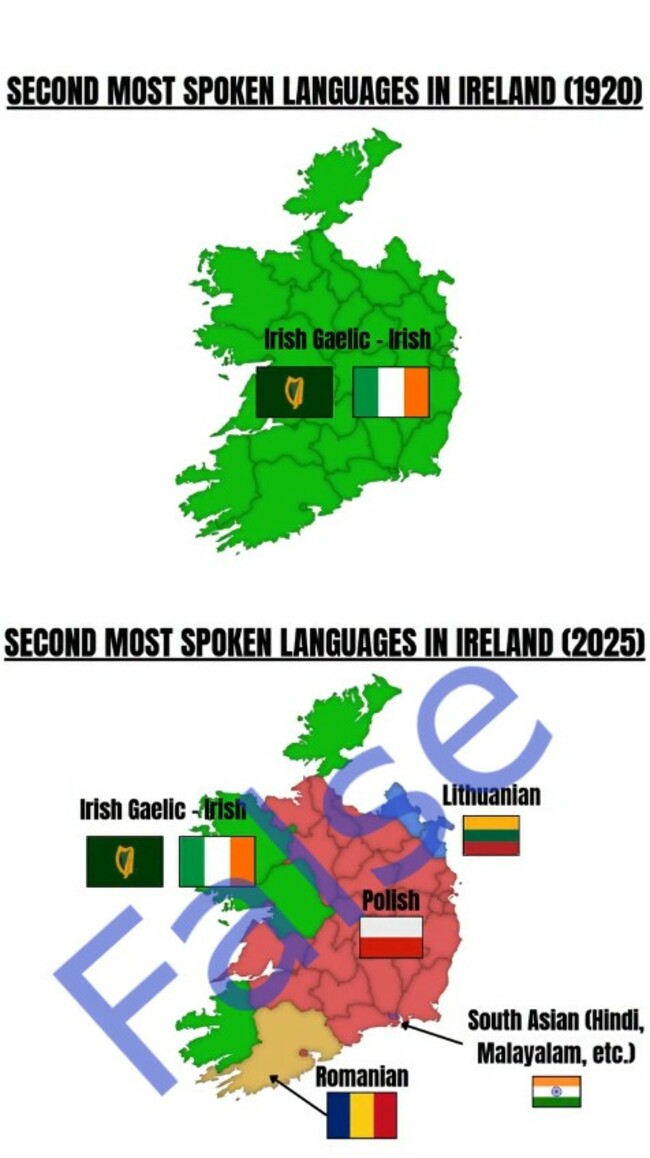
A MAP HAS been shared online that purports to show the second-most-spoken language in each of Ireland’s county council areas — but it contains false information.

Despite claims that the map is based on recent Census data, official figures contradict those that feature in it.

The Central Statistics Office (CSO), which compiles Census data, has said that questions asked in the census would not provide the information given in the map.

The map was contained in a post on Instagram on 14 February, which has garnered more than 15,500 likes on the platform to date.

The post shows a green map of Ireland, with a caption that says: “Second most spoken languages of Ireland (1920)”. The map is entirely green, standing for “Irish Gaelic”.

Below that, there is another comparative map with a caption that says: “Second most spoken languages in Ireland (2025)”.

In this second map, most of the country is dominated by a colour that indicates Polish as the second-most spoken language in a particular county. 

Louth and Monaghan are shaded blue to indicate Lithuanian is the second-most spoken language in those counties.

Cork is given as the only county where Romanian is indicated as the language spoken the most after English.

Waterford City is described as “South Asian”, and Donegal, Mayo, Galway and Kerry are shown as having Irish as their second-most-spoken language.

Screenshot 2026-02-18 104043 A map that went viral online

Other similar maps have also spread online, though they often just include “Polish” and “Irish”. These are also based on false information.

“The 2022 Irish Census found ~1.87 million people (≈40%) say they can speak Irish — but only a small part actually uses it daily,” a description of the map on a very popular Instagram post reads. “Many learned Irish in school or tick the box, yet just a few speak it regularly outside education. Shows how Irish is more about identity than everyday use. (cso.ie)”.

On the face of it, this map seems believable. Irish has declined massively since it was the dominant language of the country; languages like Polish and Lithuanian are now widely spoken; and the Census does collect information on language use.

However, there’s no way that the last Census — which was carried out in 2022 — could have provided information on languages spoken three years later in 2025, which the map purports to show.

Another reason to be suspicious is that Waterford City and County no longer have separate councils and are now administered by one council, yet they have different results on the map, which appears to divide the country into county council areas.

As it happens, the map is wrong and is not based on CSO data as it claims.

Foreign languages

The CSO does not compare the use of Irish to foreign languages; we will explore this further on. However, the map does not even describe the most-spoken foreign languages correctly.

For example, Dun Laoghaire-Rathdown is claimed to have Polish as the most-spoken second language, according to the map. However, ignoring Irish, Polish has fewer speakers in that area than both Spanish and French, according to CSO data.

Other contradictions to the map appear in the CSO’s dataset F5029, which shows that rather than Romanian being the most common foreign language in Cork, it is ninth on the list, behind (among other languages) Polish, French, Spanish, German and Portuguese.

Similarly, in Dublin City, Portuguese, Spanish, Romanian, and French all appear to be more widely spoken than Polish, contradicting the map.

The map claims that Lithuanian is also the second-most-spoken language in Louth — it’s not.

The claim that the second-most spoken languages in Waterford City are “South Asian (Hindi, Malayalam, etc.)” again contradicts the CSO data, which shows that in Waterford City and County, 784 people speak Malayalam and only 125 people speak Hindi, which even when combined are just a third the number of Polish speakers.

(The CSO does not present the same granular data for Waterford City alone).

So, if the claims about foreign languages appear to be made up, what do we know about the comparison with Irish?

Use of Irish

Although there is no source given for the map of 1920, there are reasons to believe it is roughly accurate. The most recent census taken before this was in 1911.

This showed that English was dominant in every county by that stage. And while good statistics were not collected for other languages, there is little reason to suspect that there was any county were Irish would be the third-most-spoken language.

But what about 2022? Can we compare the data on Irish speakers, taken in the most recent census, with speakers of foreign languages?

Not really.

The questions that appeared in the 2022 census for the Irish language were: “Can you speak Irish?”, and “If ‘Yes’, do you speak Irish?” (with options including “daily, outside the education system” and “weekly”).

A third option asked “how well” respondents spoke Irish.

The questions for other languages was simply: ”Do you speak a language other than English or Irish at home?” and “What is this language?”.

These are far from the same questions, and collect different points of data, with no indication of the frequency that foreign languages are spoken.

Neverthless, we can perhaps see how someone who wanted to find out whether a foreign language was more spoken than Irish might use the census results to compare these.

The description of the map given in the Instagram post talked about daily speakers outside of school.

Does this indicate that the map compares people who said they spoke Irish “daily, outside the education system” with all those who said that they spoke a language other than English and Irish in the home?

Again, no.

For example, Mayo is described as having Irish as the second-most-spoken language, but the CSO has 3,067 Polish speakers, but only 2,049 people who speak Irish daily outside the education system.

Does the map include daily Irish speakers within the education system too? No. If that were the case, Irish would be indisputably the second-most-spoken language in Ireland.

Another option is that the map meant to include both daily and weekly speakers of Irish outside the education system. However, if that were the case, lots of extra counties, such as Westmeath, should have Irish as the second-most-spoken language. The viral map says it’s Polish.

In short, the map that has spread widely online contradicts CSO data on many points, including the most spoken foreign languages in Ireland, and whether they are more spoken than Irish. Although a lot of what the map asserts initially seems plausible, the end result appears to be mostly guesswork.

The way that questions were asked in the 2022 census does not allow us to directly compare the use of Irish with other languages in daily life.

The CSO has provided a wealth of information on the use of Irish and other languages in Ireland, which can be accessed through their Census Interactive Map.

However, if the map raises concerns about the use of the Irish language, there is one reason to be optimistic. Both the 1911 and 2022 Censuses asked responders about their ability to speak Irish.

The wording of questions, methods of data collection, and patterns of Irish speaking between the 111 years have all changed. Nevertheless, the results are striking.

In 1911, excluding Northern Ireland, fewer than 554,000 respondents said they could speak Irish, which is estimated to be 17.6% of the population.

In 2022, that number had risen to 1,873,997 — about 40% of the population aged three years and over.

Even with the increased use of foreign languages in Ireland (other than English), there has been a significant rise in the understanding of Irish since the start of the 20th century when it was steeply in decline.

The Journal’s FactCheck is a signatory to the International Fact-Checking Network’s Code of Principles. You can read it here. For information on how FactCheck works, what the verdicts mean, and how you can take part, check out our Reader’s Guide here. You can read about the team of editors and reporters who work on the factchecks here.

Readers like you are keeping these stories free for everyone...
It is vital that we surface facts from noise. Articles like this one brings you clarity, transparency and balance so you can make well-informed decisions. We set up FactCheck in 2016 to proactively expose false or misleading information, but to continue to deliver on this mission we need your support. Over 5,000 readers like you support us. If you can, please consider setting up a monthly payment or making a once-off donation to keep news free to everyone.

Close
JournalTv
News in 60 seconds