We need your help now

Support from readers like you keeps The Journal open.

You are visiting us because we have something you value. Independent, unbiased news that tells the truth. Advertising revenue goes some way to support our mission, but this year it has not been enough.

If you've seen value in our reporting, please contribute what you can, so we can continue to produce accurate and meaningful journalism. For everyone who needs it.

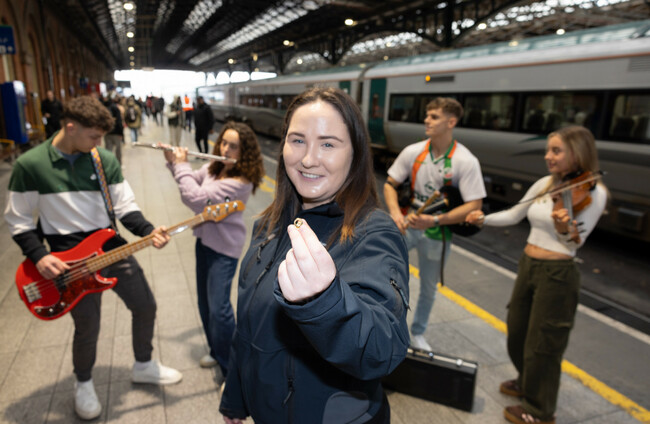
Erin Burns, the Irish language officer with Irish Rail, at the launch of Fáinne Ar Bord at Connolly Station in Dublin today. Photo: Paul Sharp Paul Sharp

Train services getting on board with Gaeilge as new 'Fáinne' scheme is launched by Irish Rail

More than half of 7,100 respondents said they would use Irish if travelling by train if they knew Irish Rail workers could speak the language.

 Foireann nua Gaeltachta The Journal a chuir an scéal seo ar fáil. Tá leagan as Gaeilge anseo.

MORE than 50% of passengers on Iarnród Éireann train services would use Irish if they knew that workers on board spoke Irish, according to the results of a new survey released today as a new language campaign is launched.

According to the results of the online survey conducted by Iarnród Éireann in conjunction with Conradh na Gaeilge, more than 70% of the 7,100 respondents said that speaking Irish was important or very important when travelling by rail.

And one in three respondents, or 36%, said that a lack of opportunities was the biggest barrier to them using the language when travelling by train.

The survey results were released as a new campaign, Fáinne ar Bórd, was launched in Dublin to promote the transport company’s policies to encourage staff to use more Irish with passengers.  

This is a new initiative that will see staff across the rail network who are fluent or have a few words of Irish wearing the Fáinne, the recognised symbol of willingness to speak Irish.

The Fáinne is a widely recognised circle shaped emblem indicating that the wearer is happy to speak Irish. There are different badges to suit all levels of Irish speakers, the gold Fáinne for fluency, the silver Fáinne for basic conversational ability,
and the Cúpla Focal badge for those with a few words and a willingness to use them.

 Irish speakers who are heading to Belfast for Oireachtas na Samhna, the major Irish festival, which begins in two weeks, will have the opportunity to do so.

A special conversation carriage will be made available at the front of the train and travel will be free for people taking part in competitions and those volunteering at the festival.

Erin Burns, Iarnród Éireann’s Irish language officer, explained that the message the company took from the survey results was the willingness of passengers to use the Irish language.

They just need the opportunity and confidence to do so. Through our partnerships with Conradh na Gaeilge and An tOireachtas, we’re making Irish more visible, welcoming, and accessible
across our services. 

Burns explained that Iarnród Éireann hoped that the various measures in the scheme would encourage “passengers to use their Irish and celebrate our common language as part of their daily journey”.

This marks the beginning of a new era for Iarnród Éireann and the Irish language, as it was not too long ago that there was a campaign to have the names of passengers in Irish clearly displayed on the panels above reserved seats. That problem has now been resolved.

Aodhán Ó Deá, development director of Conradh na Gaeilge, said that the results of the survey showed “a real enthusiasm for the Irish language and a clear desire for practical spaces to use it”.

Máirin Nic Donnchadha is the director of Oireachtas na Gaeilge and she was looking forward to the festival and this collaboration with the railway system, a connection she indicated went back over 100 years.

The collaboration between Iarnród Éireann and An tOireachtas dates back to the first Oireachtas na Samhna festival held in 1897, when the organisation offered return tickets to festival-goers for the price of a one-way fare.

Oireachtas na Samhna will begin on Wednesday, October 29, in Belfast. This is the first time the festival has been held in the city since 1997. The city which famously used to be a cold house for Irish will host competitions for sean nós singing, storytelling,  and newly composed songs not to mention book launches, seminars, film premieres and more over the five-day festival.

The Journal’s Gaeltacht initiative is supported by the Local Democracy Reporting Scheme 


Readers like you are keeping these stories free for everyone...
A mix of advertising and supporting contributions helps keep paywalls away from valuable information like this article. Over 5,000 readers like you have already stepped up and support us with a monthly payment or a once-off donation.

Close
Comments
This is YOUR comments community. Stay civil, stay constructive, stay on topic. Please familiarise yourself with our comments policy here before taking part.
Leave a Comment
    Submit a report
    Please help us understand how this comment violates our community guidelines.
    Thank you for the feedback
    Your feedback has been sent to our team for review.

    Leave a commentcancel

     
    JournalTv
    News in 60 seconds