Sign in. It’s quick, free and it’s up to you.
An account is an optional way to support the work we do. Find out more.
Sign in. It’s quick, free and it’s up to you.
An account is an optional way to support the work we do. Find out more.
LAST UPDATE | 23 Nov 2025
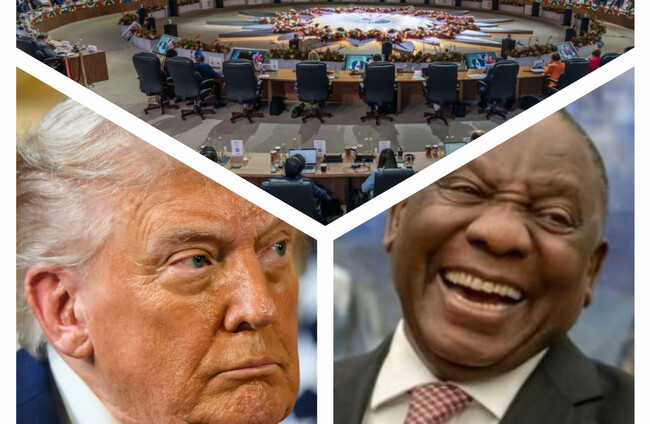
LEADERS OF THE G20 summit in Johannesburg in South Africa have agreed the official final declaration, in its bid to address issues including debt restructuring and climate change.
There were jubilant scenes in the Nasrec conference centre after South African president Cyril Ramaphosa formally closed the summit, overcoming a highly publicised boycott by the US in the process.
As well as scraps between the host nation and the White House, the summit was nearly overshadowed by yesterday’s scenes of western leaders rushing to to the sidelines to devise a response to Donald Trump’s plans for a controversial peace deal in Ukraine.
Jubilant scenes among South African delegates in the G20 media centre after president Cyril Ramaphosa formally adopts the final declaration and closes the summit pic.twitter.com/ySwObodbEj
— Eoghan Dalton (@EoghanDalton) November 23, 2025
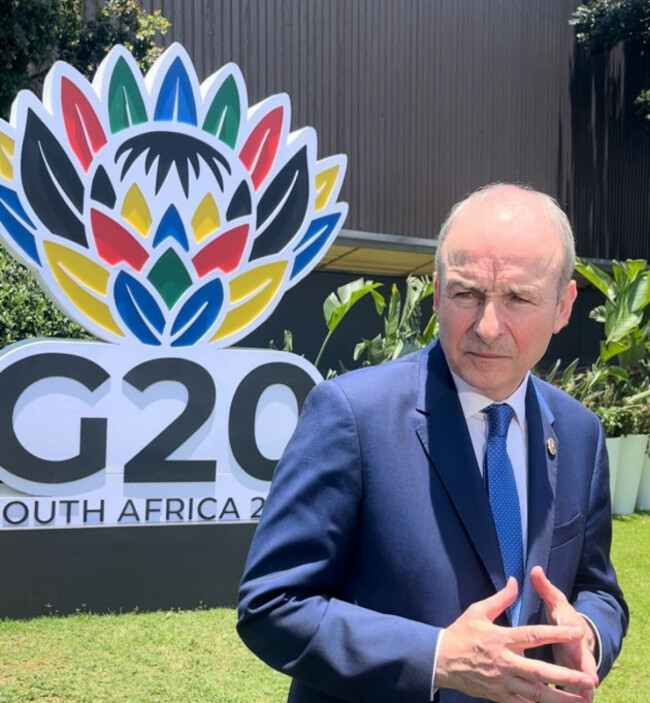
Taoiseach Micheál Martin attended the talks owing to Ireland being invited by South Africa. It was Ireland’s first time at the summit.
Addressing today’s sitting, Ramaphosa told leaders that the summit has taken place at a “crucial time as calls grow around the world” for urgent action on poverty, inequality and on climate change.
It echoed addresses made by several leaders during yesterday’s gathering, where serious concerns were expressed about the relevance of the grouping of the world’s major economies given the fracturing political scene globally.
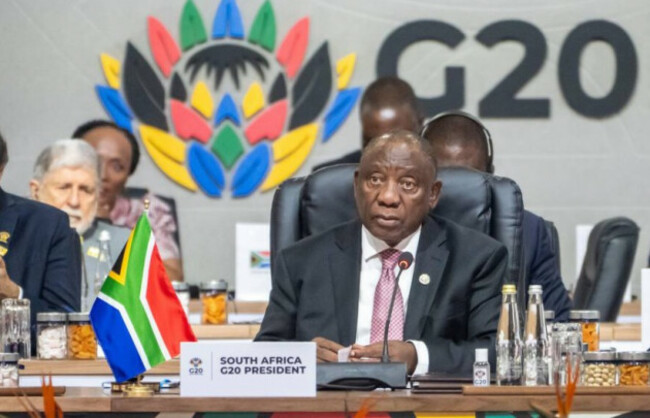
He added that South Africa has wanted to use the G20 presidency to place the Global South firmly at the heart of the G20 agenda.
This included recognising the “major obstacle” that debt burdens are posing for developing countries.
One of the odder issues that arose over the weekend was whether the presidency would be formally handed over – as is tradition – to the next hosts, the US.
Trump refused to attend himself or to send over senior diplomats, instead offering a much lower-ranked official to take on the reigns.
This was viewed as an insult by the hosts. To skirt around the issue today in his closing address, Ramaphosa simply said he and other leaders “commit to working together” under the US presidency for next year.
It’s understood a lower key handover is planned to take place with a lower ranked US official this coming week.
Speaking to media after the summit, Turkey leader Recep Erdoğan said that it’s expected the US will take over the G20 presidency from 1 December.
Rampahosa’s spokesman told reporters yesterday that it was a “diplomatic tiff” which was never going to interfere with the handover or the final declaration.
The summit will be viewed as a success for South Africa, according to the chief executive of the South African Institute of International Affairs, Elizabeth Sidiropoulos.
Sidiropoulos was among the experts in finance working on this year’s summit during negotiations between states.
“We got a declaration on the first day which I think took all of us by surprise,” Sidiropoulos told The Journal.
She said there were “obviously tradeoffs” in the declaration, with language that less direct and ambitious on issues such as climate change.
But this is a collective effort. Everybody is equal in the G20 and we have to recognise each other’s red lines.
She said that the US boycott “allowed things to proceed much more smoothly” as leaders didn’t have to be as concerned about Trump or other US officials being in the room.
But some analysts who spoke to The Journal said they believe that US allies, such as Argentina, or nations looking to curry favour with the White House still ensured that the Americans were able to make their presence felt.
The US has repeatedly lambasted South Africa for its focus on themes such as equality and sustainability for this year’s meeting.
Martin and other officials attending the gathering in Johannesburg have said that gender issues and climate change had become sticking points in the negotiations to agree on a final declaration.
It’s viewed as part of a wider pushback on gender and LGBT+ rights in many nations across the world.
One of the big issues pushed by the hosts this year has been a new framework for how poorer nations carry crippling debts that inhibit their spending on education and healthcare.
The debt restructuring for poorer nations was credited by Taoiseach Micheál Martin as a “significant win” for South Africa in its hostig of this year’s summit.
One startling figure this weekend has been how African countries will pay nearly $89 billion in debt servicing this year.
“More importantly, it’s the delivery on how do we do it, the mechanisms of doing it, using the global financial institutions, the various banks and so on. And how can we reconfigure the situation so that the bulk of funds are going to education, health services, and so on,” Martin told The Journal in Johannesburg this morning.
The Taoiseach added that it was important that countries paying the bills on their debt does not make up the bulk of the budgets of the poorer states.
“That’s ongoing work, but there’s a consensus,” Martin said.
In his closing address today, Ramaphosa urged leaders to scale up post-disaster reconstruction efforts as a preparation for future wreckage wrought by climate change.
“Climate‑induced natural disasters spare no country, but their toll is heaviest on those without the means to recover and rebuild,” Ramaphosa said.
The G20 has pledged to increase climate financing for developing economies, and to support just transition work as a way of encouraging private investment in such measures.

To embed this post, copy the code below on your site












have your say