We need your help now

Support from readers like you keeps The Journal open.

You are visiting us because we have something you value. Independent, unbiased news that tells the truth. Advertising revenue goes some way to support our mission, but this year it has not been enough.

If you've seen value in our reporting, please contribute what you can, so we can continue to produce accurate and meaningful journalism. For everyone who needs it.

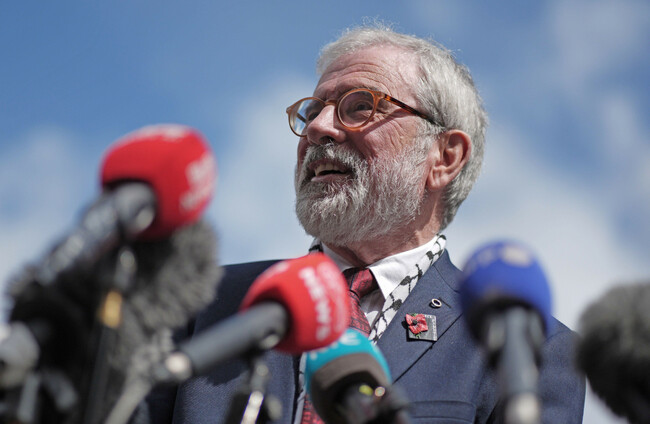
Gerry Adams speaks to the media after his libel case victory Alamy Stock Photo

Gerry Adams' comments about 'putting manners' on BBC described as 'chilling' by NUJ secretary

Séamus Dooley said the case raises the need for a review of Ireland’s defamation law.

GERRY ADAMS’ COMMENTS following his successful libel case against the BBC have been described as “chilling” by Séamus Dooley, the Irish secretary of the National Union of Journalists (NUJ).

The former Sinn Féin president was awarded €100,000 in damages after winning his case at the High Court in Dublin on Friday.

Adams said that a BBC Spotlight programme, and an accompanying online story, defamed him by alleging he sanctioned the killing of former Sinn Féin official Denis Donaldson, in which he denies any involvement.

A jury found in his favour after determining that was the meaning of words included in the programme and article.

It also found the BBC’s actions were not in good faith and that it had not acted in a fair and reasonable way.

Adams said from his perspective, the case was about “putting manners” on the BBC.

Adams also said: “The British Broadcasting Corporation upholds the ethos of the British state in Ireland, and in my view it’s out of sync in many, many fronts with the Good Friday Agreement.”

The NUJ’s Séamus Dooley told RTÉ Radio this afternoon that Friday was “a day which gives us pause for reflection”.

While stressing that Adams was entitled to take his case, “it does have profound implications for the practice of journalism”.

“And I think it has implications both in terms of defamation law, but also for me, in terms of journalism in Northern Ireland, and the relationship between Sinn Féin and journalists in Northern Ireland.”

Asked for his reaction to Adams saying he was “putting manners” on the BBC, Dooley said:

“Well, I found that a chilling comment, actually. Putting manners on the BBC to me means putting them back in their box.”

It was put to Dooley that the verdict could have a chilling effect in newsrooms in Ireland.

“That is precisely what Mr Adams meant when he said putting matters on the BBC,” Dooley replied.

“That’s extremely worrying. It doesn’t matter whether Gerry Adams was in the IRA or not, as far as I’m concerned.

“He is a figure of huge significance to journalists, to historians, to academics, and there is no doubt that he had an influence on the shape of history of Northern Ireland.

“And on that basis, any journalist has a right, any academic, to question and probe.

“The issue here, I think under defamation is the issue of fair opinion and how you square that circle.”

Given the length of the case and the huge costs associated with it, Dooley said it would be “very dangerous if journalists who carry out an investigation and have open to them, under legislation, the defence of honest opinion, then were put in the position where they had to settle because of costs”.

He said the case raises the need for a review of Ireland’s defamation law.

“We need to look at the defence of honest opinion, and how you square that circle in the context of journalists’ right to protect sources is a real difficulty.”

Dooley said that the NUJ’s position in the past had been in favour of juries in defamation cases, but that has since changed. 

“I’ve now reached the conclusion that in defamation cases, that juries are not appropriate, and one of the reasons is we will never know why the jury reached this decision,” he said, adding that if the case had been taken in Northern Ireland, it would have been decided by judges and a written explanation would have been published.

Dooley said that reforming defamation law “has never been a priority” in Ireland.

“I also think we have to look at, both from Mr Adams’ point of view and from the BBC point of view, the notion that this case has been running since 2016.

“Does anyone believe that that is fair or reasonable?”

He also said asked if the costs involved in taking such a case can be seen as reasonable when it comes to ordinary citizens. 

The BBC is expected to be landed with legal costs from the case amounting to more than €4m.

With reporting from Press Association

Readers like you are keeping these stories free for everyone...
A mix of advertising and supporting contributions helps keep paywalls away from valuable information like this article. Over 5,000 readers like you have already stepped up and support us with a monthly payment or a once-off donation.

Close
JournalTv
News in 60 seconds