Sign in. It’s quick, free and it’s up to you.
An account is an optional way to support the work we do. Find out more.
Sign in. It’s quick, free and it’s up to you.
An account is an optional way to support the work we do. Find out more.

IF YOU’VE BEEN on Instagram lately, you have likely seen people posting an image containing text that claims to block the social media app’s parent company Meta from using their data to train its generative AI tools.
People have been sharing the image in the hope that Meta will not use data from their accounts to train its AI applications.
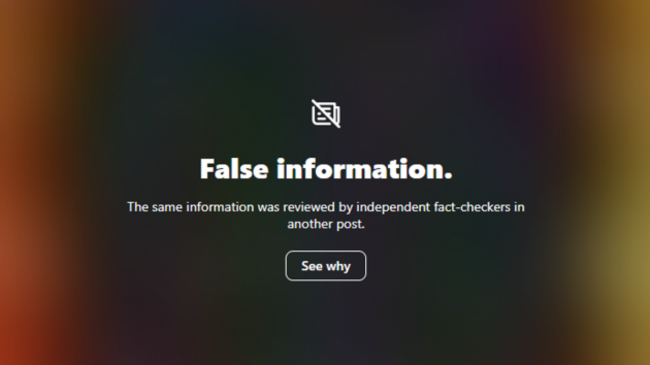
But the image is now often accompanied by a note that reads “False information”, telling Instagram users that posting it does no such thing, and linking to an article debunking it.
Many people, including celebrities like actors James McEvoy and Julianne Moore as well as former NFL player Tom Brady, have fallen for the hoax and posted the same message that begins: “Goodbye Meta AI.”
The image containing the text has been shared hundreds of thousands of times.
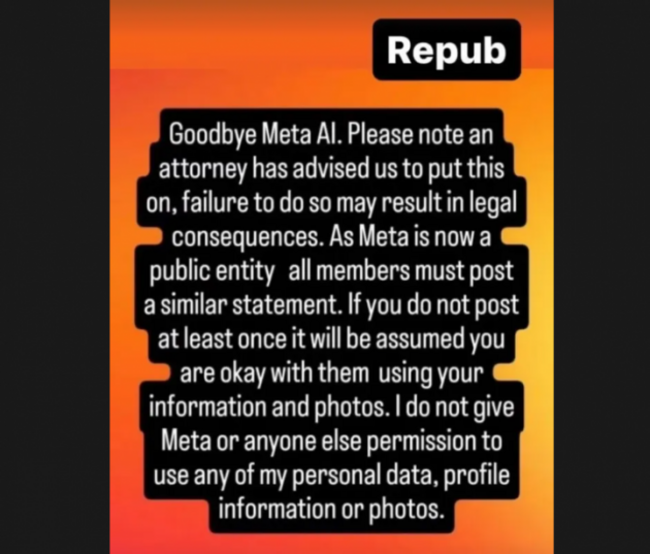
The text goes on to say:
“Please note an attorney has advised us to put this on, failure to do so may result in legal consequences. As Meta is now a public entity all members must post a similar statement. If you do not post at least once it will be assumed you are okay with them using your information and photos. I do not give Meta or anyone else permission to use any of my personal data, profile information or photos.”
Meta announced its move into generative AI, which is the technology behind image and text generating applications like Dall-E and CaptGPT, in September last year.
ChatGPT is a large language model chatbot created by OpenAI that can generate text when prompted. For example, users can ask it to write summaries on various topics or even poems in the style of famous authors. Dall-E, similarly, is an image generating application that creates pictures based on users’ prompts.
According to Meta, publicly shared posts from Instagram and Facebook – including photos and text – “were part of the data used to train its generative AI models”.
“We didn’t train these models using people’s private posts. We also do not use the content of your private messages with friends and family to train our AIs,” the company said.
Instagram users in the EU were informed earlier this year that their data would be used to train Meta’s AI products and were given the chance to opt out.
Meta has come up against EU regulations in trying to train its applications using Instagram and Facebook data from adults in Europe though.
In June, Meta said it was “disappointed” by a request from the Irish Data Protection Commission to delay training its large language models.
The EU has particularly strict and advanced rules governing privacy in the tech sector, but elsewhere in the world users were not notified about Meta’s intention to use their data for AI training.
Irish users can opt out by going to ‘Privacy Centre’ in settings on Instagram.

To embed this post, copy the code below on your site















have your say