Sign in. It’s quick, free and it’s up to you.
An account is an optional way to support the work we do. Find out more.
Sign in. It’s quick, free and it’s up to you.
An account is an optional way to support the work we do. Find out more.
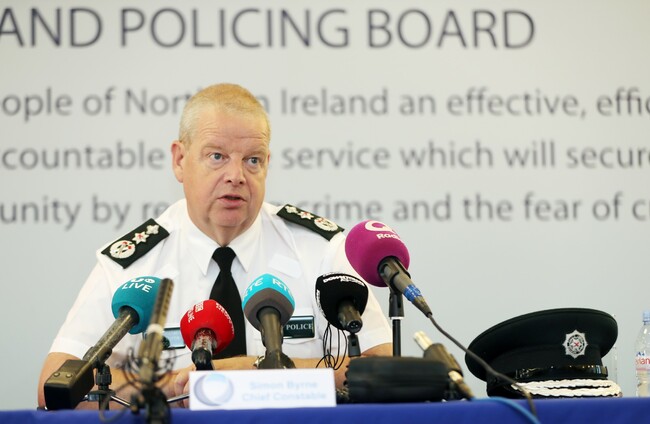
NORTHERN IRELAND’S POLICE Chief has warned that a hard Brexit could help fuel the rise of violent dissidents in the region.
Speaking on BBC Radio 4′s Today programme, Chief Constable of the Police Service of Northern Ireland (PSNI) Simon Byrne said that while police had “no intelligence” that Brexit was behind a rise in dissident republican activity, he was concerned that the combined uncertainty of Brexit and the wider political vacuum could become a “breeding ground for dissident hate”.
“The fear is if there is a hard Brexit the way this could play out in different communities right across Northern Ireland could become a trigger and a fueling point for more people to join either side of the debate,” Byrne said.
Extremists, he said, might exploit such uncertainty.
An explosion, which took place in Co Fermanagh on Monday, is being treated as a deliberate attempt to injure police officers. While no one was hurt, Byrne described it as a “sinister” development.
Today, Byrne condemned the dissidents who he said were “still pursuing an agenda that we were hoping and thought maybe 20 years ago we’d put behind us in terms of getting on and working together”.
Gardaí and the PSNI have established a list of people they believe could have carried out Monday’s bomb attack in Fermanagh.
This has been the fifth dissident attack so far this year. There was just one attack during the same period last year.
Former Chief Constable of the PSNI Hugh Orde warned earlier this year about the risks of a hard border.
Orde said recreating a hard border would have “huge consequences in terms of security” and police and customs officers “would become a target”.
Byrne also warned that effectively policing the border in the event of a hard or no-deal Brexit would prove impossible for the PSNI.
“The reality of using technology, or some form of hard checkpoint, in the border area, is simply just not practical. There are over 300 crossings that we’d have to police on a daily basis to make that effective,” he said.
“We simply don’t have enough people.”
Byrne, who praised his force’s recent co-operation with Garda Commissioner Drew Harris, said communities on both sides of the border want to “see normality continue so they can go about their daily life and business in a way that’s pretty similar to what they’re doing now”.
Due to the high number of incidents this year, police forces from both sides of the border have recently increased their level of communication.
However, Byrne warned that the next few months will prove crucial for the future of policing in Northern Ireland.
“If we get this wrong, we could drift back to almost to a paramilitary-style of policing that nobody wants to see,” he added.

To embed this post, copy the code below on your site













have your say