Sign in. It’s quick, free and it’s up to you.
An account is an optional way to support the work we do. Find out more.
Sign in. It’s quick, free and it’s up to you.
An account is an optional way to support the work we do. Find out more.
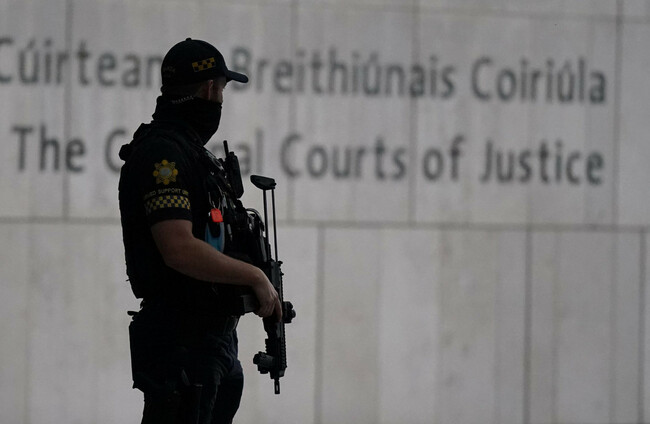
IRELAND’S HUMAN RIGHTS watchdog is calling for the abolition of the Special Criminal Court (SCC).
The Irish Council for Civil Liberties (ICCL) says that the continuation of the non-jury court is an abuse of emergency powers.
The current version of the court was established in response to terrorism and every year since 1972 the Oireachtas has voted to continue the use of emergency powers to prolong the life of the court.
This involves deeming Ireland’s ordinary courts as inadequate to effectively administer justice.
The Oireachtas will today vote on whether it should make this declaration again and justify the continuation of the controversial court.
As well as non-jury trials, the SCC has special powers to accept ‘belief-evidence’. This allows the belief of a Garda Chief Superintendent that a person is a member of an illegal organisation to be used and accepted as evidence of that person’s membership.
The Court also permits an accused’s silence to be used as evidence supporting the case against them, effectively denying them the right to silence.
In a statement, ICCL Criminal Justice Policy Officer Niamh McCormack said the declaration that ordinary courts are inadequate is an “extraordinary statement” that has “become normalised through decades of expansion of the Special Criminal Court”.
The SCC has long been the subject of international criticism. The UN Human Rights Committee called for the overhaul of the Court in 1993, 2000, 2008, 2013 and 2014. In 2000, it recommended that “steps should be taken to end the jurisdiction of the Special Criminal Court”.
McCormack said: “The ICCL echoes these calls, and believes alternatives to the court must be explored. These alternative measures must be proportionate and respect the constitutional right to a fair trial.
“There is currently no public debate on the fact that the Oireachtas makes an annual declaration of a state of emergency to justify the existence of the Court. Nor is there any meaningful discussion in relation to potential alternatives to the court which would protect against these fears without significantly depriving accused persons of their rights.”
Last year, the majority of an expert group on the State’s counter-terrorism laws recommended that the SCC be replaced with a new court that has additional safeguards and transparency.
The court is currently enabled by the Offences Against the State Act, the first of which was published in 1939 to prosecute members of the IRA and declare any similar organisations unlawful.
The majority’s report also called for the Act to be “repealed in its entirety” and parts of it to be re-enacted within other laws with a “significant” amount of amendments.
However, a minority review from the same expert group took a different viewing, saying that a permanent non-jury court would be “constitutionally inappropriate”.
McCormack said that, one year on, Justice Minister Helen McEntee has “not substantially responded” to the reports, “never mind implementing its recommendations”.

To embed this post, copy the code below on your site













have your say