Sign in. It’s quick, free and it’s up to you.
An account is an optional way to support the work we do. Find out more.
Sign in. It’s quick, free and it’s up to you.
An account is an optional way to support the work we do. Find out more.
A MISPERCEPTION ABOUT the number of people immigrating to Ireland and their reasons for doing so is linked to negative attitudes towards immigration, according to a new report published today.
The report by the Economic and Social Research Institute (ESRI) think tank found that many people overestimated the proportion of people in Ireland who were born in another country.
There were also overestimations in the number of foreign-born people who make up the prison population and who benefit from social housing.
The study was funded by the Department of Justice and Migration and sought to determine whether people’s perceptions of migration figures were accurate, and whether an overestimation of such figures was fuelling negative attitudes towards migrants in Ireland.
The report’s figures come from an online survey of 1,200 people that researchers said were recruited to be “nationally representative by age, gender, region and socio-economic status”.
Participants guessed that 27.8% of the population of Ireland were born abroad. The highest official estimate lies between 18.8 and 21.7%.
Of those in Ireland who were born in another country, participants estimated that 13.5% were from countries outside the EU, UK, and North America – but the official estimated figure is between 7 and 9.2%.
It was also guessed that 28.2% of those in prison in Ireland were not Irish, above the official figure of 20.7%.
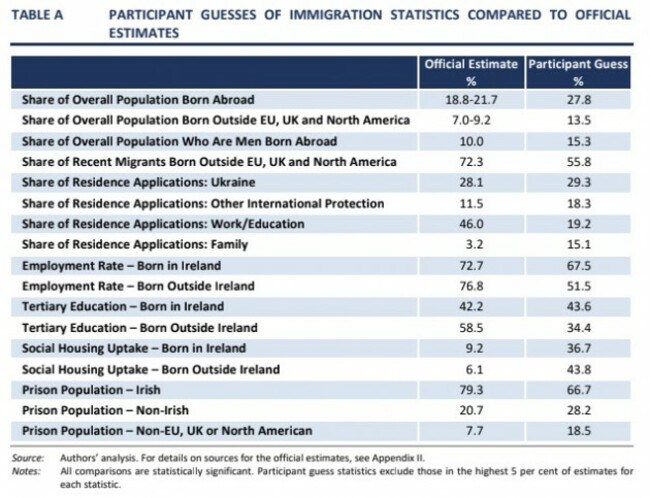
However, participants significantly underestimated the share of migrants to Ireland since 2022 that were born outside the EU, UK, and North America. It was estimated by participants that just over 55% were from countries outside these regions, when in actual fact it is estimated that around 72% are.
In the last number of years since 2022, Ireland received an increased number of migrants from Ukraine after Russia ramped up its invasion. There was also a significant increase in applications for international protection.
The figures for 2024 show that while immigration dropped overall, international protection applications rose 40% in 2024 to 18,561, the highest on record.
The number of those who avail of social housing was drastically overestimated – in terms of people both born in and outside of Ireland. People guessed around 43.8% of people born outside of Ireland were availing of social housing compared to the real figure of 6.1%.
There was a similar response when the survey asked about levels of Irish-born people availing of social housing: it was estimated that 36.7% avail of social housing compared to the real figure of 9.2%.
The misperception of many of the figures, the ESRI said, shows a link between negative perceptions and attitudes towards migrants and a perpetuated idea that Ireland has more people born outside the country present than in actuality.
The authors of the report said its research was conducted “against a backdrop of heightened salience of immigration in public discourse, marked by violent protests at buildings earmarked for asylum seekers, increases in racially motivated hate crimes and the spread of online misinformation”.
The authors said media focus on crimes committed by foreign-born people, in particular those seeking asylum, had contributed to such misperceptions.
It was stated that public figures and authorities could “avail of opportunities to highlight under-recognised facts, such as migrants’ high employment and education rates and the predominance of work and education as reasons for migration, to help rebalance public understanding of immigration in Ireland.”
Earlier this week, Dublin City councillors passed a motion pushing back against Tánaiste Simon Harris’s comments claiming that many in emergency accommodation do not have any right to housing.
Over Christmas, Harris said that there are a “significant number” of people in emergency accommodation who not have a right to housing, linking it to migration numbers being too “high”.
The councillors strongly disputed the Tánaiste’s remarks, accusing him of “blatant efforts to scapegoat and demonise migrants for his Government’s decade and a half of failure to meaningfully address the housing and homelessness crisis”.
Minister for Justice and Migration Jim O’Callaghan has also been on the receiving end of criticism for a number of his stated plans to introduce reforms to the migration system.
O’Callaghan said he wishes to ensure that Ireland is not seen “more favourably” than the UK to those seeking asylum. On Monday, the Taoiseach defended plans to introduce a three-year waiting period for the reunification of successful asylum applicants with their families.
Lead author of the report Dr Shane Timmons said: “An informed debate about issues like immigration requires shared understanding of the facts.
“While most people do not hold negative attitudes toward immigration, those who do tend to strongly underestimate migrants’ economic contribution. In reality, there are fewer migrants living in Ireland than people think and far more come for work and education than people believe.”

To embed this post, copy the code below on your site















have your say