Sign in. It’s quick, free and it’s up to you.
An account is an optional way to support the work we do. Find out more.
Sign in. It’s quick, free and it’s up to you.
An account is an optional way to support the work we do. Find out more.
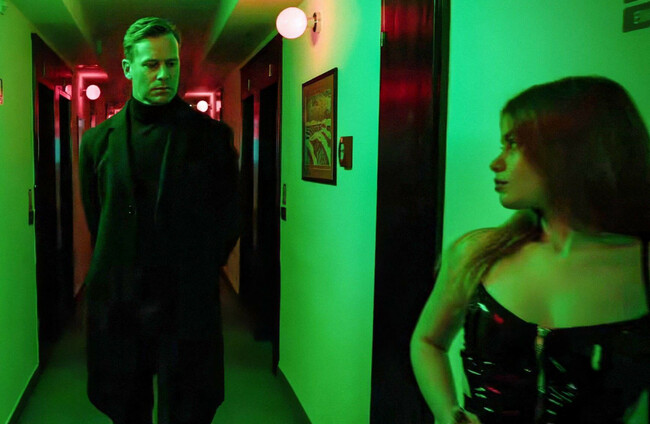

IF YOU’VE EVER wondered how chronically online you are, ask yourself whether you’ve heard of Uwe Boll’s new movie Citizen Vigilante.
The controversial production stars Armie Hammer - in his first role since allegations about abuse and violent sexual fantasies derailed his career – as a man meting out revenge against criminals, rapists and corrupt officials in a Europe supposedly collapsing under the weight of migration.
If this doesn’t ring a bell, then it’s likely you’ve been living the past week at a healthy distance from social media.
Boll is a German director who has been described as “the worst director in the world”, and has notably produced a string of badly reviewed low-budget films and video-game adaptations that made his name synonymous with cinematic ineptitude.
He has defended the film’s politics by saying Europe is in an “insane and absurd political environment” and has also denied being a Nazi when asked.
I only encountered his latest film through social media and discussions about it in a messy jumble of posts on X.
The thing about Citizen Vigilante is that it exists almost entirely in the online world.
It was only released in select cinemas in the US last month and on-demand, and was refused classification in Germany, but can be watched in its entirety on social media.
Over the past week or so, discussions about it have blown up on X in particular, partly as a result of the platform’s owner Elon Musk, who has taken to promoting it.
This isn’t because the film is particularly good – it has a 9% positive rating on the review aggregator site Rotten Tomatoes – but because of the culture war narrative that’s emerged around it as an example of supposedly subversive right-wing cinema.
Vigilante films aren’t new, and they do not have to be reactionary.
The difference is that Citizen Vigilante appears to map the fantasy of righteous violence directly onto the racial politics of social media feeds.
Its final scene (spoiler alert) shows Hammer’s character tracking down a Syrian migrant family in their apartment and executing the entire family because the teenage son was part of a group that raped a local girl.
Critics of immigration, including far-right groups, have claimed that it’s a movie that the liberal establishment doesn’t want people to see.
They have leaned into the fact that it didn’t receive a classification rating in Germany, a move that effectively prevents cinemas from screening it, to suggest that timid European authorities are frightened of the truths it tells.
Poor ratings have been blamed on the squishy liberal views of film critics, who, the argument goes, are denouncing it because it tells uncomfortable truths about migration and crime.
These, of course, are the regular cries of anti-immigrant and far-right groups when they take aim at mainstream reaction to their views in the media or political circles.
Fringe views have been turned into hype for a film that reflects those groups’ political beliefs.
They have repackaged the humdrum bureaucracy of film classification as censorship, and smeared critics as being part of a media establishment that wants to cover up what people are really thinking.
When Elon Musk entered the fray, those absurd complaints got much louder.
Musk, the world’s richest man and owner of X, has increasingly promoted anti-immigrant talking points while presenting himself as a champion of free speech.
In a bid to bring Citizen Vigilante to the world, he shared the entirety of the film to his feed last weekend, so anyone could watch it for 48 hours.
It was a move which revealed the deep irony at the heart of both the movie and the discourse that had enveloped it.
A production that was initially framed by its supporters as censored, suppressed and too dangerous for European authorities was now being distributed by the world’s richest man on the world’s most influential social media platform.
It was not exactly samizdat.
A violent, anti-immigrant and anti-Muslim fantasy was placed in front of millions of people online by one of the most powerful people on the planet.

That matters because, like me, most people who heard about Citizen Vigilante this week did not hear about it in the way people traditionally hear about films.
It was instead brought to us as culture war propaganda with a misleading narrative about “the movie they don’t want you to see”.
Citizen Vigilante is particularly well-suited as a vehicle for political posturing because its premise was assembled from narratives that already circulate constantly in far-right and anti-immigrant spaces online.
Even its title appeals to the base instincts of far-right and anti-immigrant groups, presenting its hero as an everyman who turns into a caped crusader.
Boll created a universe around claims that Europe is collapsing, migrants are violent, women are unsafe, legal systems are too weak, and politicians are betraying people.
His hero, a kind of role model of the worst of the internet’s keyboard warriors, is a man who believes that the only moral response to all of that is to do what authorities supposedly refuse to do: take retribution on those who are bringing society down.
Its politics have a palingenetic quality: society is rotten, enemies are within, and only violence can bring about the renewal of normality.
The worldview in Citizen Vigilante is the exact same as the one that shows up whenever a violent crime involving a migrant or non-white person goes viral, as happened in Belfast just a few weeks ago.
In those tellings, individual cases are held up as proof of civilisational decline, elite betrayal and the failure of multiculturalism.
The film is less a mirror held up to society than a mirror held up to the darker corners of social media.
And it fits neatly into the political internet because far-right and anti-immigrant users reward renegade heroes and instant gratification far more than nuance or ambiguity.
Citizen Vigilante gives that online audience what they have already been primed to want.
It does not ask people to think differently; it rewards them for already thinking a certain way.
It therefore doesn’t matter whether the movie is good or even if it will reflect what the world looks like in 2026.
As long as it can be used as evidence in a broader debate about censorship, immigration, political correctness and civilisational decline, it will have done its work.

To embed this post, copy the code below on your site














have your say