Sign in. It’s quick, free and it’s up to you.
An account is an optional way to support the work we do. Find out more.
Sign in. It’s quick, free and it’s up to you.
An account is an optional way to support the work we do. Find out more.

ON THURSDAY MORNING, a video popped into my social media feed supposedly showing people on the streets of Israel celebrating the country’s latest win.
“Massive celebrations in Tel Aviv right now, as the Mossad plot to get Argentina into the World Cup final has succeeded,” the post was captioned.
The unverified video of cheering Argentinian fans in an unspecified country is one of countless similar posts that are billing tonight’s final as a proxy battle between Israel and Palestine.
It found me in the usual way, bundled up in a timeline of posts as I sought out any sliver of content I could consume after Argentina’s semi-final win over England.
For historical and foreign policy reasons that are far too numerous to explain here, Argentina are seen as representing Israel while Spain are flying the flag for the Palestinians.
The internet is exceptionally good at applying acetone to nuance at the best of times, but especially so when fervent partisan views can be projected on to teams and players.
Every day throughout this tournament, it only took a few scrolls to find matches turned into moral referendums or conflict propaganda.
Wave after wave of posts presented players and teams as heroes or villains fighting for their side’s victory.
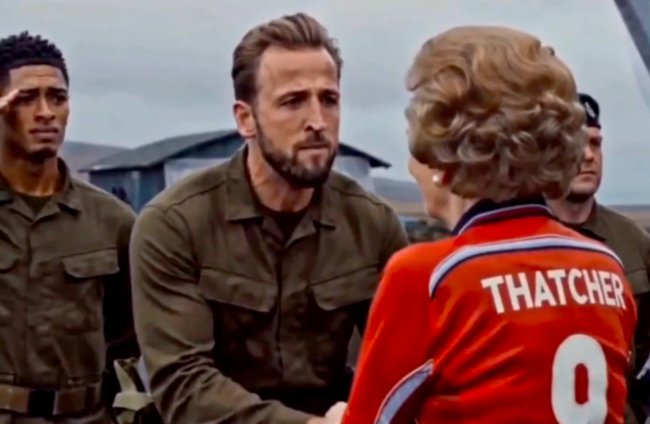
So much of it happened through shitposting enabled by generative AI, which allowed footballers to be presented as battlefield generals or beside long-dead political leaders and other heroes.
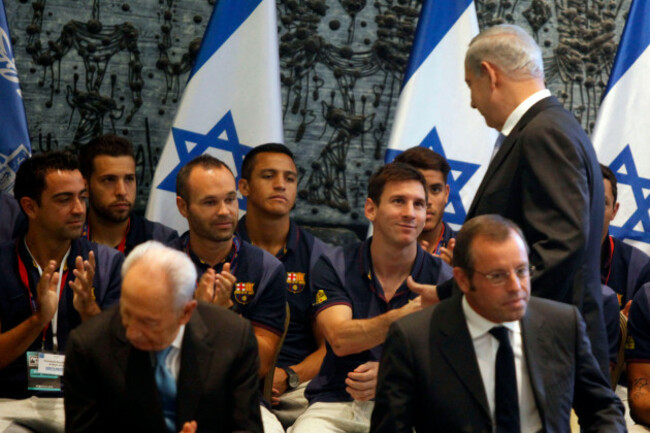
The narrative around tonight’s final comes after claims swirled about Lionel Messi’s supposed Zionist beliefs, with images of him visiting the Western Wall in Jerusalem and with Israeli prime minister Benjamin Netanyahu held up as proof.
But even though Messi has engaged with Israel in a professional capacity over time, he is a famously apolitical figure and he never appears to have given his views on one of the world’s most intractable conflicts.
Football is a powerful vehicle for this kind of geopolitical commentary, especially when it comes to an event like the World Cup, because it is easy to inject the sport with symbolic narratives when one side is pitted against another on the international stage.
People can use it to keep a scoreboard for messy conflicts, where real-world politics is unresolved, morally complicated and full of suffering.
Tonight’s final isn’t the only time this has happened.
This week’s semi-final between England and Argentina also became subsumed by the context by the context of the Falklands War long before a ball was kicked.
Days before Wednesday’s match, there were deepfake videos doing the rounds on social media showing Harry Kane and Jude Bellingham in navy gear aboard boats as they prepared to attack Argentine warships in the South Atlantic.
Nigel Farage, a day before fulminating over images of Argentine players waving a banner that proclaimed ‘Las Malvinas son Argentinas’, cheered on England ahead of the match by taking to X to post: “Let’s do it all over again, just like 1982.”
It’s not that this didn’t happen before the internet – the war was a huge part of the backdrop for Argentina’s 2-1 victory over England in the 1986 tournament – and more that online commentary has hyper-charged conflict mythologies around football.
Nor are these platform-driven narratives limited to one team against another.
Racists and anti-immigrant users have spent weeks speculating about the makeup of European and South American squads, suggesting those who are ‘whiter’ have performed better in the tournament.
One fake story that did the rounds on social media after Germany’s penalty shootout defeat to Paraguay in the round of 32 falsely claimed that fans had started a petition to ban Muslim and black players from the national team.
It’s grim stuff, but it’s par for the course with the World Cup.
Sport has long been a useful metaphor for war, nationalism and political posturing, and this is a tournament where nations compete beneath flags and sing their anthems before games.
Its naked politicisation has infamously allowed the World Cup to be used as a propaganda vehicle by despotic and morally corrupt regimes since its inception nearly a century ago.
Social media has simply breathed technological life into that.
The construction of ideological meaning around games is actively rewarded by platforms, especially if users can make the narrative simplistic and emotionally resonant.
Before, that meaning was attached to international sport by governments and the media; nowadays, anyone can manufacture their own mythology around a match.
It has led to a situation where some of the world’s most complicated conflicts are reduced to an extension of fandom.
Solidarity is seen as a matter of donning the correct jersey, and victory is celebrated as the overcoming of different ideologies, ethnic groups or sides in a war.
That is not to say political solidarity has no place in sport. Quite the opposite: sport’s public and symbolic nature makes it an ideal space to protest against war, racism and other wrongs.
The difference is that online posturing does not draw attention to injustice or invite greater understanding of a conflict.
Instead, it strips conflicts down to emotionally combustible components and rebuilds them as images that simply entrench people.
Tonight’s World Cup final will likely be the most-watched event of 2026, and one of the most-watched of the decade.
It doesn’t need additional political meaning to make it more intriguing as a contest, but the match is fertile ground in the engagement arms race in an age where so much of sport is enjoyed via second screening.
By the time kick-off arrives, the final has already been played for days in people’s feeds.
Fifa president Gianni Infantino may have finally achieved his manifest destiny of uniting the world through football; the irony, of course, is that online it brings us together by giving everyone something new to fight about.

To embed this post, copy the code below on your site
















have your say