Sign in. It’s quick, free and it’s up to you.
An account is an optional way to support the work we do. Find out more.
Sign in. It’s quick, free and it’s up to you.
An account is an optional way to support the work we do. Find out more.
DEPENDING ON WHO you ask, Ireland’s housing sector is either flowing with “massive optimism” or bracing itself for a slowdown that will mean halted development throughout the country.
That was the feeling coming away for some from the Irish Home Builders Association (IHBA) summit in Croke Park, as speakers gave varying views on what the ongoing war in Iran might mean for the near-term future of the sector.
So while dismissed by some involved as a talking shop, the summit showcased growing anxiety among the construction sector at the far-reaching impact of the war.
The first alarm was sounded in the opening address by IHBA chair Michael Prenty, who said the inflation builders are dealing with risked “undermining” more positive efforts of the past 18 months.
But the major alarm came when Paddy McElligott – who heads capital investment firm Activate Capital – told the audience that there might be a “pause” in institutional investment, “particularly for apartment schemes”.
It might not quite sound like a shock on the surface, but Irish housing is highly reliant on institutional investment. For instance, some of Housing Minister James Browne’s recent moves have been driven by a need to attract that type of money into projects here.
These include the widespread changes to rental legislation and his recent trip to Cannes to try and attract investors.
Eurostat data shows that a major 39% fall in apartment numbers, in 2024, coincided with a plunging in the role of institutional investors in buying new homes.
But it wasn’t all doom and gloom. Several figures pointed to how the industry has, on an almost annual basis, been hit with global turmoil that impacts the sector.
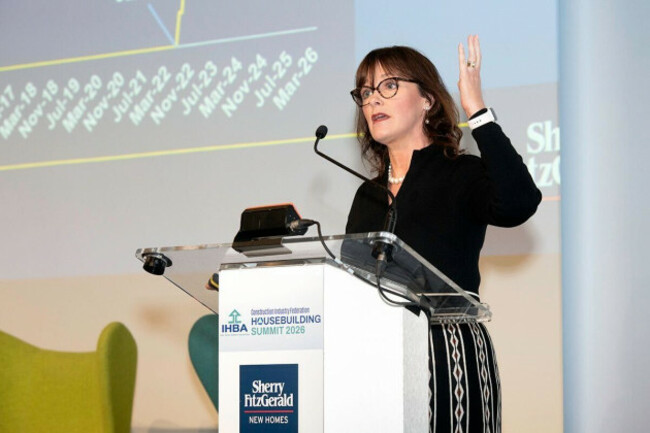
“Every time we take one step forward,” said Marian Finnegan of Sherry Fitzgerald, “something hits us and we take one step back.”
She pointed to how the total completions for last year reached 36,300 units – some 20% higher than the year prior – as proof of that step forward.
Finnegan said the industry had weathered shocks from Covid, the Ukraine war, Trump’s tariffs, and that all of this had given the country’s builders an ability to adapt for the new shock from the Middle East.
The tug-of-war between the hopeful and pessimistic viewpoints was partly a struggle to try and restrain more negative talk at the summit, as indicated by Ivan Gaine, managing director of Sherry Fitzgerald’s commercial and new homes section.
The country’s property market “needs, like we all do, constant reassurance,” said Gaine.
He appeared on a panel beside one Department of Housing official, who he at one point apologised to for “using a word she hates”, that word being “tweak”.
“We need to tweak the plans,” expanded Gaine, referring not just to upcoming developments, but also to state schemes to incentivise building.
He stressed that there was “brilliant momentum in the first two months of the year”, but “what worked in February may not work in May or June.”
Cluid, a not-for-profit that delivers social and affordable housing, brought more reality to the discussion when its chief commercial officer Eibhlin O’Connor said the war had already added between €15,000 and €20,000 to each home they are building.
Several industry figures were coy about what the increase might mean for the end user – like someone who has managed to save up for a deposit to buy a home.
Housing Minister Browne said it would “premature” to discuss such increases at this point, but he said his department was monitoring the situation.
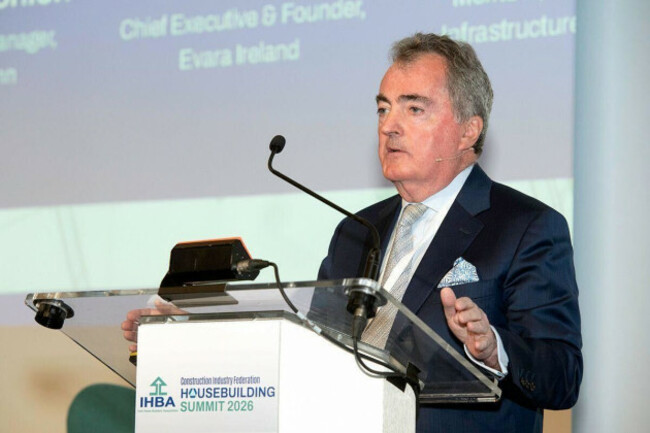
The debates around the impact of the war had left Michael O’Flynn sounding a frustrated note after sitting through the day’s panels, and partaking in one himself.
“We can’t blame Iran for everything,” he told The Journal.
“January and February were okay but I wouldn’t look at them with the same enthusiasm as some do,” he added.
His own company, which provides housing in Cork and Dublin, has been hit by increases “up to 10%” for concrete, piping and insulation over the last two months. That’s before the mammoth increases in fuel that have impacted heavy machinery used on sites.
He was blunt about Ireland’s chances of making the government’s target of 300,000 homes by 2030:
“Not a chance.”
That’s because, O’Flynn said, “we’re way behind where we need to be already.”
He pointed to a “massive deficit” in the number of homes that should have been provided before now. This has previously been estimated at 300,000 homes, which are on top of the government’s own target of 300,000 over the next four years.
However, the government’s Infrastructure Taskforce chairperson Sean O’Driscoll took another view: he was “extremely confident” that the country would not only weather the storm, but also resolve the crisis his group was formed to tackle.
O’Driscoll, who was introduced by MC Ivan Yates as being a veteran of racing festival Cheltenham, told the crowd that work was progressing on making building easier:
“Get on with your business,” he told the room. “Plan it and don’t wait for tomorrow.”
O’Driscoll is well-regarded by construction bosses, several of whom praised him for his aims to shorten timelines on decisions for major projects by half.
He told yesterday’s audience that he’d back the sector on housing “more than I’d back my horse”.
With the number of people in emergency accommodation hitting a new record high of 17,308 last month, plenty others will be hoping the confidence is well placed.

To embed this post, copy the code below on your site















have your say