We need your help now

Support from readers like you keeps The Journal open.

You are visiting us because we have something you value. Independent, unbiased news that tells the truth. Advertising revenue goes some way to support our mission, but this year it has not been enough.

If you've seen value in our reporting, please contribute what you can, so we can continue to produce accurate and meaningful journalism. For everyone who needs it.

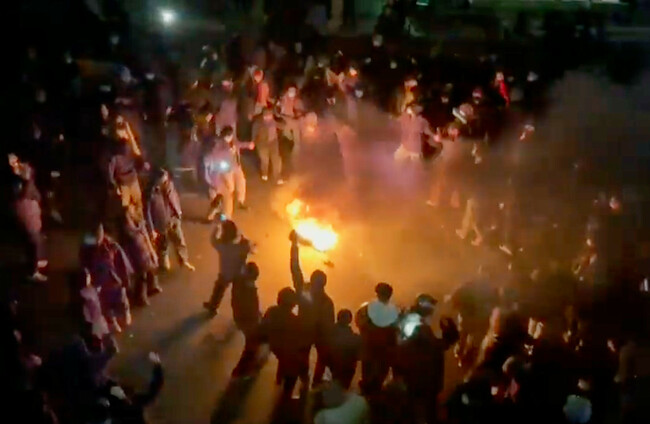
A still from footage taken in Tehran on 9 January Alamy Stock Photo

'I want a revolution': Iranians in Ireland fear for their families during communications blackout

“Almost all potential leaders inside the country are already imprisoned, silenced or killed,” Zahra said.

IRAN IS CURRENTLY seeing historic levels of civil unrest as anti-government protests have swept the country, but a communications blackout means Iranians outside of the Islamic Republic cannot contact their loved ones as reports of more than 500 deaths filter out. 

The Journal spoke to two Iranian women who live in Ireland and have been following the protest movement with a mixture of fear for their friends and family and hope that the regime of Ayatollah Ali Khamenei may be about to fall. 

Zahra, a 30-year-old woman living in Dublin who gave a pseudonym to protect her identity, said that any alternative would be better than the current regime, which has a long history of human rights abuses and enforces strict veiling laws mandating what women can wear in public. 

She last spoke to her friends and family in Iran on 10 January. 

“What I want is a revolution, not a cosmetic change, not improvement within the system, but the end of the system itself,” she said, while stressing that she is not a political person by nature but that the situation in Iran has made her one. 

“At this point, I would vote for any change,” she said. “Nothing can be worse than the Islamic Republic.” 

The wave of protests began around two weeks ago as a demonstration against the rising cost of living, but has since become a major challenge to the government. 

“We have no clean air, no stable electricity, no water, no economy. People are under pressure every day. The situation is already beyond collapse,” Zahra said. 

“Everyone who could leave has left. Those who remain are exhausted, angry and almost trapped.” 

She said many Iranians are in the same position as her, on the outside looking in. 

“Many of us are here because of them (the government). Leaving our country was not a choice, it was a consequence.

“Being unable to hear from family, checking the news obsessively and waiting for updates that may never come is paralysing.” 

She said she would return to Iran “the moment the Islamic Republic ends”, even if it meant a return to the monarchy that was ousted in the revolution that established the current government. 

The current government came to power following a revolution in 1979 that overthrew the ruling Pahlavi dynasty led by the shah of Iran. 

The shah was an authoritarian dictator but the Pahlavi dynasty still has many supporters in Iran and abroad. 

Zahra is also torn about whether she would support foreign intervention, as has been threatened by the United States. 

She said the Iranian government is “heavily armed and can kill quietly, systematically, and without consequences”, whereas ordinary citizens are “unarmed, exhausted and disposable in the eyes of the regime”. 

“How can such an imbalance ever lead to real change?” she asks. 

Reza Pahlavi, the exiled son of the ousted monarch known as the shah, has played a prominent role in calling for the protests.

“Do not abandon the streets. My heart is with you. I know that I will soon be by your side,” he said yesterday. 

Zahra believes that Pahlavi may be the best vehicle for overthrowing the government because of his name recognition, and because the protest movement appears to be otherwise leaderless.

“Almost all potential leaders inside the country are already imprisoned, silenced or killed,” Zahra said. 

Pahlavi has broken with traditional monarchists and said he does not seek to reestablish his family’s rule, expressing a wish to hold a referendum that would allow Iranians to determine the form of a future government.  

Many protests have featured Pahlavi’s image and slogans supporting him. 

Zahra said Pahlavi is “not my future leader” but that she would support him if it brought an end to the Islamic Republic. 

Fear of speaking out

Fatima, 35, another Iranian living in Ireland who also gave a pseudonym out of fear of reprisals against herself and her family, said that Pahlavi’s public messages of support is what turned the demonstrations into a mass movement of millions. 

She attended a demonstration in solidarity with the protesters in Dublin yesterday that was attended by around 200 people, even though she fears the possible attention of agents working outside of Iran and the potential repercussions for her family back home. 

Asked why she wanted to give a name other than her own, she said it was because they will either “kill me or kill my parents”. 

According to Amnesty International’s last review of the state of human right in Iran, “enforced disappearances and torture and other ill-treatment were widespread and systematic” and that the death penalty was used arbitrarily.

Three days ago, Fatima’s friend sent her a photograph showing the various bullet casings and other projectiles that had been shot at people on a street near their home in Tehran. 

He friend collected what appear to be a stun grenade, live bullets, tear gas, and pellets.

“What is especially alarming is that a live bullet appears to have been used in a narrow alley, a situation that clearly suggests it was not meant for crowd control, but to kill an individual,” she said. 

Fatima has not spoken to her friend since she received that photo. 

One video that has emerged in the last couple of days shows a vast number of corpses in body bags on a road in Tehran outside a forensics lab, where people were gathering to identify their loved ones.

Warning: The video referenced below contains distressing footage (click through to view).

Fatima said this video has served as a tipping point in countering the government-controlled media narratives about the protesters. 

The Iranian embassy in Ireland today issued a statement saying the Islamic Republic “neither in law nor in practice opposes the holding of peaceful assemblies”. 

Due to the lack of internet access and telecommunications, it is not possible to get a fully accurate picture of what is happening in Iran outside of what little has been shared on social media.

When asked if she thinks the protest movement will lead to the downfall of the Islamic Republic, Fatima replied: “100%.” 

Readers like you are keeping these stories free for everyone...
A mix of advertising and supporting contributions helps keep paywalls away from valuable information like this article. Over 5,000 readers like you have already stepped up and support us with a monthly payment or a once-off donation.

Close
67 Comments
This is YOUR comments community. Stay civil, stay constructive, stay on topic. Please familiarise yourself with our comments policy here before taking part.
Leave a Comment
    Submit a report
    Please help us understand how this comment violates our community guidelines.
    Thank you for the feedback
    Your feedback has been sent to our team for review.

    Leave a commentcancel

     
    JournalTv
    News in 60 seconds