Take part in our latest brand partnership survey

We need your help now

Support from readers like you keeps The Journal open.

You are visiting us because we have something you value. Independent, unbiased news that tells the truth. Advertising revenue goes some way to support our mission, but this year it has not been enough.

If you've seen value in our reporting, please contribute what you can, so we can continue to produce accurate and meaningful journalism. For everyone who needs it.

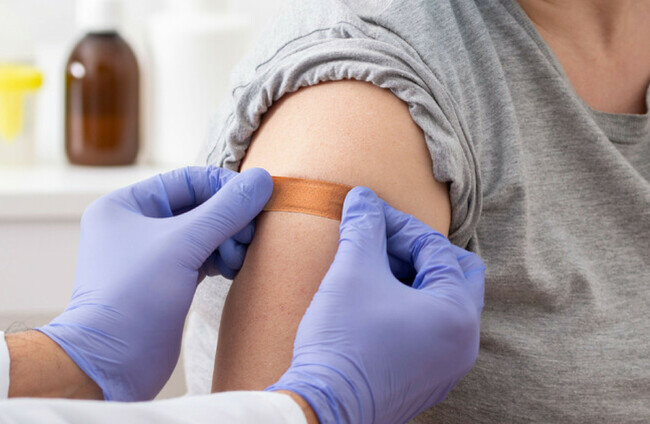
Across Western Europe, Ireland has the 7th highest number of children who have never received a routine childhood vaccine Alamy Stock Photo

Ireland has third lowest childhood vaccine coverage among high-income nations

One GP remarked that ‘vaccine fear is a very real thing’ and called on the HSE to do more to combat it.

IRELAND HAS THE third lowest childhood vaccine coverage among high-income nations globally.

It also has the sixth lowest coverage among the countries on the European continent and the second lowest among western European nations.

And while there’s been a stark 75% global decline since 1980 in the number of children who had never received a routine childhood vaccine, Ireland has the seventh highest number of so called “zero-dose” children in Western Europe.

In 2019 before the onset of the Covid pandemic, the “zero-dose” count was 2,460 – this more than doubled to 4,942 in 2023.

With childhood vaccination coverage of 91%, Ireland is below the 95% milestone needed for herd immunity and is someway off its 2030 target of 97.7%.

The findings have been complied in an article in The Lancet on childhood vaccination coverage globally between 1980 and 2023.

‘Scare mongering’

Dr Illona Duffy, a GP based in Monaghan, said that while her practice is “quite good” in terms of childhood vaccination rates, it isn’t at 95%.

The 95% figure is important because this is the threshold at which there is herd immunity against a number of contagious diseases.

Duffy said that by not vaccinating your child, “you’re not only leaving your own child at risk, but others”.

“If we achieve high rates of vaccines we get herd immunity,” said Duffy.

“By having lots of people vaccinated, it keeps the amount of these disease in the community low, therefore it drops everybody’s risk of getting them and protects everybody.”

When asked why Ireland ranks so lowly in childhood vaccination coverage, Duffy pointed to three issues.

The first is parents putting off vaccines because other things get in the way and eventually it drops off the radar.

The second is vaccine refusals and the third issue is somewhat similar – vaccine refusal among parents of Eastern European origin in particular.

A 2022 European Commission report said that “steep declines in vaccines confidence are a worrying trend most notable in Eastern and Central Europe, the Baltics, and Netherlands”.

It added that “perceptions towards vaccines in general remain low” in these regions.

Moldova, Bosnia and Herzegovina, Ukraine, North Macedonia and Austria were the European nations to have lower childhood vaccine coverage than Ireland as of 2023.

Misinformation

Duffy said this vaccine refusal is the result of “a lot of scare mongering around vaccines”, much of which is based on widely debunked misinformation.

For example, Duffy said that when she asks vaccine hesitant parents about their concerns, “most of them are getting it from blogs and they’re still talking about concerns of the MMR vaccine causing autism”.

“There is no link between the MMR vaccine and autism,” said Duffy, “yet that fallacy continues.”

This myth can be traced back to a now-retracted Lancet article by Andrew Wakefield, a British conspiracy theorist who was then a research doctor, that was published in 1998.

The Wakefield paper has been described as “perhaps, the most damaging medical hoax of the last 100 years” and multiple subsequent studies attempting to replicate Wakefield’s findings were unable to find a link between vaccines and autism.

However, Duffy told The Journal that public information campaigns refuting this “remains poor” and warned that when something has “become ingrained into certain people’s belief, it’s very hard to reverse that negative commentary”.

She also pointed to an increase in vaccine refusal following the Covid pandemic and warned that a “huge amount” of scepticism is coming from social media.

“I tell them, ‘people who are happy with the vaccines and have no side effects don’t put this up on social media, so you’re not actually seeing real data and you’re seeing a lot of scare mongering’.”

She also called for greater messaging towards women during pregnancy because “uptakes of vaccines that are encouraged for pregnant women tend to be low”.

Duffy also called on the HSE to study the cohorts who are not vaccinating and to carry out research on what their fears are in order to allay them.

Individual Health Identifier

Kingston Mills is a Professor of Experimental Immunology at Trinity College Dublin.

He said part of the reason for the low vaccine rates is the lack of an integrated patient identifier number “to keeps tabs on whatever a person gets in terms of medicines and vaccines”.

“If somebody moves from a GP practice or moves location, the records don’t normally travel with them” said Mills.

“So we’re relying on the parent to remember whether they have done something or not.”

He said a patient identifier number with the records of vaccines taken would enable for the public to be issued with reminders to get vaccinated.

“It’s much more haphazard here,” said Mills, “where you’re relying on PR campaigns or GP and school systems to make sure people get vaccinated.”

And before he commented on The Lancet article, Mills said he wanted to stress that the measles vaccine is “incredibly effective”.

“It’s 99% effective so your chances of getting measles if you’ve had two doses of that vaccine are extremely low.”

He noted that there was an epidemic of Measles in Europe last year.

Some 127,350 measles cases were reported in the European Region in 2024 – double the number reported for 2023 and the highest number seen since 1997.

Of the cases in Europe last year with a known vaccination status, 90% of children between the ages of one and four were unvaccinated.

In 2023, 89.2% of junior infants had received their MMR vaccine which protects against measles, a considerable margin short of the 95% needed for herd immunity.

“If you’re not vaccinated, your chances of getting measles are substantially higher than if you are vaccinated”, Mills noted.

He added that The Lancet article “comes as no surprise”.

“I have no information that’s got a scientific basis to tell you the reason behind it,” said Mills, “other than it’s possibly vaccine hesitancy.”

He added: “You don’t need to be a scientist or medic to figure out that if parents don’t take their children to get vaccinated, they’re increasing the risk of their children getting measles.”

‘Challenges’

In a statement to The Journal, the HSE said it “remains committed to reversing recent declines in vaccine uptake and ensuring every child has access to life-saving vaccines”.

While the HSE said “significant progress” has been made in childhood vaccination coverage in Ireland, it acknowledged that “recent years have brought challenges, particularly during and after the COVID-19 pandemic”.

The HSE also pointed to the 2024-2027 Strategic Plan launched by its National Immunisation Office.

The HSE said this plan “sets out a clear roadmap to work with partners to achieve a 95% uptake of all routine childhood vaccines”.

It also aims to reduce the number of children who have not received any routine childhood vaccines and to support healthcare professionals in identifying under-immunised children.

The plan also sets out to improve the ability to monitor the uptake of childhood immunisations, and strengthen vaccine delivery in clinical and community settings, particularly in areas or communities where uptake is lowest.

The HSE added that “clear, empathetic communication with parents and caregivers is essential to building trust and confidence in vaccines”.

The spokesperson said the HSE is working closely with stakeholders, such as GPs and schools, to “expand access, maintain and build vaccine confidence, and deliver equitable immunisation services”.

Readers like you are keeping these stories free for everyone...
A mix of advertising and supporting contributions helps keep paywalls away from valuable information like this article. Over 5,000 readers like you have already stepped up and support us with a monthly payment or a once-off donation.

Close
JournalTv
News in 60 seconds