Sign in. It’s quick, free and it’s up to you.
An account is an optional way to support the work we do. Find out more.
Sign in. It’s quick, free and it’s up to you.
An account is an optional way to support the work we do. Find out more.
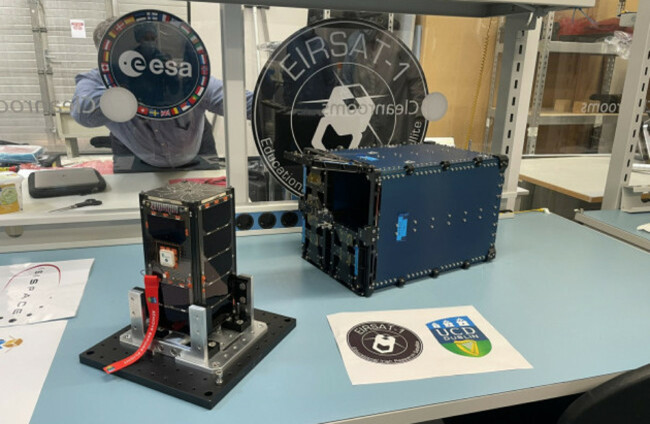
IRELAND’S FIRST EVER satellite has detected two gamma-rays bursts.
EIRSAT-1(Educational Irish Research Satellite 1) was designed, built, and tested by students at University College Dublin.
A SpaceX Falcon 9 rocket carrying EIRSAT-1 lifted off from the Vandenbeg Air Force Base in California last December and it has been in orbit ever since.
During this time, it has completed more than 4500 orbits of Earth, and travelled approximately 200 million kilometres.
EIRSAT-1 is a CubeSat, a satellite that is a little bit smaller than a shoebox.
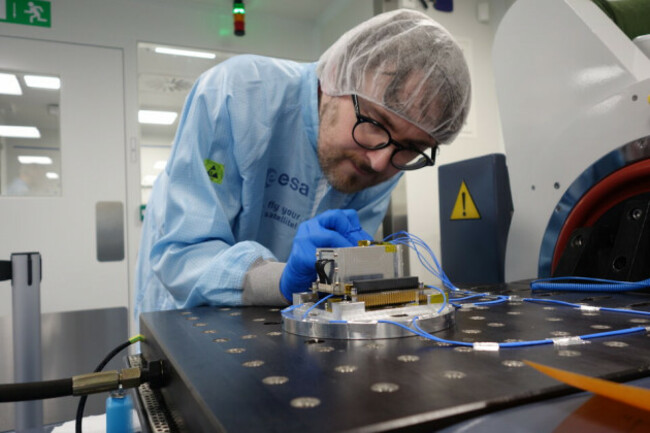
The satellite has three “payloads”, or experiments in it, one of which is a gamma-ray burst detector.
Gamma-ray bursts occur during the death of massive stars or when two stars collide.
Gamma-rays are a form of electromagnetic radiation, but because they cannot penetrate Earth’s atmosphere, satellite-based experiments are needed to detect them.
The gamma-ray detector on EIRSAT-1 has made two detections of gamma-ray bursts.
The first detection was made on 21 August and was a “long” type gamma-ray burst, which accounts for around 70% of those observed.
The European Space Agency explains that “long” is a relative term, and in the case of gamma-ray bursts, it means that the event had a duration greater than two seconds.
These “long” bursts are caused by the death of a high-mass star.
The second detection came a mere 79 minutes later, but was a rarer “short” type, likely caused by two stars colliding and forming a black hole.
Lorraine Hanlon is the Director of UCD’s Centre for Space Research and the Endorsing Professor for EIRSAT-1.
Speaking to RTÉ’s Morning Ireland, Hanlon said gamma-ray bursts “boggle the mind”.
“In a gamma-ray burst, the energy that is put out is more than our Sun will produce over its 10-billion-year lifetime, they are phenomenal explosions in deep space and they only last for a few seconds so we have to be lucky to catch them,” said Hanlon.
She noted that many years was spent developing the gamma-ray detector and that it’s a “brilliant validation of all that hard work to see it succeed in its mission by these detections”.
Hanlon explained that the gamma-ray bursts “challenge our understanding of physics and we want to know more about what makes the universe tick and push our understanding of how the laws of physics, as we understand them, operate in these really extreme environments”.
She added that the gamma-ray bursts can be used as a “beacon to signpost the very first stars that formed and died in the universe”.
EIRSAT-1 also has an “algorithm that allows us to reorientate the satellite’s position and move it around in space”.
This is the next phase of the mission and is said to be going very well so far.
Meanwhile, Hanlon said work will begin later in the year with the European Space Agency to develop a more “complex instrument” that will “pinpoint” where the gamma-ray bursts happen so that other telescopes can follow-up on it.

To embed this post, copy the code below on your site














have your say