Sign in. It’s quick, free and it’s up to you.
An account is an optional way to support the work we do. Find out more.
Sign in. It’s quick, free and it’s up to you.
An account is an optional way to support the work we do. Find out more.
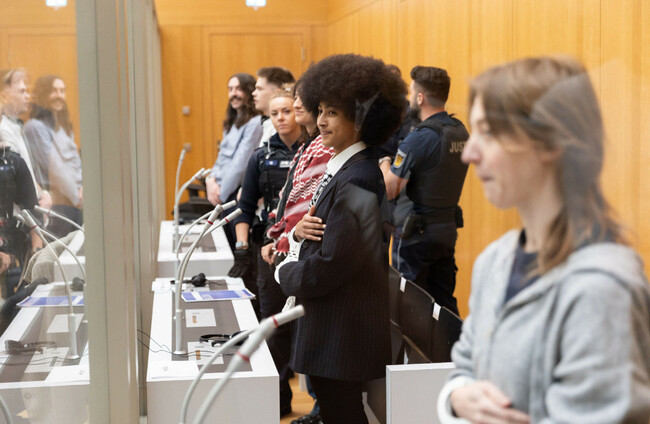
SEVERAL IRISH TDS intervened with German authorities over the use of a glass enclosure in prison for an Irish man and four other activists known collectively as the ‘Ulm 5′, defence lawyers have said.
Speaking at a press conference in the European Parliament in Brussels today, lawyers and family members of the five pro-Palestinian activists alleged that their clients have been subjected to conditions that violate their rights under European law.
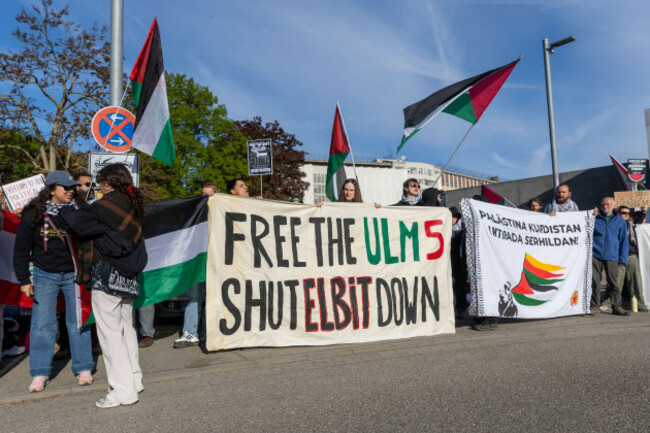
The group, which is made up of activists from Ireland, the UK, Germany and Spain, are on trial in Stuttgart over a break-in at an Elbit Systems facility in Ulm in September 2025.
Videos posted online after the incident showed activists spray-painting slogans on the site and accusing Germany of facilitating Israel’s military actions in Gaza.
If convicted, the defendants face prison sentences of up to five years.
German prosecutors have alleged that the group caused around €1 million worth of damage and are pursuing charges linked to membership of a criminal organisation.
The five have been held in pre-trial detention since their arrests.
During today’s press conference, Sinn Féin MEP Lynn Boylan asked whether EU member states had intervened on behalf of their citizens given the conditions being described by lawyers and family members.
Mathes Breuer, a German defence lawyer representing Spanish defendant Leandra Rollo Valenzuela, said there had been limited diplomatic engagement.
“I can say that there was an intervention by the Irish state regarding this glass cage,” Breuer said (Breuer was referring to the use of a glass box during family visits to the activists in prison, and mistakenly referred to several TDs as “the Irish State”).
“There has been connection, small talk, with Leandra, my client, with the Spanish consulate, but so far I think that’s about it.”
Breuer alleged that the trial conditions breach both the European Convention on Human Rights and EU law.
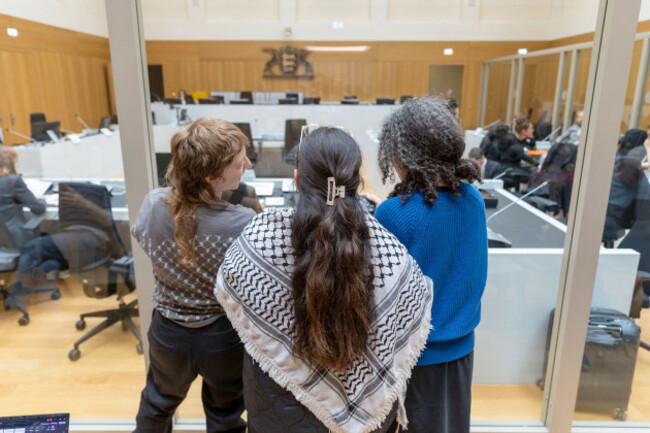
“Our clients have to watch the whole case in a glass cage behind the defence,” he said.
“There is no way to have a secret, confidential communication with the defence during the trial.”
Breuer also criticised the use of handcuffs when defendants are brought before the court and said the case is being heard in a high-security courtroom more commonly associated with terrorism prosecutions.
“They are presented in handcuffs before the press and the lay judges,” Breuer said.
“None of them has a criminal record, they are not charged with any attacks on humans, just with damaged property.”
The activists are being tried under Section 129 of the German criminal code, which relates to membership of a criminal organisation.
Their lawyers argue the charges are disproportionate given that the alleged offences centre on property damage.
The case is being heard at Stuttgart-Stammheim, a courthouse historically associated with the trials of members of the Red Army Faction militant group.
Irish activist Daniel Tatlow-Devally, one of the members of the Ulm 5 on trial in Stuttgart, used testimony read to the court last month to question the fairness of the proceedings.
“I would first like to say that what has taken place here to date means that I am not at all convinced that this is a fair trial, and I also doubt that the court will genuinely listen to me,” Tatlow-Devally said.
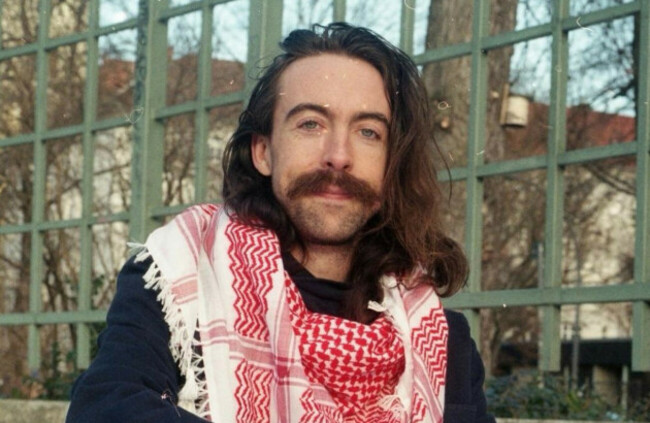
He added their actions at the Elbit facility were motivated by opposition to Israel’s military campaign in Gaza and Germany’s support for Israel.
“By damaging the arms production facilities of Elbit Systems in Ulm, the aim was to stop – to the greatest extent possible – their material support for the crimes being committed in Gaza,” he said.
Tatlow-Devally also described the experience of pre-trial detention as “deeply unsettling”.
“I have grown accustomed to the sound of a cell door locking shut and closing me off from the world,” he said.
“For five months, I only saw my loved ones through a pane of plexiglass – the result of an administrative error.”
Speaking to RTÉ’s Prime Time in April, his father Conor claimed that Daniel spends “23 hours a day in a cell”.
“He eats his meals there. His liberties are very minor,” he said.
At today’s event in Brussels, family members described what they characterised as severe restrictions and poor prison conditions.
Nikki Robertson, mother of British defendant Zo Hailu, said the five were initially held in separate prisons and subjected to extensive monitoring.
“In particular, the conditions in pre-trial detention have been abnormal from the start,” she said.
“Procedural violence is how I would prefer to call it.”
Robertson alleged that all communications were monitored and claimed some detainees had experienced inadequate healthcare and food shortages while in custody.
She also described prolonged isolation and restrictions on family contact.
The allegations have previously been disputed by prosecutors.
According to reporting by the BBC, the Public Prosecutor’s Office in Stuttgart said it had “not requested any special conditions of detention” and that restrictions imposed on the defendants were standard under German law.

To embed this post, copy the code below on your site











have your say