Sign in. It’s quick, free and it’s up to you.
An account is an optional way to support the work we do. Find out more.
Sign in. It’s quick, free and it’s up to you.
An account is an optional way to support the work we do. Find out more.
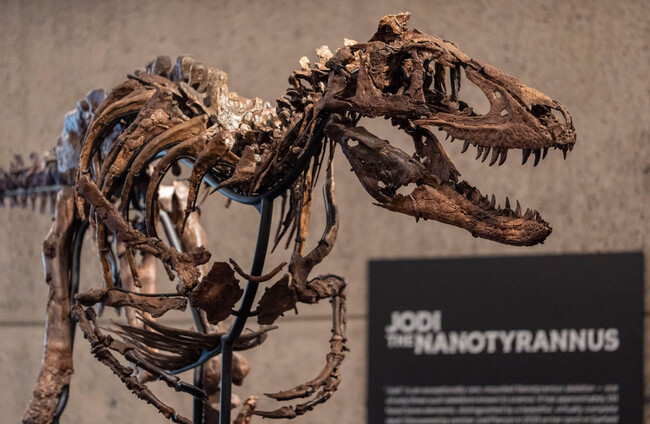
A RARE DINOSAUR skeleton nicknamed Jodi has sold for $47.3 million (€42.4 million) at auction in New York, far exceeding its estimated price of $6-9 million.
Six bidders competed for more than 12 minutes at Sotheby’s on Tuesday before the saleroom broke into applause as the winning bid was confirmed.
The auction house said Jodi became the second most valuable dinosaur ever sold at auction, behind the Tyrannosaurus rex skeleton Gus, which fetched $50.1 million (€44.9 million) in July.
Measuring almost six metres long and comprising approximately 190 fossil bone elements, Jodi is a Nanotyrannus, a smaller predator that lived alongside T. rex around 67 million years ago.
According to Sotheby’s, it is one of only three substantial Nanotyrannus skeletons known to science.
The sale room at #SothebysNewYork erupted into applause today as Jodi the Nanotyrannus became the second most valuable dinosaur ever sold at auction. Six bidders battled for more than 12 minutes, with Jodi nearly octupling its pre-sale estimate. The elusive predator was the first of its kind to come to market following the groundbreaking scientific confirmation that Nanotyrannus is its own distinct genus and not an adolescent T. Rex. Jodi is surpassed only by Gus the T. Rex, which sold this past July for a record-breaking $50.1 million. Fittingly, specialist Jodi Pollack was on the phone with the winning bidder for Jodi. Here's the moment the Nanotyrannus sold for a final price of $47.3 million.
— Sotheby's (@Sothebys) October 27, 2026
The sale follows research published last year that addressed a decades-long argument among palaeontologists: whether Nanotyrannus was a distinct dinosaur or simply a young T. rex.
A study published in Nature examined a remarkably well-preserved skeleton and found that it was approaching physical maturity despite its relatively small size.
Differences in its anatomy and growth supported the conclusion that Nanotyrannus was a separate genus, rather than a dinosaur that would eventually grow into a T. rex.
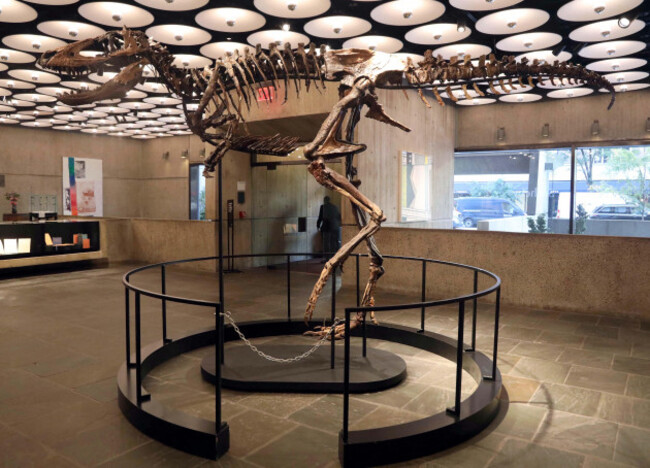
A subsequent study published in Science provided further evidence, using fossilised throat bones to establish that another Nanotyrannus specimen was also near maturity.
Sotheby’s said Jodi was the first skeleton of its kind offered at auction since the research confirming the distinction.
The final sale price includes the auction house’s premiums, but excludes applicable taxes and other costs.

To embed this post, copy the code below on your site













have your say