Sign in. It’s quick, free and it’s up to you.
An account is an optional way to support the work we do. Find out more.
Sign in. It’s quick, free and it’s up to you.
An account is an optional way to support the work we do. Find out more.
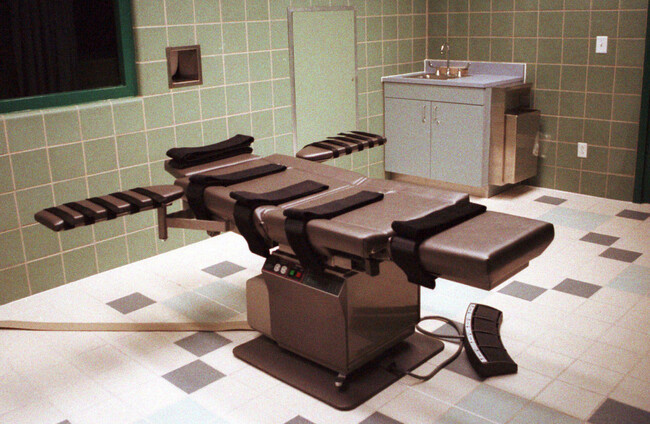
TENNESSEE DEATH ROW inmate Christa Pike was injected with a supposedly lethal dose of pentobarbital on Wednesday. Then she was injected again.
She is still alive.
The Tennessee death row inmate is now critically ill in hospital after surviving two doses of the drug during a failed attempt to execute her.
It’s an extraordinary outcome for a method of execution that was introduced in the US as a supposedly more humane alternative to the electric chair, gas chamber and firing squad.
But lethal injection has a long history of going wrong, with executions abandoned after officials struggled to find veins and prisoners taking prolonged periods to die after drugs were administered.
Pike’s case appears to be different again. According to death penalty experts, she is the first person in the modern US era known to have survived after actually being injected with lethal doses of execution drugs.
So why does the US execute people by lethal injection, what exactly is being injected into them, and how can the procedure fail?
Before lethal injection, executions in the US were more commonly carried out by methods including electrocution, hanging and the gas chamber.
In the 1970s, states began looking for an alternative that could be presented as less violent and more humane.
The modern lethal injection protocol was proposed in Oklahoma in 1977 by medical examiner Jay Chapman.
The idea was to use an intravenous line (a small tube inserted into a vein in the arm) and drugs to render a prisoner unconscious before killing them, replacing the overt violence of older execution methods with something that looked more like a medical procedure.
Oklahoma adopted the method without scientific studies being carried out on the proposed protocol.
Other states quickly followed and Texas carried out the world’s first execution by lethal injection in 1982.
The British Medical Journal described its emergence as part of the “medicalisation” of capital punishment, noting that lethal injection was devised as a way of “sanitising the death penalty” at a time when hanging, electrocution and gas executions were increasingly regarded as inhumane.
Amnesty International, which opposes capital punishment in all circumstances, has similarly argued that lethal injection can create an appearance of a clinical and humane death while masking what the organisation describes as the inherent cruelty of execution.
It eventually became the dominant method of execution in the US.
But its apparently clinical nature has not prevented executions from going badly wrong.
There is no single lethal injection formula used across the United States.
The traditional method involved three drugs: an anaesthetic intended to make the prisoner unconscious, a paralytic which stops their muscles from moving and a final drug which stops the heart.
That combination has been particularly controversial because paralysis can prevent a prisoner from showing outward signs of distress if the anaesthetic has not worked properly.
A 2005 study published in The Lancet examined toxicology reports from 49 executions in four US states.
It found that post-mortem concentrations of the anaesthetic thiopental were below the level required for surgery in 43 of the 49 prisoners, while 21 had concentrations which researchers said were consistent with “awareness”.
The researchers concluded that lethal injection anaesthesia methods were flawed and that some prisoners “might experience awareness and suffering during execution”.
Protocols vary between states, however, and Tennessee now uses just one drug, pentobarbital.
Pentobarbital is a barbiturate, a class of drugs which depress activity in the central nervous system.
In sufficiently high quantities it can suppress breathing and cardiovascular function, causing unconsciousness, coma and ultimately death.
Tennessee adopted its current single-drug pentobarbital protocol in 2024 after a review of the state’s execution procedures.
The state’s protocol provides for IV access through which the drug enters the bloodstream.
In practice, it has repeatedly proved to be one of the weakest points in lethal injection.
Prison officials carrying out executions are not performing an ordinary medical procedure in an ordinary medical setting.
Finding a usable vein can be difficult, particularly in prisoners who are older, have medical conditions or have a history of intravenous drug use.
And doctors and other healthcare professionals face ethical restrictions on participating in executions.
Amnesty has highlighted that tension for decades, arguing that lethal injection places pressure on healthcare workers to participate in deliberately ending a person’s life rather than treating them.
Tennessee’s attempted, but botched, execution of Christa Pike was an extreme display of cruelty and the latest reminder that the death penalty is the ultimate cruel, inhuman, and degrading punishment. Gov. Lee must grant all those on death row clemency and commute their…
— Amnesty International USA (@amnestyusa) October 1, 2026
If an IV is not properly positioned, the drugs may also fail to travel into the bloodstream as intended.
One possibility is “infiltration”, where the IV punctures or becomes dislodged from the vein and fluid instead leaks into the surrounding tissue.
That is what happened during the notorious 2014 execution of Clayton Lockett in Oklahoma.
Officials struggled for an extended period to establish intravenous access before eventually using a vein in his groin.
After the execution drugs began to flow, Lockett began moving and speaking despite having been declared unconscious.
A doctor eventually discovered that the IV had infiltrated, with liquid and blood visible around the insertion site.
Lockett died 43 minutes after the execution began.
Other executions have been abandoned before the drugs were administered at all.
In 2009, executioners in Ohio spent around two hours trying unsuccessfully to establish IV access to Romell Broom before the attempt was called off.
Tennessee had a similar problem earlier this year when it attempted to execute Tony Carruthers.
Officials managed to establish one IV but were unable to place the backup line required under the state’s protocol, and his execution was eventually abandoned.
For now, there is no definitive answer.
The Tennessee Department of Correction said after Wednesday’s failed execution that it had followed “every step” of its established protocol.
Governor Bill Lee has since described what happened as “deeply disturbing”, halted the state’s remaining execution this year and ordered an independent third-party investigation.
Her lawyers had argued that she had small and difficult-to-access veins as well as a blood condition which increased the risk of complications.
Lawyer Randy Spivey said he counted at least seven attempts to insert needles into Pike’s left arm and saw what appeared to be a bent needle removed following one unsuccessful attempt.
“This is awful.”
— Fox News US (@FoxUSNews) October 1, 2026
Randy Spivey, an attorney for Tennessee killer Christa Spike, said “she was aching” for Colleen Slemmer’s family when asked by Fox News Digital about the murder victim’s loved ones.
Spike was scheduled to be executed Wednesday for murdering Slemmer in 1995.… pic.twitter.com/y4DVfVk8tr
Once the execution began, witnesses said Pike complained that her arm hurt and felt as though it might “burst open”.
Her lawyers said her right arm later turned purple.
After she survived the first administration of pentobarbital, the state administered the drug again, but she remained alive.
One theory being advanced by Pike’s lawyers is that an IV infiltrated, meaning some or all of the pentobarbital was deposited into the tissue of her arm rather than travelling properly through her bloodstream.
“If the setting of the intravenous either became dislodged or pierced all the way through the vein,” lawyer Stephen Ferrell said, the drugs could have ended up in her arm.
“It sounds like that is likely to have occurred.”
That has not yet been established, however.
Questions have also been raised by Pike’s legal team about the condition of the pentobarbital itself, but there is currently no public evidence establishing that degraded drugs caused the execution to fail.
The state’s investigation will now have to establish where the process broke down.

To embed this post, copy the code below on your site












have your say