Sign in. It’s quick, free and it’s up to you.
An account is an optional way to support the work we do. Find out more.
Sign in. It’s quick, free and it’s up to you.
An account is an optional way to support the work we do. Find out more.

LAST UPDATE | 29 Apr 2025
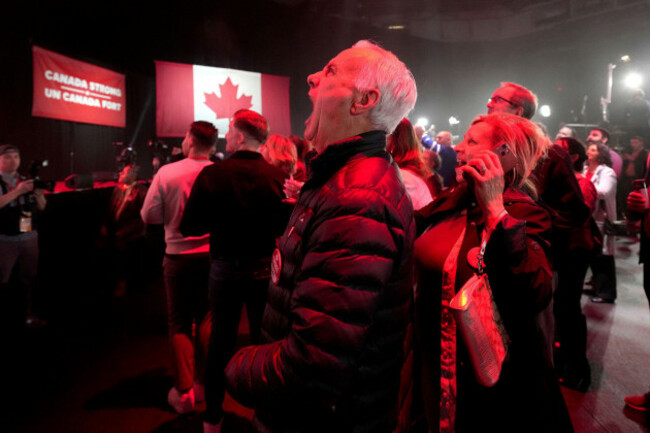
CANADIAN PRIME MINISTER Mark Carney’s party has won the country’s national election, securing another term in power after convincing voters it is the party best placed to navigate the turmoil created by US President Donald Trump.
As the election polls closed, the Liberal Party were projected to win more of parliament’s 343 seats than the Conservative Party, though they may not win an outright majority, meaning they would need to rely on one or more smaller parties to form a government and pass legislation.
The win has been hailed as a stunning political turnaround for a party which had been considered doomed to fail just months ago.
Taoiseach Micheál Martin has congratulated Carney on his success.
“Congratulations to Mark Carney and the Liberal Party on your election victory,” Martin wrote on social media this morning.
“Irish-Canadian relations are deep and strong, based on shared values. I look forward to working with Canada’s new government.
Tánaiste and Minister for Foreign Affairs Simon Harris has also offered his congratulations, adding: “At this pivotal moment, we look forward to deepening the partnership between our nations, and working together to address the challenges and opportunities that lie ahead.”
Carney, who had never held elected office and only replaced Justin Trudeau as prime minister last month, previously served as central bank governor in both Canada and Britain.
“Our old relationship with the United States, a relationship based on steadily increasing integration, is over,” Carney said in a victory speech in Ottawa.
“America wants our land, our resources, our water, our country. But these are not idle threats. President Trump is trying to break us so that America can own us. That will never, that will never ever happen,” he said.
In his speech, Carney called for unity, reminding Canadians of the challenges posed by ongoing hostilities with the US – the issue that he put at the heart of his campaign.
“Let’s put an end to the division and anger of the past. We are all Canadian and my government will work for and with everyone,” he said.
On Trump, Carney said that his first meeting with the US President will be to discuss the future economy and security relationship “between two sovereign nations”.
“It will be our full knowledge that we have many, many other options to build prosperity for all Canadians.”
He reiterated his promise to make the Canadian economy less dependent on the US and to reduce barriers to interprovincial trade.
People in the crowd often piped up, saying, “No! Never!” when Carney mentioned Trump’s desire to claim Canadian land.
Trump’s trade war and annexation threats outraged Canadians and made dealing with the United States a top campaign issue.
His actions infuriated Canadians and stoked a surge in nationalism that helped the Liberals flip the election narrative and win a fourth-straight term in power.
“We were dead and buried in December. Now we are going to form a government,” David Lametti, a former Liberal Justice Minister, told broadcaster CTV. “We have turned this around thanks to Mark,” he said.
LIVE: Thank you, Canada • EN DIRECT : Merci Canada https://t.co/E4uJHXmF1c
— Mark Carney (@MarkJCarney) April 29, 2025
The Conservative Party’s leader, Pierre Poilievre, hoped to make the election a referendum on former prime minister Justin Trudeau, whose popularity declined toward the end of his decade in power as food and housing prices rose – but Trump attacked, Trudeau resigned and Carney, a two-time central banker, became the Liberal Party’s leader and prime minister.
In a speech conceding defeat and with his own seat in the House of Commons still in doubt, Poilievre said he would keep fighting for Canadians and their right to an affordable home on a safe street.
Historian Robert Bothwell said Poilievre appealed to the “same sense of grievance” as Trump but that it ultimately cost him with voters.
Even with Canadians grappling with the fallout from a deadly weekend attack at a Vancouver street festival, Trump was trolling them on election day, suggesting on social media that he was on their ballot and repeating that Canada should become the 51st state.
He also erroneously claimed that the US subsidises Canada, writing: “It makes no sense unless Canada is a State!”
Trump has infuriated many Canadians, leading many to cancel US vacations, refuse to buy American goods and possibly even vote early. A record 7.3 million Canadians cast ballots before election day.
“The Americans want to break us so they can own us,” Carney said in the run-up to election day. “Those aren’t just words. That’s what’s at risk.”
Foreign policy had not dominated a Canadian election as much as it did this year’s since 1988, when, ironically, free trade with the United States was the prevailing issue.
In addition to the trade war with the US and frosty relationship with Trump, Canada is dealing with a cost-of-living crisis. More than 75% of its exports go to the US, so Trump’s tariffs threat and his desire to get North American automakers to move Canada’s production south could severely damage the Canadian economy.
While campaigning, Carney vowed that every dollar the the government collects from counter-tariffs on US goods will go towards Canadian workers who are adversely affected by the trade war.
He also said he plans to keep dental care in place, offer a middle-class tax cut, return immigration to sustainable levels and increase funding to Canada’s public broadcaster, the Canadian Broadcasting Corporation.
Additional reporting from AFP and Lauren Boland

To embed this post, copy the code below on your site















have your say