Sign in. It’s quick, free and it’s up to you.
An account is an optional way to support the work we do. Find out more.
Sign in. It’s quick, free and it’s up to you.
An account is an optional way to support the work we do. Find out more.
MATHS WEEK STARTED on Saturday and, as is our annual tradition, we’re setting our readers some puzzles. Give them a go!
Day four – What are the chances?
The Chevalier De Méré (Antoine Gombaud 1607-1684) was not actually ennobled but nevertheless enjoyed using the “Chevalier” title. In fact, he was a 17th century French writer and liberal thinker who is remembered nowadays because he unwittingly was responsible for that important branch of mathematics, probability.
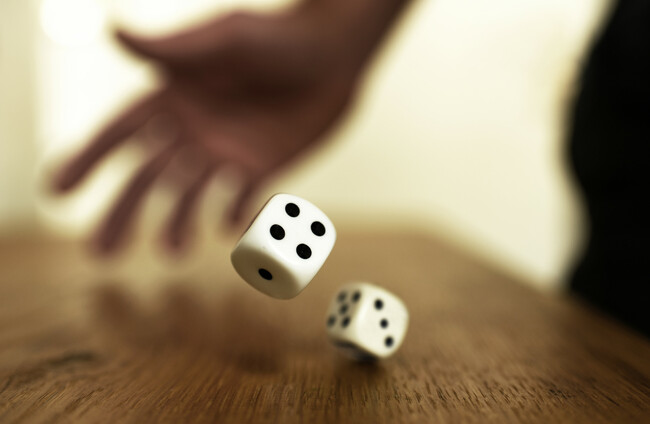
He was fond of gambling and would offer even money bets that he would throw at least one 1 in four rolls of a die.
He found that over a sufficient number of games, he was always ahead. His friends must have noticed this too, because he switched to offering a bet that he would throw a double one on 24 rolls of two dice.
He reasoned (correctly) that for every throw of one die, there were six numbers that could pop up on the second die; that means there is one sixth the probability of getting a double one in one throw of two dice.
He reasoned then (incorrectly) that one would need six times as many throws with this new bet, therefore 24 throws.
However, he found that he was losing money with this regime and enlisted the help of his friend the brilliant Blaise Pascal to explain why.
Pascal, one of the most brilliant minds in history, figured out that when he threw one die four times the chances of a one was slightly greater than 50%.
However, the Chevalier’s logic was faulty in that when he threw two dice 24 times, the odds were slightly less than 50%. Therefore, after playing for a while he would find himself losing money.
Blaise Pascal was able to overcome our human difficulty in reckoning probability and chance and developed the mathematical foundations of probability.
The maths of probability has a huge influence on our lives: it is used to predict chance in everything from casinos to your life insurance. Pascal was born 400 years ago this year.
Monday’s puzzle: The answer
The local train will get you to your destination in 8 minutes faster.
Local train:
70km at 60km/h = 70 minutes (60km/h is 1km per minute)
6 x 2 minute stops = 12 minutes
Total 82 minutes: you will arrive in 82 minutes
70km at 70km/h will take one hour (60 minutes)
And an extra 30 minute wait will mean you will arrive 90 minutes later.
-
The Dublin train will get in 20 minutes before the Galway train. That means if she arrives in the station in those 20 minutes she’ll get the Galway train.
After the Galway train departs, there will be a 40 minute wait for the Dublin train.
Therefore, if she arrives in the station anytime in those 40 minutes she will get the Dublin train.
Assuming her arrival is indeed random, she will have a 40:20 (2:1) chance of getting the Dublin train and thus will visit her son in Dublin twice as often as her daughter in Galway.
Come back tomorrow at 7.30pm for the answers to today’s puzzle.
The puzzles this week have been compiled by Eoin Gill and Colm Mulcahy of Maths Week Ireland / South-East Technological University (SETU).
To embed this post, copy the code below on your site
have your say