Sign in. It’s quick, free and it’s up to you.
An account is an optional way to support the work we do. Find out more.
Sign in. It’s quick, free and it’s up to you.
An account is an optional way to support the work we do. Find out more.
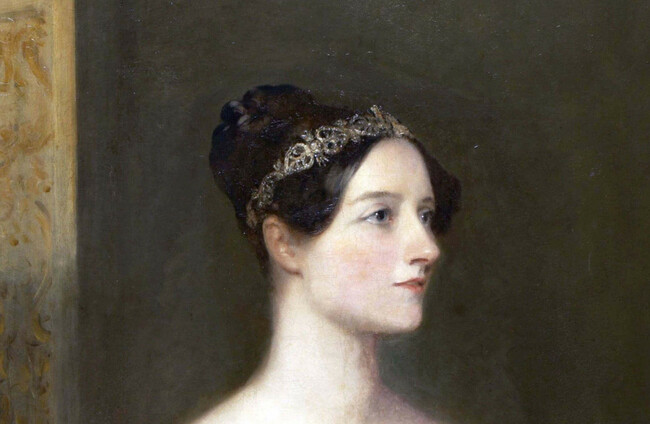
MATHS WEEK is under way and, as is our annual tradition, we’re setting our readers some puzzles. Give them a go! You can check out other events being held over the next week here.
Happy Ada Lovelace Day!
Ada is celebrated on the second Tuesday in October. Today! This is celebrated in Maths Week when it falls within the week and, of course, this is the latest date upon which it can fall.
Ada Lovelace was a 19th-century mathematician credited with writing the first computer programme. Ada was fortunate to be born an aristocrat to a mother that ensured she was well educated by tutors. She became an accomplished mathematician and collaborated with Charles Babbage – one of the leading mathematicians of the age.
Babbage designed a mechanical computer and Ada wrote a programme for it. Whereas Babbage only imagined number-crunching, Ada foresaw the potential of a programmable computer for information processing. Ada Lovelace Day celebrates women in STEM.
14 October is also the birthday of Eamon de Valera, former Taoiseach and President of Ireland. De Valera was a maths teacher and, despite his busy political career, held a lifelong interest in mathematics and science, establishing the Dublin Institute for Advanced Studies (DIAS).
Reputedly he once brought a blackboard into a cabinet meeting to teach the ministers about Venn diagrams. Any effect must not have lasted as recent Taoiseach Leo Varadkar bemoaned the poor knowledge of maths amongst ministers during his time in Cabinet.
Venn diagrams can help make sense of information that our brains otherwise find difficult to process.
Today’s puzzle illustrates how a visual representation of data can help make sense of something when representation in words or numbers is confusing.
Give it a go:
A maths student on a J1 Visa gets a job as a chef. On her first day a party of 30 arrives and orders from the set menu.
The waiter decides to test her.
He tells her that 11 ordered a main course and dessert but not starters.
5 ordered the starter and main course but not dessert.
4 ordered the starter and dessert only.
Nobody ordered a main course and not a starter or a dessert.
Nobody ordered a starter and not a main course or a dessert.
3 ordered only one course.
She was not fazed by this at all and set about preparing the meals.
Can you figure out how many of each course she needs to prepare?
*** ***
Monday’s puzzle: The answers
1. Robinson is 32
If we use the letter R for Robinson’s age, B for the brother’s age, S for the sister’s age and M for the mother’s age, we can write the following:
B = R+2 (1)
S = R + 6 (2)
M = R + 20 (3)
(R + B + S + M)/4 = 39 (4)
Multiply both sides of equation (4) by 4 gives:
R + B + S + M = 156 (5)
Substitute the B,S,M in equation (5) with expressions in terms of Robinson’s age
R + R + 2 + R + 6 + R + 20 = 156
4R + 28 = 156
Subtracting 28 from each side gives us
4R = 128
R = 32
2. 30
Call Anne’s age A and call her son’s age B
A = 3xB (1)
A+10 = 2x(B+10)
A + 10 = 2B + 20
A = 2B + 20 – 10
A = 2B +10 (2)
From (1) we have A = 3B so we can replace A in equation (2) by 3B which gives us:
3B = 2B + 10
B = 10
So, as A = 3B, Anne’s age is 30 and her son is 10.
3. Don is 70 and Bill is 30
Call Don’s age D and Bill’s age B.
We can say that 10 years’ ago Don’s age was D-10 and Bill’s age was B-10.
And that:
D-10 = 3x(B-10)
D-10 = 3B – 30
D = 3B -20 (1)
Likewise, we can say in 10 years’ time Don will be D+10 years old and Bill will be B+10
years old.
We can write this like so:
D+10 = 2x(B+10)
D + 10 = 2B + 20
D = 2B + 10 (2)
As the right hand side of both equations (1) and (2) are equal to D we can write:
3B – 20 = 2B +10
3B -2B = 10 + 20
B = 30.
And as equation (2) tells us D = 2B + 10 and B = 30, we can write
D = 2×30 + 10
D = 70
Come back tomorrow at 7.30pm for the answers to today’s questions and a brand new challenge.
These puzzles were prepared exclusively for The Journal by Eoin Gill, co-founder and co-ordinator of Maths Week Ireland.

To embed this post, copy the code below on your site















have your say