Sign in. It’s quick, free and it’s up to you.
An account is an optional way to support the work we do. Find out more.
Sign in. It’s quick, free and it’s up to you.
An account is an optional way to support the work we do. Find out more.
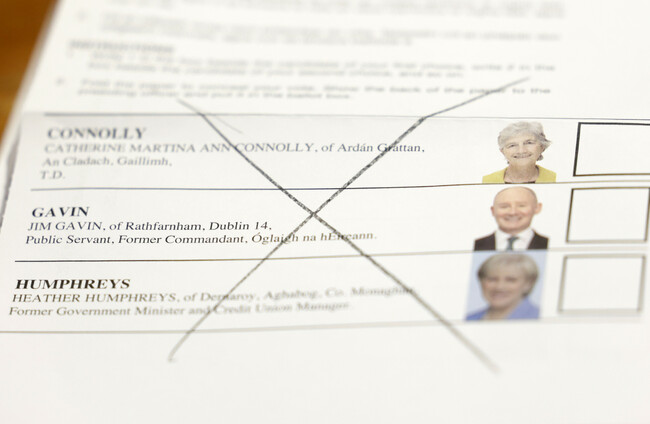
AS BALLOTS ARE being counted across Ireland today, many fringe figures online are celebrating the high number of votes that were spoiled in this year’s presidential election.
Some of those accounts are pointing to the number of spoiled votes – combined with a low turnout – as evidence the election result is illegitimate.
Before even a single vote had been cast, social media was swarmed with claims that the presidential election had been “rigged”.
The users pushing often point to their candidate’s exclusion from the ballot — and use it to claim, falsely, that Ireland is no longer democratic.
In recent weeks, The Journal FactCheck has witnessed numerous instances of users claiming that the election was undemocratic, in posts that were spread widely on social media platforms such as Facebook, TikTok, Instagram and X.
Many complained about their preferred candidate not being on the ballot, and used this to claim, falsely, that Ireland is no longer democratic.
And as the initial results in the presidential election come in, some are calling for the election to be annulled or to be re-run, citing an increase in spoiled votes, or a low turnout.
“If Catherine Connolly is a woman of integrity, she should step down and call for a rerun”, one X user who regularly spreads misinformation wrote shortly after ballot counting began.
“This is not a legitimate election. The people have clearly said so.”
This election is not the first to be called illegitimate by online activists, either in Ireland or internationally.
The Journal FactCheck has debunked a number of these claims for this election.
They include false assertions that candidates who wish to run for president had to have government backing, that Simon Harris blocked ‘the will of the people’ by not letting Fine Gael representatives nominate Conor McGregor for president, and that Irish presidents can unilaterally call referendums.
An AI-generated video that appeared to show Catherine Connolly withdraw from the presidential race made headlines after it was shared on social media. But the video was just one in a series, the last of which appeared to show RTÉ news announcing that the majority of votes counted in the election so far had been spoiled.
There was also a widespread claim online that a High Court judge had said that the nomination process was unconstitutional – a claim the Courts Service denied in a case that was dismissed earlier this week.
Another similar case, in which the plaintiff offered to assume the role of the presidency until the referendum could be held to amend the constitution (which he implied was in violation of itself), was thrown out of court on Monday.
Both these court cases and many of the misleading claims about them focused on the fact that members of the two parties in government, Fianna Fáil and Fine Gael, did not propose anyone for president other than their own candidates — with suggestions that the government parties thereby blocked independent candidates from appearing.
However, there are 106 Oireachtas members who are not in those parties, and 11 county councils that do not have Fine Gael and Fianna Fáil majorities.
These would allow enough proposals for seven potential candidates to run in the election without any support from government parties.
Indeed, the current leader in early tallies and likely next president, Catherine Connolly, is an independent whose nomination was secured with the help of non-government Oireachtas members.
Ultimately, these claims and the people who pushed them coalesced around the #SpoilTheVote movement. A campaign for which was launched a week before the vote and fronted by figures like repeated spreader of misinformation, Michael McCarthy, and celebrity chef Paul Treyvaud who had said that Ukrainians being allowed to vote in local elections last year was “absolute voting corruption and a national scandal”.
A strong online campaign has been encouraging people to spoil their votes, with those pushing it saying it would send a message of dissatisfaction with the system or the government.
Early tallies indicate that this campaign has been modestly successful, with the number of spoiled votes likely to surpass previous records (though initial estimates put the total number at around 12%).
A number of these ballots will be from voters who simply made a mistake filling out their paper; there is a small proportion of these in every election.
However, many of the additional spoiled votes that appear to have been cast this election are from those who have expressed a dissatisfaction with the government and its policies.
Many people on social media have posted images of their spoiled ballots along with messages to that effect.
Others, however, reflected that the public was not enthused about the limited number of candidates running in this election.
There’s no tally or count of the spoiled votes to categorise them by what message, if any, they intended to send.
Similar misinformation questioning the legitimacy of Irish election results has been seen around previous votes over the past year.
During the local and European elections in June, far-right online activists worked to undermine the legitimacy of non-white candidates who were running in the election, often subject them to racist abuse.
At the same time, asylum seekers (who have been eligible to vote for more than 20 years in Ireland’s local elections) were also targeted; the system that allows residents to vote in local elections was described as “corruption” or even “treason”.
That election also saw AI used to spread misinformation, such as an article featuring made-up quotes from people, both real and fictional, to claim Fine Gael had launched an investigation into vote-rigging by their councillors (they had not).
Months later, as the results from the general election began to be tallied, indicating that no far-right party’s candidate had been successfully elected, conspiracy theories and accusations of vote-rigging again swirled in fringe groups.
Every major far-right party had suggested that Ireland’s general election was illegitimate.
Accusations that the current presidential election was rigged are part of a recently formed pattern, rather than an exception. And, in many cases, the same personalities are pushing these claims.
False stories about elections of being fraudulent are also commonplace in recent international elections. Most notably, US president Donald Trump continues to say that the 2016 election was stolen from him, and had refused to commit to accept the results of the 2020 vote while he was still campaigning.
Since the 2020 US presidential election, it has become clear that false stories about elections being rigged and votes not being counted properly have begun to be shared more widely across the world.
At the start of 2023, researchers at the European Digital Media Observatory (EDMO) began to keep track of false stories and narratives about elections in European countries which had elections that year.
The results were striking: every single country across Europe saw misinformation being shared about the election.
Their analysis found that these false stories being shared on social media and messaging platforms were about voter fraud, foreign influences and unfair practices.
Ultimately, these stories had the apparent goal of delegitimising the elections: making it seem like the results were invalid or that the people who were voted in had won by shady practices, decreasing the trust that people have in their government and other authorities.
“False claims that the election/nomination process was ‘rigged’ did not materialise overnight,” said. Aidan O’Brien, a researcher of electoral disinformation with the European Digital Media Observatory (EDMO).
“In mid-April, Conor McGregor claimed that if he was not allowed on the ballot, it was proof that Ireland was not a democratic country,” claims that were spread by figures such as US influencer Tucker Carlson.
“Once McGregor ‘dropped out’, other candidates and campaigns quickly adopted his narrative that the nomination process was undemocratic.
“These claims have been fed by incendiary language online, for example, comparing Ireland to Iran or North Korea.”
O’Brien also cast blame on social media companies for not doing enough to prevent misinformation.
The Journal’s FactCheck is a signatory to the International Fact-Checking Network’s Code of Principles. You can read it here. For information on how FactCheck works, what the verdicts mean, and how you can take part, check out our Reader’s Guide here. You can read about the team of editors and reporters who work on the factchecks here.

To embed this post, copy the code below on your site














have your say