Sign in. It’s quick, free and it’s up to you.
An account is an optional way to support the work we do. Find out more.
Sign in. It’s quick, free and it’s up to you.
An account is an optional way to support the work we do. Find out more.
WHAT LOOKS LIKE Sharon Ní Bheoláin speaks to the camera.
The figure announces: “Within the last few minutes, at a Catherine Connolly campaign event, Catherine Connolly has confirmed her withdrawal from the presidential race.”
The camera then cuts to footage apparently of Connolly lip-syncing to the words:
“It is with great regret that I announce the withdrawal of my candidacy and the ending of my campaign.”
The video is fake – the images and audio created by artificial intelligence trained off the images of real people without their consent to create a deepfake.
The footage continues, seeming to cut to RTÉ Political Correspondent Paul Cunningham standing outside Leinster House saying that the election is cancelled, and Heather Humphreys will be appointed as president by default.
The video was posted on 21 October, and reportedly viewed 160,000 times before it was taken down from Facebook.
It remained online on YouTube, though with far fewer views.
This is not the first AI-generated political video posted online during the election campaign, nor even the first posted from this fake RTÉ’s Facebook and YouTube accounts.
The page that posted the video describes itself as “NOT The Real RTE News!” and has previously posted other realistic-looking fake newscasts, including one in which The National Women’s Council of Ireland said one of the candidates should be in a nursing home.
A week before voting began, it released a video that began with an AI Clare Byrne speaking.
“We’re getting the first results in from 13 count centres,” the fake Byrne says.
“I can report that, shockingly, 56 percent of the ballots coming in are spoiled ballots.”
A hint to the motives of the makers of these AI videos appears later. An AI-generated version of RTÉ news presenter David McCullagh is portrayed reporting from a count centre with ‘Election 2025 ‘appearing on screens in the background. The fake McCullagh says: “The exclusion of independent candidates was undemocratic”.
He then appears to speak to a journalist who compares Micheál Martin and Simon Harris to Vladimir Putin.
The video was shared hundreds of times since being published on 17 October. Given the timing, it’s unlikely to fool many ahead of the election (although it could float about on the internet for years, causing confusion).
Nevertheless, the presenters, the journalists, and the RTÉ One logo that feature in these deepfake videos all look and sound real. In the bottom right corner, in tiny, semi-transparent writing, it says “Veo” — the name of an AI video generator.
However, these are far from the only AI-generated videos that have spread so far during this presidential election.
The quality of the fakes is less an indication that malicious actors are trying to tamper in the election than a reflection of how modern AI tools can create realistic fabricated footage. This can now be done so easily and convincingly that it risks fooling the public, even when its creators don’t intend to.
Like the fake RTÉ news report about election results, almost all the AI-generated political images seen by The Journal this election have advocated that people spoil their votes.
This includes numerous videos on YouTube, TikTok, and X, in which conventionally attractive computer-generated women speak to camera, saying that democracy has been eroded and that spoiling a vote is the only way to restore it.
Other images feature AI-generated ballots where Maria Steen’s name has been written in below the printed candidates names. There is no suggestion that Steen – or, for that matter, any of the candidates or media personalities portrayed in the deepfakes – has any association with the creators of the videos and images.
Other videos include faked images of politicians.
These include photos of Catherine Connolly dressed up in USSR military fatigues, or videos where she is described as a member of Hamas, and shown wearing a keffiyeh-like a headscarf.
That same video goes on to show Heather Humphreys dressed as a Nazi officer, all to an AI-generated song.
Another video, appearing to take aim at Connolly’s past legal work for banks – one of the talking points of the campaign – shows children getting out of bunk beds in an ornate dining room (presumably meant as a stand-in for a room in the Áras) while Connolly, dressed in barrister robes, smiles on.
“A new proposal to help all the kids who lost their homes via high court repossession cases,” the caption on X reads.
Politicians not in the running also feature strongly, including AI-generated videos showing Simon Harris and Micheál Martin being arrested, as well as Leo Varadkar in handcuffs.
Those politicians also appear in a AI video alongside Jim Gavin, where, in US and British accents, they talk about being corrupt. The video ends with an AI-generated Conor McGregor saying he was “coming for retribution”.
An AI-generated image show Micheál Martin, Simon Harris, and Mary Lou McDonald plotting against the Irish.
Another video that features fake images of known figures, including Maria Steen, which falsely claimed that Steen had been polling in second place behind Gavin before he dropped out of the race.
Steen also appeared in another AI video, though her controversial blue Hermes bag featured even more prominently, altered to now be emblazoned by the word “spoil” in metal letters.
Other videos are stranger, such as one 28-second video where Heather Humphreys is depicted on a loop sharing a passionate kiss with socialist TD Paul Murphy.
While the person who uploaded that video had previously promoted a spoil the vote movement, it is hard to discern the intended meaning of that particular clip.
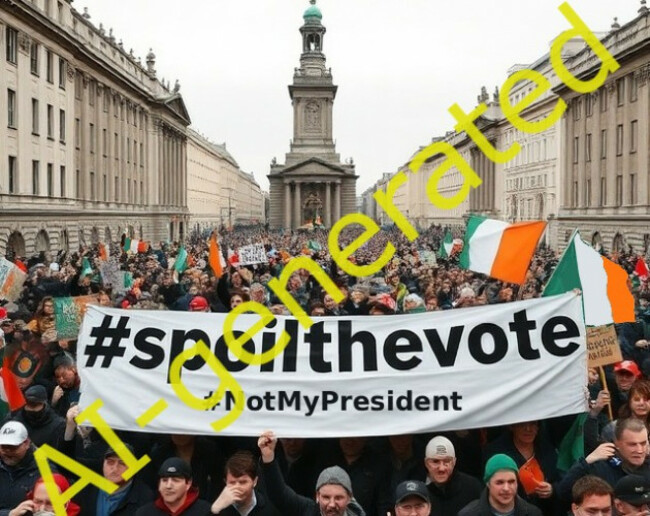
Another obviously AI-generated photo shows hundreds of people marching and waving tricolours behind a #spoilthevote banner, standing on a street reminiscent of O’Connell Street in Dublin, but which doesn’t match any real location.
The person who posted it on X on 3 October admitted in replies that it was made with AI, indicating he did not intend to fool anyone into thinking it was real — but he had.
The following day, Lawyers for Justice Ireland, a conspiracy theory and anti-immigrant Facebook page with 59,000 followers, responded to photos indicating there had been a poor turnout for a “National Protest for Ireland” that day.
To counter those claims, they posted a picture of a large crowd.
“The cheerleaders for the globalists love to post photographs taken early when people are gathering,” their post read. “They can breathe more easily in their echo chamber.”
However, the picture they used in their rebuttal was the same image that was posted to X the previous day and admitted to be AI-generated.
Update: In a statement sent in response to this story, a YouTube spokesperson said: “We terminated the channel for violating our Community Guidelines, which strictly prohibit channel impersonation.
“Our teams are working around the clock to safeguard this election, and we’re ready to take action on content that violates our policies.”
The Journal’s FactCheck is a signatory to the International Fact-Checking Network’s Code of Principles. You can read it here. For information on how FactCheck works, what the verdicts mean, and how you can take part, check out our Reader’s Guide here. You can read about the team of editors and reporters who work on the factchecks here.

To embed this post, copy the code below on your site









have your say