Sign in. It’s quick, free and it’s up to you.
An account is an optional way to support the work we do. Find out more.
Sign in. It’s quick, free and it’s up to you.
An account is an optional way to support the work we do. Find out more.
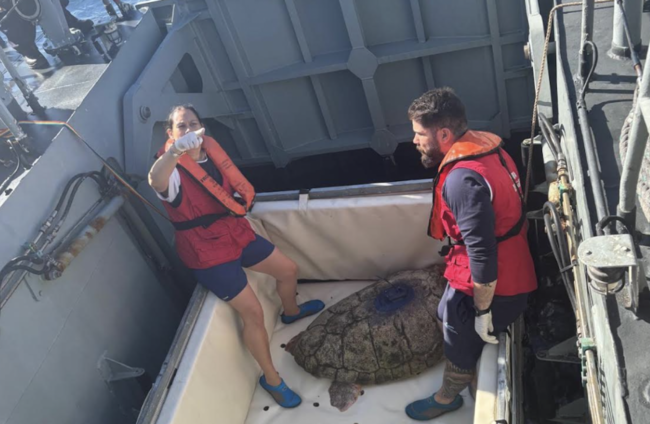
IT TOOK JUST three small steps to freedom for Molly, Kerry’s 257 pound loggerhead rescue turtle – as she dived into Atlantic waters today, but it was a journey that was more than 22 years in the making.
The massive turtle was released back to the wild today, 12 miles off the coast of Portimão after a crane lifted her on board a Portuguese naval ship.
More than two decades after the badly injured and cold-stunned turtle washed up on an Irish beach in 2004, her rescuers watched on emotionally as the much-loved turtle was slowly lowered into the open ocean through a special hatch.
“It was absolutely fabulous and sad,” said marine biologist Kevin Flannery, director of Dingle Oceanworld, who had cared for her for the past two decades.
Flannery gave a cheer as he watched on along with a CNN TV crew as Molly swam strongly out into the open ocean.
“There was no hesitation at all, she didn’t even say goodbye to me”, he said with a laugh, “She went into the water and away she went.
“She could cop it from once we left port with the smell of the salt water – she was getting sort of agitated.
“She could smell the sea, and she took off, and we wish her all the blessings in the world.
“It was like your child going to college. You don’t know whether you’re happy or sad, but we’ve had her for so long, and it’s only right that she gets released, and that she goes back into the wild, and hopefully heads for her breeding ground.”
It has been a long, slow road to recovery for the turtle who was rescued by Flannery after she washed up in a storm in the Maharees peninsula on the Kerry coast as a 40lb 12-year-old adolescent.
The marine biologist had orchestrated the return of dozens of stricken turtles on flights down to the Spanish or African coasts over the years.
The aquarium has become adept at painstakingly nursing young turtles back to health after being blown thousands of miles off course to Ireland.
But it was thought Molly, who is now thought to be in her 30s, would never be strong enough to survive in the wild as she was only able to swim in circles due to badly injured flippers.
“When I got her first got her two front flippers were gone, cut off by being a propeller, a shark or something, we don’t know”, Flannery said.
“The flippers were gone, and she was dying and bleeding and the lot. And then we got her back to health, and they said she wouldn’t be strong enough to swim or catch food, she’d starve to death.
“She wouldn’t have the strength to swim against the current with those small flippers.”
But in recent years, she surprised everyone at the aquarium by developing a powerful swimming style with her damaged flippers.
“That has all changed now since she got so strong and big. We began to notice in the last couple of years.
“She was getting so strong inside, she was getting aggressive with the sharks. We used to take her out for X-rays and then we found that she was nearly producing eggs. So then it was time.”
While other rescued juveniles – which tend to weigh only a few pounds – could often travel in a special container in a passenger seat, 18-stone Molly was a very different proposition.
There was considerable red tape to navigate, including obtaining veterinary certificates and CITES permits, before she was flown to Portugal by TAP Air Cargo in April in a specially designed padded box.
Marine biologists in the turtle hospital in Zoomarine’s Porto d’Abrigo then took over where Irish staff left off and prepared her for her return to the wild over the past five months.
They focused on ensuring she could identify natural food sources and execute diving patterns compatible with ocean living.
Kevin Flannery said he is “pretty confident” she will be able to catch her own food.
“Her main aim now seems to be making for the breeding ground. That’s what I figure from the way she was heading.”
He says Molly who had shared a tank with a shark in Kerry would have no fear of predators due to her adult size.
It is hoped a satellite tag attached to Molly will start to transmit her location in a few days.
“I would say she’s going to make safe for her breeding ground. I think she’d head over to the gulf. We’ll make the information available to the public and hopefully the tag will be there for a few months.”
Her birthplace was a mystery until a US university professor, Dr. David Duffy, flew over from Florida to Kerry last year to take DNA samples from Molly and other stranded turtles.
DNA samples examined in his laboratory have shown she originally came from the Gulf of Mexico and Kevin Flannery believes she is now instinctively making her way back home.
“It was the way she was facing most of the time in the tank. I want to go out south. I want to go south. I want to go south. That seemed to be it”.
To embed this post, copy the code below on your site











have your say