Sign in. It’s quick, free and it’s up to you.
An account is an optional way to support the work we do. Find out more.
Sign in. It’s quick, free and it’s up to you.
An account is an optional way to support the work we do. Find out more.
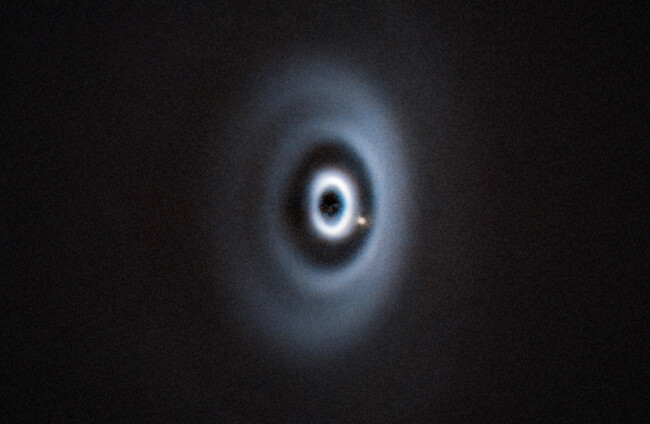
ASTRONOMERS AT THE University of Galway are part of an international team of researchers who have discovered a new planet still in the early stages of its formation.
The proto-planet has been given the name WISPIT 2b and it is believed to be about 5m years old, which is young in planetary terms.
It is located around 430 light years from Earth, meaning light takes 430 years to get from there to us.
While that sounds like a long way, it’s actually still in our “galactic back yard”, situated within our own Milky Way galaxy, said Dr Christian Ginski, a lecturer at the School of Natural Sciences at the University of Galway.
The discovery of WISPIT 2b was an unexpected one, according to the team that came across it.
The research that led to the discovery was co-led by astronomers at the University of Galway alongside their colleagues at Leiden University in the Netherlands. A companion study was also carried out by the University of Arizona in the US.
The findings of the project have been published today in the international publication Astrophysical Journal Letters.
The new planet, which shows up as a small dot nestled between a young sun similar to our own and the multi-ringed dust disk that encircles it, is believed to be a gas giant like Jupiter.
WISPIT 2b was spotted at one of the world’s most advanced observatories, the European Southern Observatory’s Very Large Telescope (ESO’s VLT) located in the Atacama Desert in Chile.
“When we saw this multi-ringed disk for the first time, we knew we had to try and see if we could detect a planet within it, so we quickly asked for follow-up observations,” said Ginski.
“The planet was captured in near infrared light – the type of view that someone would see when using night-vision goggles – as it is still glowing and hot after its initial formation phase,” he said.
The team behind the discovery believe WIPSIT 2b will provide a rare and invaluable window into the process of planet formation.
Ginski praised the work of the Galway students on the research team.
“We were so fortunate to have these incredible young researchers on the case. This is the next generation of astrophysicists who I am sure will make more breakthrough discoveries in the years to come.”
Chloe Lawlor, a PhD student in physics with a specialisation in astrophysics, said she felt “incredibly fortunate to be involved in such an exciting and potentially career defining discovery”.
Jake Byrne, an MSc student in Physics with a specialisation in Astrophysics at University of Galway, said he could hardly believe it was a real detection when Dr Ginski first showed him the image of WISPIT 2b.
“Contributing to something this impactful, and doing so alongside international collaborators, is exactly the kind of opportunity early-career researchers like Chloe, Dan and I dream of,” he said.
And Dan McLachlan, another MSc student in physics specialising in Astrophysics, said:
“In my experience so far working in astronomy, sometimes you can get so focused on a small task and you forget about the big picture, and when you zoom out and take in the magnitude of what you are working on it shocks you.”

To embed this post, copy the code below on your site












have your say