We need your help now

Support from readers like you keeps The Journal open.

You are visiting us because we have something you value. Independent, unbiased news that tells the truth. Advertising revenue goes some way to support our mission, but this year it has not been enough.

If you've seen value in our reporting, please contribute what you can, so we can continue to produce accurate and meaningful journalism. For everyone who needs it.


Chloe Lawlor, PhD student, Centre for Astronomy, School of Natural Sciences, University of Galway. Martina Regan

Galway student leads team to discovery of new planet

Chloe Lawlor has not one, but two planet discoveries under her belt after the latest finding.

SOME 430 LIGHT years away from Earth – or, in km, four quadrillion, sixty-eight trillion – a new planet sits around a star named WISPIT 2. 

It is the second planet to be discovered around the young star, and was uncovered by a Galway PhD student leading a team of international astronomers.

Twenty-five-year-old Chloe Lawlor is in the second year of her PhD at the Centre for Astronomy at the School and Natural Sciences and the Ryan Institute at the University of Galway, and the new planet – WISPIT 2c – is the second planet she’s had a hand in discovering.

Last year, Lawlor was part of a team that discovered the first planet around the star, which was named WISPIT 2b, in August 2025. Lawlor worked under lecturer Dr Christian Ginski in that research – but this time she headed up the project, collaborating with two other researchers from the Netherlands and Germany respectively.

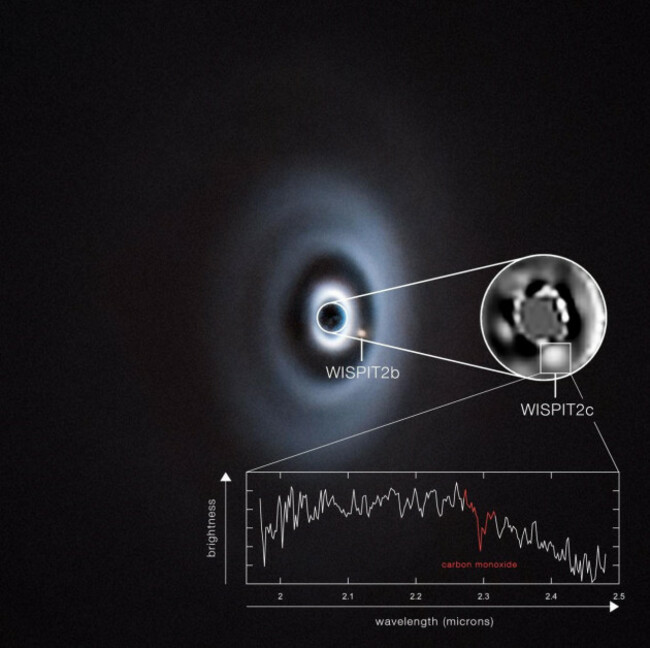
The new planet is a very young gas giant based on the temperature and its radius from the atmosphere spectrum.

It is twice as massive as the previously detected WISPIT 2b and orbits four times closer to its host star, which makes it incredibly difficult to detect with ground-based telescopes. 

It was spotted at one of the world’s most advanced observatories, the European Southern Observatory’s Very Large Telescope (ESO’s VLT) located in the Atacama Desert in Chile.

unnamed ery Large Telescope images of two planets (WISPIT 2b and the newly discovered WISPIT 2c) forming around the young star WISPIT 2. ESO / C. Lawlor, R. F. van Capelleveen et al. ESO / C. Lawlor, R. F. van Capelleveen et al. / C. Lawlor, R. F. van Capelleveen et al.

WISPIT 2c is estimated to be around ten times the mass of Jupiter, the latter being the largest planet in our solar system (for context, Jupiter has around 318 times the mass of Earth). 

The findings of the project have been published today in the international publication Astrophysical Journal Letters.  

Speaking to The Journal, Lawlor explained much of the significance of the discovery is derived from the fact that the planet, at a mere 5m years old, is “very young”, which means it still has its protoplanetary disk.

The disk is a rotating disk of dense gas and dust that surrounds a newborn star. It’s from this material that planets form. The planets in this system are still very young, which is important for theories about planet information, she said.

“We kind of understand how it works up until a certain point, and then the rest is sort of a mystery,” Lawlor explained. “We have a couple of theories, but not really confirmations, of how it works.

“WISPIT 2 [the star] might be a close analog to our own solar system, so it might be a way for us to link how our solar system might have looked a couple of billion years ago.”

WISPIT 2 is 5m years old – in its infancy compared to Earth’s solar system, which is around four to five billion years old. 

The discovery is huge for Lawlor – but she’s already begun preliminary work at researching further, and examining the dust in the disk to learn more about planet formation. 

As for when she finishes the PhD in another two years, she said she’d like to remain in research, if possible.

“I think it’d be really nice if I could get a lecturing position. I’d really love to do that, but those are kind of few and far between. But I’d definitely like to stay doing research anyway.”

Readers like you are keeping these stories free for everyone...
A mix of advertising and supporting contributions helps keep paywalls away from valuable information like this article. Over 5,000 readers like you have already stepped up and support us with a monthly payment or a once-off donation.

View 15 comments
Close
15 Comments
This is YOUR comments community. Stay civil, stay constructive, stay on topic. Please familiarise yourself with our comments policy here before taking part.
Leave a Comment
    Submit a report
    Please help us understand how this comment violates our community guidelines.
    Thank you for the feedback
    Your feedback has been sent to our team for review.

    Leave a commentcancel

     
    JournalTv
    News in 60 seconds