We need your help now

Support from readers like you keeps The Journal open.

You are visiting us because we have something you value. Independent, unbiased news that tells the truth. Advertising revenue goes some way to support our mission, but this year it has not been enough.

If you've seen value in our reporting, please contribute what you can, so we can continue to produce accurate and meaningful journalism. For everyone who needs it.

They're an increasingly popular Christmas present - but it's easier to sign up for many online services than to cancel them. Shutterstock

Irish watchdog says it's way too hard to cancel online subscriptions

Meanwhile, here’s what happened when we tried to cancel Amazon Prime…

IRELAND’S CONSUMER WATCHDOG has called for a new ‘easy in, easy out’ EU law on cancelling online subscriptions.

From dating apps to streaming, podcasts and gaming, online subscriptions are a part of modern life – and an increasingly popular Christmas present. But the same level of consumer protection does not exist online as in traditional bricks and mortar shops.

The Competition and Consumer Protection Commission (CCPC) told Brussels it is too often much more difficult for consumers to get out of digital contracts than to sign up to them.

The CCPC has been contacted by at least 100 Irish consumers this year about problems cancelling digital contracts for everything from streaming services and software subscriptions to dating and fitness apps, gaming, betting and news.

The European Commission is currently drafting a Digital Fairness Act to tackle deceptive and manipulative website and app design, among other harmful practices.

Preliminary research, published last year, found more than two thirds of European consumers have struggled to cancel online contracts. The majority of consumers had also had a subscription they were not using automatically renew, without any prior warning.

Free trials that morphed into paid subscription traps were also identified as a big issue in the European Commission’s research.

Ireland’s CCPC urged Brussels in recent weeks to introduce new laws in this area.

“There should be specific legislation requiring businesses to make it as easy to withdraw from a contract or cancel a subscription as is it is to sign up – ‘easy in, easy out’,” the CCPC told The Journal.

In a submission to the European Commission ahead of the draft Digital Fairness Act’s publication next year, the CCPC also called for a new legal requirement on businesses to include cancellation links when they remind consumers of a renewal date.

This could “nudge” consumers to shop around, the CCPC explained.

Elsewhere, the CCPC called for an EU crackdown on personalised pricing based on profiling of consumers, as well as “absolute transparency” on the use of dynamic pricing, whereby businesses charge more in response to demand.

Where a consumer receives a personalised price that is unfair, for example through unfair profiling, this should be prohibited. Personalised pricing should also be transparent.

However, the Irish regulator added that new laws should be “proportionate” and the impacts on businesses must be considered.

Amazon Prime

One example of a business that strongly encourages consumers to sign up for an automatically renewing subscription is Amazon.

When it launched its new Irish website earlier this year, the online retail giant encouraged customers to join its Prime service for €6.99 per month. This allows customers to get free one-day delivery on many products, as well as access to the Prime streaming service.

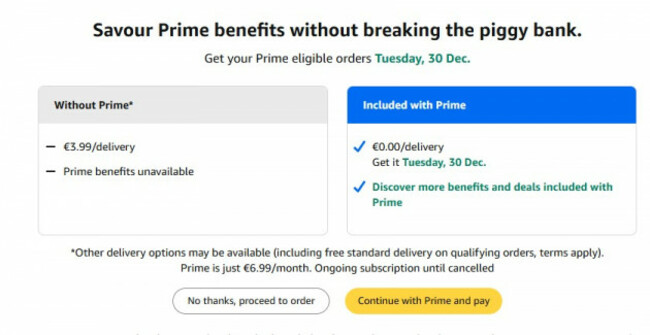
When Irish customers go to buy something from Amazon, the design of the checkout – including the choice of colours and the language used – encourages signing up to a Prime membership while making a purchase.

Opting into Prime is presented as “continuing”, whereas opting to buy something without signing up for Prime counterintuitively requires clicking on “no thanks”.

amazon prime screenshot Screenshot of the Amazon.ie checkout encouraging Prime sign-up. Amazon Amazon

In September, the US Federal Trade Commission fined Amazon a $1bn penalty – as well as requiring $1.5bn in refunds – after settling allegations that Amazon enrolled millions of consumers in Prime subscriptions without their consent and knowingly made it difficult for them to cancel.

The FTC said Amazon had used “sophisticated traps designed to manipulate consumers into enrolling in Prime” with confusing and deceptive user interfaces. After this settlement, Amazon can no longer have a check-out button it used to have that said “No, I don’t want Free Shipping”.

Ireland’s CCPC told us it was contacted by eight consumers who had problems trying to cancel Prime subscriptions in the first eight months of this year. The CCPC receives about 45,000 contacts per year.

The Journal wanted to see how things are working out with the new Amazon.ie, so we signed up to Amazon Prime from two separate email addresses, bought books and immediately cancelled the accounts.

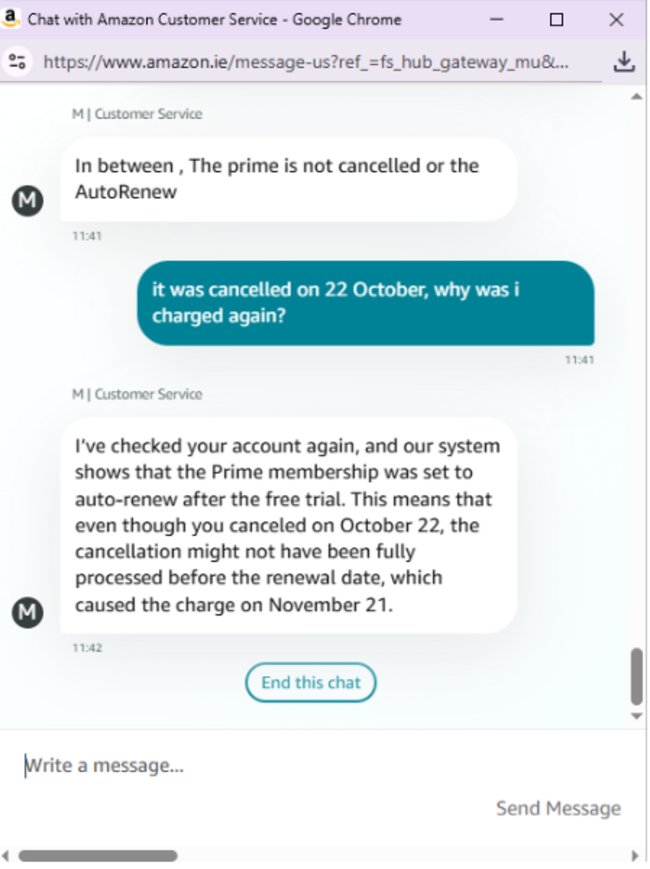
One of these cancellations was immediately processed – but the other was not, and the €6.99 subscription charge was debited after the one-month free trial elapsed. No notice of this charge was given.

When we contacted Amazon customer service, an agent admitted the cancellation had not been processed when it was first requested. Amazon refunded the €6.99 after the charge was queried.

image001 Amazon customer service confirmed the cancellation was not processed. Amazon Amazon

Amazon told us its Prime sign-up and cancellation processes are “clear and simple by design” and customers cancel at any time with “just a few clicks”. It said its customer service is available 24/7 by phone, email or chat and it sends “clear confirmation emails” before renewal.

“In the rare instances where a technical issue occurs, we work quickly to correct it and ensure the customer is not charged,” Amazon said.

In relation to the US Federal Trade Commission settlement, Amazon said the company and its executives have always followed the law and the the settlement allowed it to “move forward and focus on innovating for customers”, to whom it said Prime offered “substantial value”.

Readers like you are keeping these stories free for everyone...
A mix of advertising and supporting contributions helps keep paywalls away from valuable information like this article. Over 5,000 readers like you have already stepped up and support us with a monthly payment or a once-off donation.

Close
88 Comments
This is YOUR comments community. Stay civil, stay constructive, stay on topic. Please familiarise yourself with our comments policy here before taking part.
Leave a Comment
    Submit a report
    Please help us understand how this comment violates our community guidelines.
    Thank you for the feedback
    Your feedback has been sent to our team for review.

    Leave a commentcancel

     
    JournalTv
    News in 60 seconds