Sign in. It’s quick, free and it’s up to you.
An account is an optional way to support the work we do. Find out more.
Sign in. It’s quick, free and it’s up to you.
An account is an optional way to support the work we do. Find out more.

YOU COULD ALWAYS read a list of Oscar winners the morning after the awards show, but you’d miss out on the live thrill of watching winners take the top honors.
At their best, Oscar acceptance speeches are emotional, entertaining performances that express the true character of the people behind the year’s best films.
Representatives of Toastmasters International, a public speaking organization with over 14,650 clubs spanning 126 countries, went through hundreds of Oscar acceptance speeches and narrowed the list down to the six they found most memorable. They considered many more, but decided to focus on the past two decades.
Their criteria included the expression of personality, graciousness, excitement, modesty, and a practiced delivery.
We spoke with Dilip Abayasekara, former international president of Toastmasters, to explain what makes each of these speeches so exceptional.
Gooding may be the only person to have turned the Academy’s orchestra music from an uncomfortable signal to slink off stage into a triumphant, movie-like soundtrack. His speech has become beloved for the barely restrained joy behind it, but channeled through appreciation of everyone who made his role possible.
“I like to call what he was showing ‘pure love energy,’” Abayasekara says, laughing. “He was himself, not an actor.
Affleck and Damon, in their mid-20s, were still relatively new to Hollywood, which made their excitement and energy all the more enjoyable to see, especially since they were so naturally playing off each other on stage.
Abayasekara says that their speech stands out for the way they mention the role that each person they thank played in their lives, rather than just listing off names.
Williams, breathless with emotion, exhibits the sincerity, humor, and “winsome enthusiasm” that made him such a likeable actor, Abayasekara says.
This speech, for his first Oscar, is remembered as one of the most heartwarming.
Benigni got an ovation before he even arrived on stage.
“He spoke with his whole body,” Abayasekara says. Benigni used sweeping gestures and poetic language of appreciation to let the audience know how grateful he was to them for having embraced him. “He exhibits that which he applauds,” Abayasekara notes.
Abayasekara enjoys contrasting Streep’s speech with Benigni’s. “It’s much quieter. She shows you don’t have to jump all over the stage” to express excitement, he says.
Streep takes her time with her speech, and pauses as necessary when she gets choked up with emotion. “You want emotion to drive the speech, not detract from the delivery,” Abayasekara says, which is exactly what Streep pulls off.
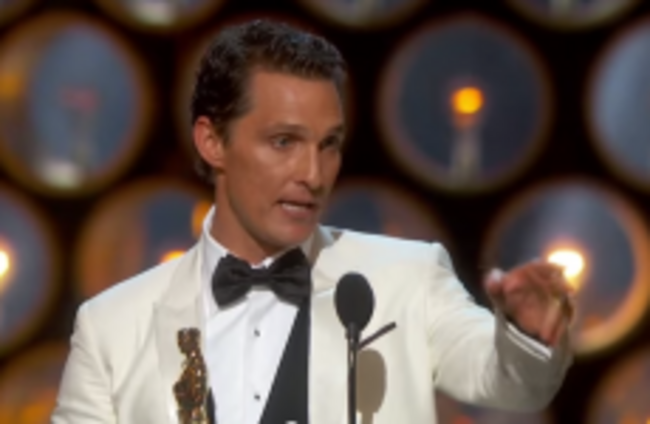
“This is definitely the best structured one,” Abayasekara says. McConaughey’s speech suggests practice and focus, and is a rare speech with a defined beginning, middle, and end.
With a combination of passion and humor, McConaughey fearlessly talks about the role his faith and personal relationships have had in his life, and he ends his speech with his signature “Alright, alright, alright,” which Abayasekara says is like an in-joke with the crowd that concludes winning them over completely.

To embed this post, copy the code below on your site








have your say