Sign in. It’s quick, free and it’s up to you.
An account is an optional way to support the work we do. Find out more.
Sign in. It’s quick, free and it’s up to you.
An account is an optional way to support the work we do. Find out more.
LAST UPDATE | 1 Mar 2025
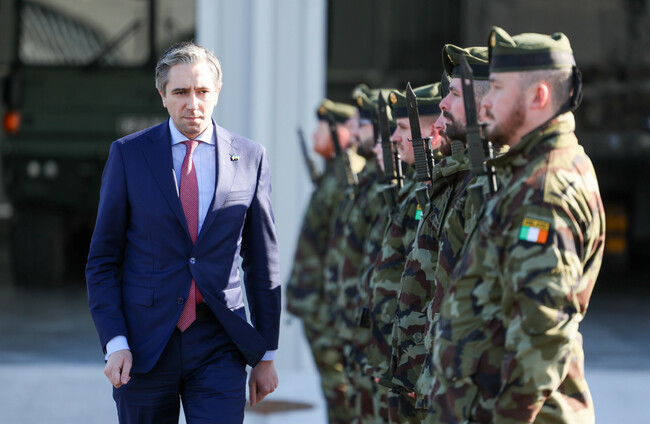
THE TÁNAISTE HAS said that Irish troops will not participate in a peacekeeping mission in Ukraine if it would put them in a situation where they would have to fight to enforce the peace.
Speaking yesterday afternoon in The Cadet School in The Curragh Camp, Simon Harris, who is Minister for Defence, Trade and Foreign Affairs said that his Government would not support sending Irish soldiers to a mission in which they would have to engage combatants.
“We very much would see our roles as we generally do in this space of peacekeeping, not peace enforcement,” he said.
The Tánaiste’s comments come before the bitter row between Donald Trump and Volodymyr Zelenskyy at the White House yesterday.
It is understood that behind the scenes European preparations for a peace mission would involve a phased approach – moving from an initial deployment, observer and then military boots on the ground.
As examined by The Journal there are a number of possible approaches for Ireland in such a mission including small detachments to larger amounts of soldiers and vehicles.
Ireland’s deployment of troops is governed by the Triple Lock system which means there must be a United Nations Security Council resolution, agreement of the Cabinet and a vote in the Dáil.
There are generally two types of peacekeeping missions under the UN Charter – the first is Chapter Six which is known as peacekeeping or stabilisation and observation.
The second option is Chapter Seven which is much more robust and is known as peace enforcement.
This would see soldiers essentially with the clearance to fight to maintain a ceasefire or peace agreement.
Irish troops in Lebanon under the UNIFIL mandate do not have the power to fire on combatants except in very strict self defence scenarios.
The Defence Forces has been in robust and dangerous peacekeeping missions in Africa and the Middle East but their role has generally been to monitor.
Harris explained that it was too early to determine how a mission would look in practice as Russia and Ukraine are continuing to trade fire. He said that he has seen no signals that would suggest that Vladimir Putin is interested in making a peace deal.
The Tánaiste said that Putin and Russia are continuing to bomb civilian targets and “that doesn’t look to me like a person is looking to make peace”.
“Our immediate focus as a government and as members of the European Union is to constructively contribute to the conversation about what peace looks like.
“We’re very clear that peace has to take place in a context that’s respectful of the UN Charter. Nothing about Ukraine without Ukraine, indeed, nothing about Europe without Europe on the peace keeping element.
“We don’t believe we should recuse ourselves from that conversation if, and there is a lot of ifs, if you got to a point where there was a peace agreement and a cessation of violence, and there was a requirement to have peacekeepers.
“So that’s something that the government is open to engaging on, but within the parameters that are already laid out in terms of the traditions of Oglaigh na hÉireann,” he added.
UK prime minister Keir Starmer is to hold a summit tomorrow with more than a dozen European to “drive forward” action on Ukraine and security.
Ahead of the main summit, Starmer will chair a morning call with Baltic nations, before welcoming Ukrainian President Volodymyr Zelenskyy to Downing Street to discuss the war with Russia.
Leaders from around continental Europe including France, Germany, Denmark and Italy as well as Turkey, NATO and the European Union have been invited to the summit in London later on Sunday, his office added.

To embed this post, copy the code below on your site











have your say