Sign in. It’s quick, free and it’s up to you.
An account is an optional way to support the work we do. Find out more.
Sign in. It’s quick, free and it’s up to you.
An account is an optional way to support the work we do. Find out more.
(Seo alt ónár bhfoireann Gaeltachta. Is féidir an bunleagan as Gaeilge a léamh anseo)
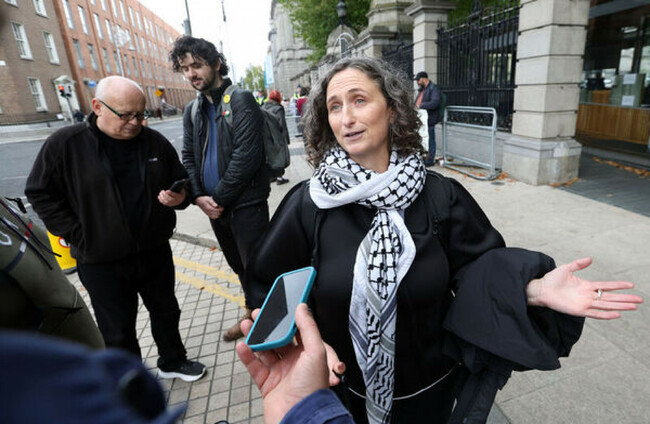
THE QUESTION OF Irish language interpreters in the European Union has been brought to the fore again following a widely reported incident in which Sinn Féin MEP Lynn Boylan was speaking before a parliamentary committee.
Irish became a full working language of the EU in 2022 but its practical use across EU instititutions faces difficulties. MEPs voted on a derogation in 2024 which would postpone the availability of Irish language interpreting and other services until at least 2029.
However, for the duration of Ireland’s Presidency of the EU Council, a special agreement is in place and Irish language interpreters have been hired on a temporary basis.
This agreement facilitates the availability of Irish language interpreters for committee meetings of the EU Parliament when an Irish minister is present and for summit meetings in Ireland.
The uncertainty over when interpreters are available was highlighted at the EU Foreign Affairs committee meeting which was attended by Helen McEntee, the Minister for Foreign Affairs and Trade. Lynn Boylan opened her contribution to the committee with the statement:
“Go raibh maith agat a Chathaoirligh agus maidin mhaith a aire, it’s unfortunate that we can’t use our own language in this committee but I will continue now in English.”
The chairperson then told her she was able to speak in Irish – something that took Boylan by surprise, who said: “Ah, okay, we didn’t know, so I’ll continue in English because I wasn’t prepared.”
Video footage of the incident has been viewed across the world – it is said to have received more than 7 million views, with that number continuing to grow.
Boylan told The Journal that language activists had raised the question of the derogation with Sinn Féin and the party supported their demand for the abolition of the derogation.
Boylan said it had been unclear to them whether Minister Helen McEntee would be present at the meeting, as Sinn Féin believed she was due to attend three meetings in Brussels that day.
The MEP explained that there had been mixed messages about whether interpretation would be available at the meeting at which the video was made, and that she had been told that a request for that service had definitely not been received for one meeting.
“I was not trying to have a go at the Minister,” she said. “We were making the broader point that we should be able to speak in Irish at committee meetings.
“I am very embarrassed about what played out.”
She also explained that, since speakers have only two minutes to speak at these meetings, she would have had to have her statement prepared in advance – whether in English or in Irish – and that it was far from easy to translate that statement into Irish on the spot.
While some believe the incident has done damage to the effort to have interpretation services made permanently available, Fianna Fáil MEP Cynthia Ní Mhurchú said the incident and the furore it sparked had pushed the question of interpretation services to the fore.
“This has drawn attention to Irish,” said Ní Mhurchú. “What the Government [of Ireland] has done is not only to say that Irish is critically important and is the official language but they have put in place this temporary plan – whether it is as weak as it is, or as strong as it is – at the very least they have done something.
“Please God, I very much hope that this will plant a seed growing that means the Taoiseach and the Tánaiste will put as much pressure as possible on the interpretation service out here during these six months and afterwards to bring an end to the derogation.”
In a response from the Department of Foreign Affairs and Trade, which has responsibility for Ireland’s Presidency of the EU Council, no direct answer was given to the question of whether Irish language interpretation would be available when the Presidency comes to an end on 31 December of this year.
“This is Ireland’s first Presidency since Irish gained equal status with the other 23 official languages,” said a spokesperson for the Department.
“In the first weeks of Ireland’s Presidency, Irish has been used, promoted and celebrated as an official language of the European Union and the Government has a firm resolve to continue this practice.”
Referring to interpretation, the spokesperson said the Department had followed best practice by signing an agreement with the EU Directorate responsible for interpretation and under this, it was agreed that the service would be available at informal Ministerial meetings of the Presidency and at summits in Ireland.
“In relation to Irish interpretation in the European Parliament, the issue is raised on a regular basis within the Parliament, at both official and political level.
“The number of Irish interpreters being increased across all EU Institutions, including the European Parliament, is a priority for the Government and is part of a wider effort to expand the number of Irish officials in the EU as part of the ‘A Career for EU’ strategy launched by Minister Thomas Byrne.”
The Journal has sought further clarification on the Government’s plan to ensure the continuation and expansion of interpretation when Ireland’s EU Presidency comes to an end.
The Journal’s Gaeltacht initiative is supported by the Local Democracy Reporting Scheme.

To embed this post, copy the code below on your site













have your say