We need your help now

Support from readers like you keeps The Journal open.

You are visiting us because we have something you value. Independent, unbiased news that tells the truth. Advertising revenue goes some way to support our mission, but this year it has not been enough.

If you've seen value in our reporting, please contribute what you can, so we can continue to produce accurate and meaningful journalism. For everyone who needs it.

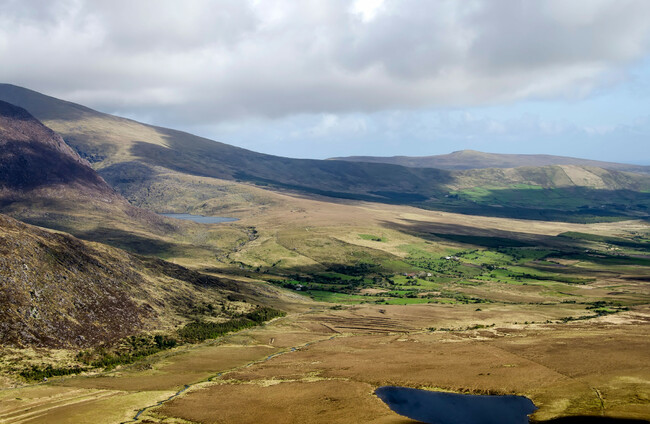
Conor Pass is the highest mountain pass in Ireland, Dingle Peninsula. Alamy Stock Photo

Ireland's national parks Our Nature Restoration Plan faces a reality check

Ambitious EU targets are coming — but without stronger laws, staffing and standards, the State risks failing to restore the land it already owns, writes Pádraic Fogarty.

LATER THIS YEAR, Ireland will submit its draft Nature Restoration Plan to the European Commission for approval.

The Plan, a requirement of the Nature Restoration Law passed in 2024, is expected to include area targets for the restoration of a number of habitat types, such as old oak forests, flower-rich grasslands and marine reefs.

For the first time, these objectives come with binding deadlines which must be reached first by 2030, then 2040, and with all habitats and species in need of restoration in good condition by 2050. It is an exciting challenge for the country.

After an intense battle with farming organisations, many of whom wanted the law to be scrapped, the government agreed that the drive between now and 2030 will be focused on public land. Farmers are off the hook, at least in the short term.

Ireland’s not so green isle

Ireland is unusual in that the State owns relatively little of the land (although it owns all of the seabed in our territorial waters), only about 8.5 per cent in fact, with most of this Coillte plantation forestry.

Fewer than 1,000 km2 fall within National Parks, but this figure has been increasing in recent years. The National Parks and Wildlife Service (NPWS), the agency responsible for nature conservation, reports that the State bought 3,614 hectares between 2020 and September 2025 across 16 counties, with a sharp increase from 2023.

In December 2025, it was announced that 40.5 hectares of land were purchased to greatly increase the size of the Glen of the Downs Nature Reserve in Co. Wicklow, to expand its oak forest.

In taking this approach, Taoiseach Micheál Martin is making good on his promise in early 2023 that the State “must purchase land for native woodlands and for simple rewilding at its most basic because the biodiversity challenge is so crucial”.

More recently, the Minister of State for Nature Christopher O’Sullivan told TheJournal.ie that he wants to “significantly” expand the number of national parks and nature reserves and is eyeing a target of 10,000 hectares of new purchases every year.

The way forward

By directly owning the land, he said that the NPWS “can decide what measures we take without having to necessarily consult with private land owners… So, we can make a real difference”.

Speaking to RTÉ in March, he added that he wanted to go further by “acquiring” land from State bodies such as Coillte and Bord na Móna, saying that this transfer of responsibilities between agencies “makes sense”.

Bord na Móna is already restoring 33,000 hectares, less than half, of its 80,000-hectare holding. Coillte, meanwhile, manages a vast estate of 440,000 hectares, much of it on peatlands in the west of Ireland, not suitable for commercial forestry. These degraded lands are ripe for restoration.

The appearance of the State on the land market is not universally popular. The Irish Natura and Hill Farmers Association has called on the government “to immediately cease all plans associated with the purchase of hill lands”, claiming it was discouraging young farmers from entering the sector, which it said was “galling”.

This is a misstep from the farm organisation. Their staunch opposition to the Nature Restoration Law is what is driving the need for nature restoration on public land and diverting funds that might have gone to young farmers who wanted to get into the ‘business’ of nature restoration.

National Parks, most of which are in remote rural settings, are leading drivers of the local economy; money spent on nature restoration is frequently employing local people directly or local contractors, not to mention the important tourism income it attracts.

A recent Seanad debate on national parks showed that most counties want one of their own. Senators called on the government to create one for the Midlands region, Kildare, the south-east or Cork, areas which are all currently deprived of one.

Minister O’Sullivan is no doubt buoyed by this popular support, which is coming on the back of a broader increase in capacity of the NPWS started by his predecessor, the Green Party’s Malcolm Noonan.

However, he has also noted that “there’s no point in creating a national park for the sake of it, it has to have meaning” and he wants to introduce legislation to back up the label.

What makes a national park?

Currently, the government can call any bit of land or sea a national park with no obligation to meet standards or provide resources.

This has been particularly obvious two years on from the declaration of a new national park on and in the waters around the Dingle Peninsula, with continued sheep grazing and peat extraction on the land at the Conor Pass purchased by the State.

In January, a report from the Marine Institute showed that hundreds of protected grey seals are drowning in fishing gear in the marine part of it. While there are good things happening in many of our national parks, so far, the high-profile announcement of Páirc Náisiúnta na Mara Ciarraí has not delivered anything for nature.

Passing a law to give legal backing for national parks has been government policy since 2002 and is a commitment in each of the four National Biodiversity Action Plans published during this time. Last August, the minister for Housing, Local Government and Heritage, Fianna Fáil’s James Browne said that passing legislation was a “priority” for his department (which oversees the NPWS), but a report from the NPWS in December last admitted that the process “had not yet started”.

Meanwhile, the same report says that long-promised management plans for national parks remain “behind schedule”. Too often, the condition of our national parks and nature reserves is not known because proper surveys have not been carried out, or are overrun with sheep, goats, deer or invasive plants, while no clear goals or objectives have been set for them.

Staff shortages hinder progress even where funding is available for projects, while communication with local communities and the public remains poor.

So, while it is positive that the government wants to expand national parks, it has yet to demonstrate that it is capable of managing the land it has to the high standards needed if nature is really to be restored.

This is important as private landowners, who own most of Ireland, and who will eventually be called on to participate in nature restoration, are unlikely to get on board if the State cannot lead the way.

Pádraic Fogarty is an environmental campaigner.  

Readers like you are keeping these stories free for everyone...
A mix of advertising and supporting contributions helps keep paywalls away from valuable information like this article. Over 5,000 readers like you have already stepped up and support us with a monthly payment or a once-off donation.

Close
4 Comments
This is YOUR comments community. Stay civil, stay constructive, stay on topic. Please familiarise yourself with our comments policy here before taking part.
Leave a Comment
    Submit a report
    Please help us understand how this comment violates our community guidelines.
    Thank you for the feedback
    Your feedback has been sent to our team for review.

    Leave a commentcancel

     
    JournalTv
    News in 60 seconds