Sign in. It’s quick, free and it’s up to you.
An account is an optional way to support the work we do. Find out more.
Sign in. It’s quick, free and it’s up to you.
An account is an optional way to support the work we do. Find out more.
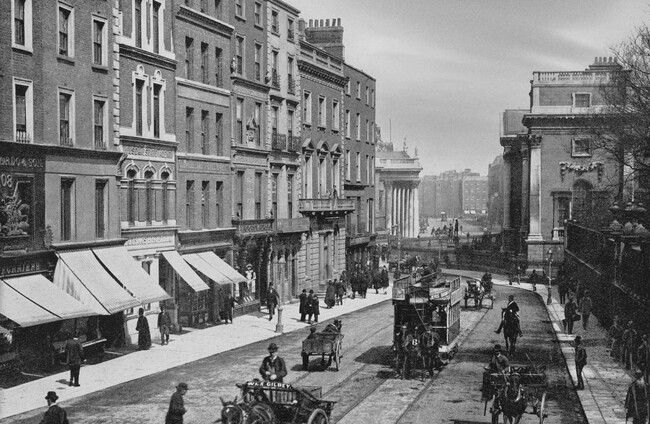

‘There’s something about Christmas. There’s something about it that creeps inside and finds the child in you’ – Barry’s Tea radio ad, Christmas train set, 1994.
CHRISTMAS SEASON ARRIVES earlier every year. At least that’s how it feels, as shops put up their Christmas displays before the curtain has fallen on Halloween.
Still, there’s a comfort in the arrival of the traditions that belong only to those short few weeks leading up to 25 December, from the first Christmas song of the season and the revival of beloved TV and radio ads to the eagerly awaited arrival of Santa in the shopping centres and towns around Ireland.
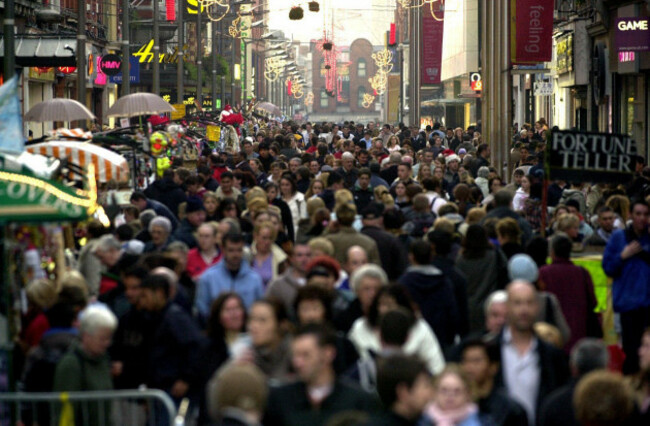
This year the Dictionary of Irish Biography (DIB) — one of nine research programmes in the Royal Irish Academy — is celebrating Christmas through the ages, so put on your Rudolph pjs, pour yourself a cup of something festive and enjoy a feast of Christmases past…
If the earliest Christmas celebrations in Ireland largely looked very different to today, some aspects have remained constant: feasting, rest and a sense of renewal as the days start to lengthen once again. Fraternal squabbling too, like the spat between two eighth-century monks – Dublittir, abbot of Finglas, and Máel-ruain (qv), abbot of Tallaght – who disagreed about whether to relax their strict monastic rules at Christmas. Máel-ruain forbid his monks to drink beer, believing it caused forgetfulness of God; Dublittir took what was surely the more popular (and arch) approach of allowing it on the grounds that his monks would get to heaven just as well as those of Máel-ruain.
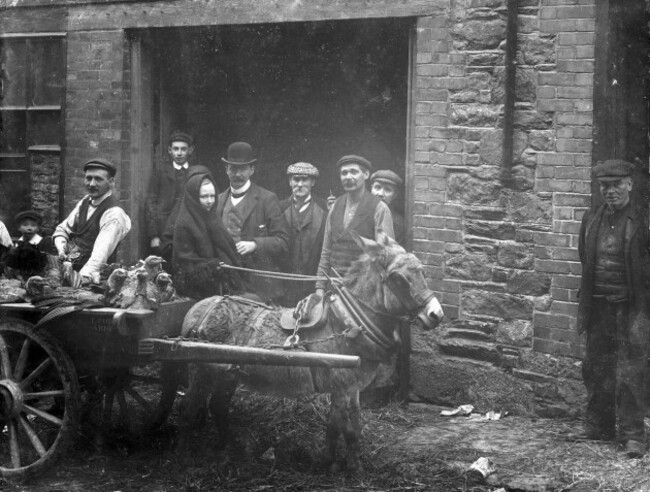
A slightly later account of Christmas in Ireland comes from the pen of Gerald of Wales. His Expugnatio Hibernica (written c.1189) described a feast held by Henry II in a hall specially constructed in Dublin for the occasion: ‘The feast of Christmas was drawing near, very many of the princes of the land repaired to Dublin to visit the King’s court, and were much astonished at the sumptuousness of his entertainments and the splendour of his household; and having places assigned to them at the tables in the hall, by the King’s command, they learnt to eat cranes which were served up, a food they before loathed.’
The addition of cranes to Christmas dinner unsurprisingly didn’t catch on! But the food provided in 1351 by Uilliam Buidhe O’Kelly, king of Uí Mhaíne, would be much more familiar to the modern palate. He invited poets, nobles and the poor to a Christmas feast so large that temporary accommodation had to be built for all the guests.
The meal included beef, pork and oatcakes slathered with butter and honey, and the occasion was so great that it gave rise to the Irish saying ‘cuireadh fáilte Uí Cheallaigh romhainn’ (‘we got the O’Kelly welcome’) to describe generous hospitality.
Two centuries later, a feast hosted by Brian na Múrtha O’Rourke was so impressive that it lived on in the folklore of Co. Leitrim for years after, inspiring the song ‘Pléaráca na Ruarcach’, composed about 1700 by Hugh McGuaran, set to music by Turlough Carolan and later translated into English by Jonathan Swift.
And while turkey has largely replaced goose as the traditional meat served on Christmas Day, other treats and nibbles remain firmly part of the Irish Christmas experience, including tins of USA or Afternoon Tea biscuits from George Jacob’s bakery and Cadbury’s chocolate, supposedly based on the chocolate recipe invented by Sir Hans Sloane in the seventeenth century.
Music has always played an important role in celebrating Christmas, especially Christmas carols. One of the earliest carols written in the English language is found in a fourteenth-century manuscript written by Franciscan friar Michael of Kildare, while the twelfth-century ‘Wexford carol’ is considered one of the oldest surviving in the European tradition – it was re-discovered by musician and historian William Flood at the turn of the twentieth century. According to tradition, this carol could only be sung by men. A Christmas favourite, ‘While shepherds watched their flocks by night’, was written c. 1698 by Dubliner Nahum Tate.
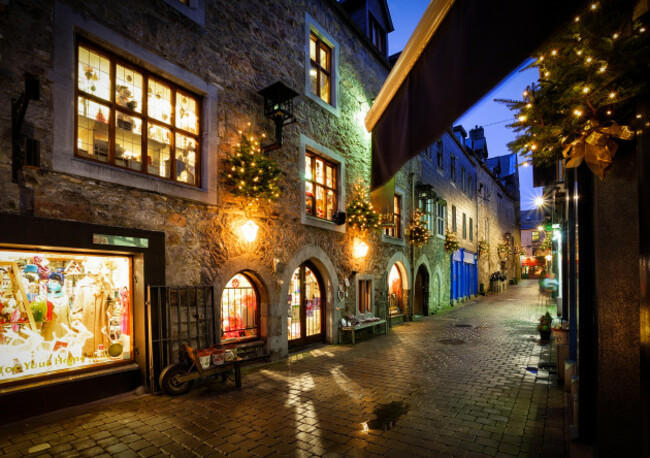
More recently, Christmas has inspired some of pop music’s most recognisable hits. Christmas shoppers browse to the strains of Bing Crosby’s ‘White Christmas’, Mariah Carey’s ‘All I want for Christmas’, Wham’s ‘Last Christmas’ and, of course, the most famous of them all – The Pogues’ ‘Fairy tale of New York’, based on the 1973 novel of the same name by J. P. Donleavy.
Theatre has played a major part in Irish Christmases for centuries, though a seventeenth-century provost of Trinity College Dublin, Robert Ussher, proved himself a precursor to Dickens’ Scrooge when he banned Christmas plays for being frivolous.
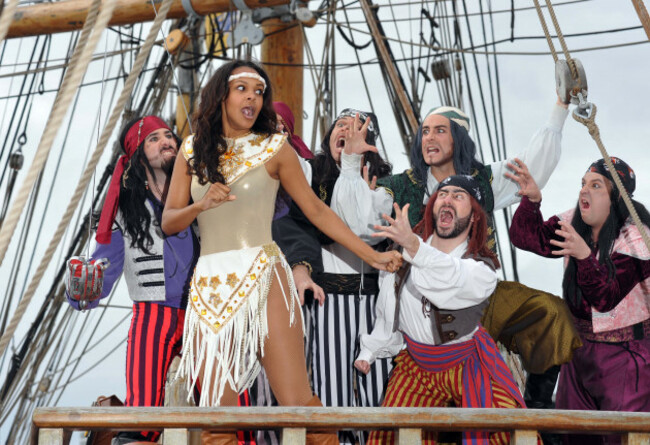
Of course, pantomimes are the theatrical show now most closely associated with Christmas, and Dublin venues such as the Theatre Royal, the Queen’s Theatre and the Olympia and Gaiety theatres have a rich history of staging traditional Christmas ‘pantos’. Since the first modern ‘panto’ was staged in the Gaiety in 1874, people have flocked to watch comedy superstars such as Maureen Potter, Noel Purcell, Harry O’Donovan and Jimmy O’Dea playing the all-important panto Dame.
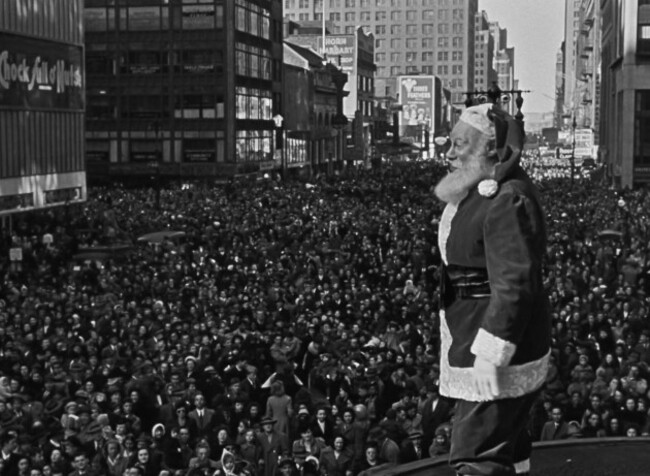
In the latter part of the twentieth century, television and film became a central feature of Christmas, especially in the days before streaming services when the RTÉ Guide Christmas special was pored over for Christmas movies. Classics such as A Miracle on 34th Street (1947) starring Maureen O’Hara, and the musical version of Charles Dickens’ A Christmas Carol (1966) starring Wilfrid Brambell as Ebeneezer Scrooge, are still beloved and are screened annually.
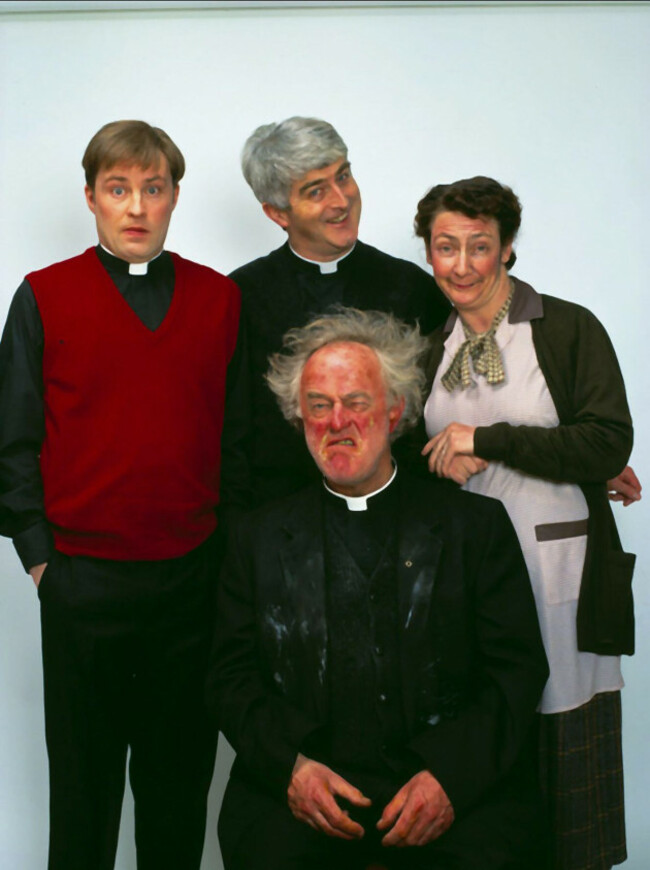
For some however, it isn’t truly Christmas until Dermot Morgan’s Father Ted and Frank Kelly’s (qv) Father Jack have lost their way in the lingerie department of Dunnes Stores; for others, Christmas starts when the Billie Barry kids high-kick their way across the screens during the Late Late Toy Show. Certain ads on television and radio evoke a sense of nostalgia, including ‘Christmas train set’ for Barry’s Tea – one of the longest-running radio ads that was created by Catherine Donnelly and Peter Caffrey of Irish International in 1994.
The Christmas tree is a surprisingly late addition to the Christmas tradition – Presbyterian minister Alexander Porter Goudy is thought to have had one of the first Christmas trees in Ulster, perhaps as early as1857. Time off from work was surprisingly rare too – nineteenth-century businessman Charles Dawson prided himself on being an employer who allowed his workmen to take Christmas Day off.
And of course, before the store’s demise, no Irish Christmas was complete without a trip into Dublin city on 8 December to visit Santa and see the Christmas window in Switzer’s flagship store on Grafton Street.
Nollaig shona daoibh go léir.
Go Deeper…
ESB advertisement, ‘Going home’ (1980s)
Penney’s Christmas TV ad (1990)
Barry’s Tea, Christmas train set radio advertisement (1994)
An Post, Walking in the air Christmas TV ad (2005)
Guinness Christmas TV Ad (c. 2011)
Laura Marriott, ‘Pantomime’, History Ireland, 29:3 (May/June 2021)
Niamh Wycherley, ‘Christmas in Medieval Ireland’, Maynooth University, Spotlight on Research blog (2022)
Dr Niav Gallagher is a medieval historian. The Dictionary of Irish Biography (DIB) is one of nine research programmes in the Royal Irish Academy and Niav joined the DIB team in 2018, researching and writing biographies as well as curating the database of prospective DIB entries. Niav is co-editor of Irish lives in America (RIA, 2021), a collection of fifty biographies of Irish emigrants to the US, with Liz Evers.
To embed this post, copy the code below on your site









have your say