Sign in. It’s quick, free and it’s up to you.
An account is an optional way to support the work we do. Find out more.
Sign in. It’s quick, free and it’s up to you.
An account is an optional way to support the work we do. Find out more.

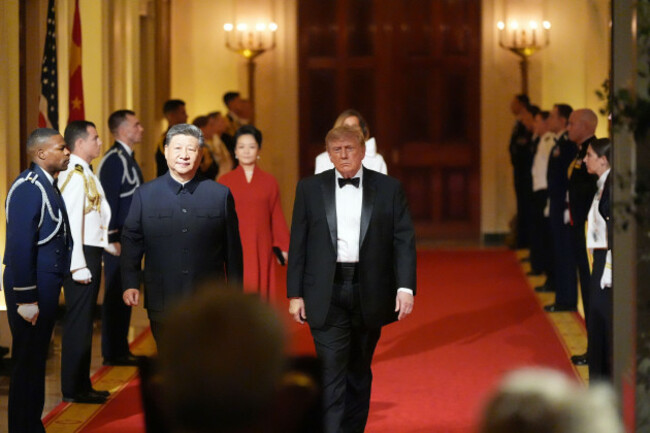
THERE WERE LOTS of champagne corks popping during US President Donald Trump and Chinese Prime Minister Xi Jinping’s asymmetric bromance last week.
But where’s the beef?
Trump’s fawning over Xi, proudly showing him his new helicopter pad and inviting him for a sneak preview of his new ballroom was excruciating to watch. Never mind the palpitations at the Pentagon, following his US Ambassador David Perdue’s claim that Trump offered to sell US military hardware to China.
Xi, inscrutable and unyielding, offered nothing in return. No commitment to stop backing Iran, no commitment to buy more US goods and no agreement on AI that would prevent a latter-day equivalent of a nuclear arms race.
All Trump got was two pandas.
He may be already drooling at the prospect of his next sleepover with Xi, once those pesky November midterm elections are out of the way, but right now Trump is in trouble.
And so are his AI ambitions.
So far this year, Google, Microsoft, Meta, Oracle, xAI, OpenAI and Amazon have spent more than $700 billion (€616 billion) on AI infrastructure. America has almost 5,000 operational data centres with as many again planned or under construction.
But rapid proliferation of data centres has come to a shuddering halt over in a dozen states over the past several weeks, as Republican and Democratic candidates respond to a massive backlash which has turned into a nationwide NIMBY and looming election flashpoint.
More than 70% of Americans now oppose the building of data centres of any size in or near their communities. Urban, suburban and rural Americans of all political hues have done a 180-degree volte-face on the issue.
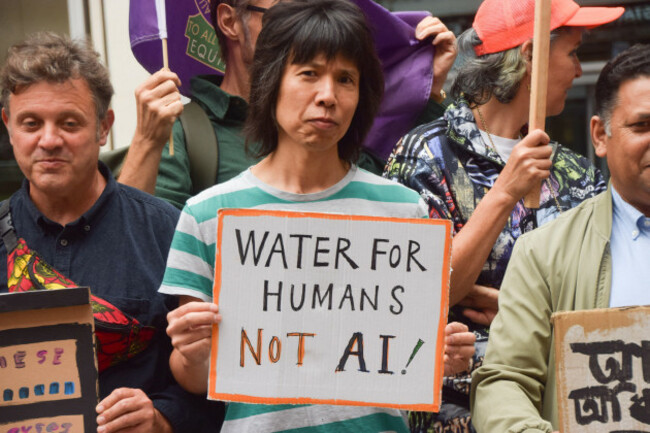
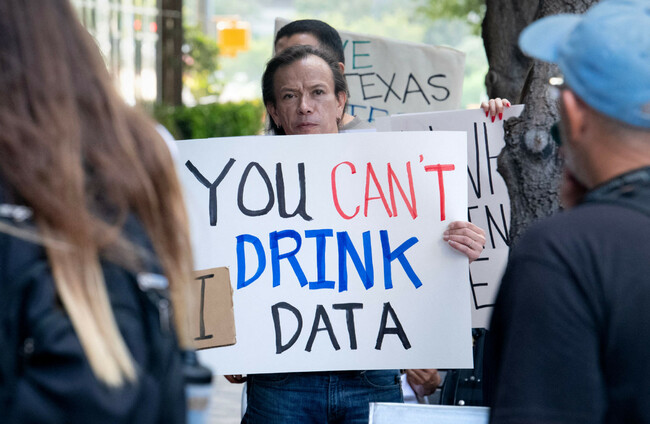
Data centres have become a lightning rod for wide-ranging voter discontent. Republican candidates in red states, including strongholds like Texas and Iowa, are facing down seething constituents who have seen little benefit stemming from the glut of data centres in their states. The promised economic boom failed to materialise. Now fury over soaring electricity bills has cemented an already deep distrust for AI overlords like Elon Musk, Jeff Bezos and Sam Altman.
These avatars of AI prosperity with their super yachts, their petty feuds, and their fascist-adjacent musings – have long since given America the collective ick. Last week, prospective voters witnessed their AI overlords clinking champagne glasses with Trump and Xi in a Grand Guignol tableau of corruption and greed.
Big tech’s ‘magnificent seven’ also control almost all of America’s social and online media platforms and an increasing swathe of its legacy media. Despite their ability to hone the messaging around AI, a mixture of arrogance and indifference has tarnished the brand. What was billed as the next industrial wave, one that would kickstart a new era of American prosperity, is triggering a pitchfork revolution.
Just two years ago, local mayors and city councils were offering tech giants all kinds of inducements and incentives to come build massive data centres in their backyards. Now they’re demanding moratoriums and regulations. And the governors of a dozen states – most of them Republican – are listening.
For American voters, angry and frustrated by Trump’s slew of broken promises, the AI golden goose has morphed into a sinister Trojan horse. Instead of bringing the economic boom and surge in well paid jobs they were promised, local politicians and community activists in two dozen states claim data centres have delivered little other than polluted water, soaring electricity bills and vast eyesores that emit deafening noises and which they claim are responsible for a surge of mysterious illnesses amongst humans and animals in their vicinity.
Yesterday, Mike Johnson, who is all but certain to lose his job as House Speaker after the midterms, claimed the public revolt against data centres is the result of a Chinese psyop. “I really believe that. That’s not a conspiracy theory,” he added for good measure. If it is, apparently no-one told Trump, who might have used last week’s festivities as an opportunity to instruct his buddy Xi to cease and desist rattling the voters cages.

Johnson, as he is wont to do, parroted Trump’s line that introducing a moratorium or imposing new regulations would allow China to gain the edge in the AI race. “We don’t need to jump in and hyper-regulate this because we’ll lose the race to China,” he said.
Two weeks ago, he shrugged off the warnings from Elon Musk, Dario Amodei and Demis Hasaabis that AI was advancing at a faster rate than current human safety frameworks could handle. He responded to their calls for immediate legislation by sending Congress on an extended hiatus, saying he didn’t regard legislative guardrails for AI as an urgent matter. “We don’t need everybody to panic right now,” Johnson responded to tech experts who warned we may be hurtling towards AI-induced human extinction.
You’d think the threat of his imminent political extinction might focus his mind a little, but both the Speaker of the House and the US President have adopted a remarkably sanguine approach to both the AI overlords’ warnings and the public mutiny on the issue.
Not so his fellow Republicans, who are reading the political tea leaves in their constituencies and responding accordingly.
Concerns about the loss of the Senate and House, even by significantly slimmer margins, have prompted candidates in two dozen races across 18 states – most of them Republican – to run television ads calling a freeze on new data centres and new regulations that would force the industry to foot the bill for the massive upgrades electricity companies carry out to accommodate the data centres. A single hyperscale centre, which uses as much power as 100,000 homes. Yet the entire tab is picked householders in most states.
In Texas, which hasn’t elected a Democrat to the Senate or governor’s office in more than three decades, polls are showing that Greg Abbott, whose fourth term as governor was regarded as a foregone conclusion, is neck and neck with a hitherto unheard-of Democratic challenger. In the Senate race, Republican Ken Paxton is facing a more serious challenge from Democrat James Talarico.
Rising prices and the impact of data centres are the animating issues that are making the once unthinkable – a blue wave in Texas – enough of a possibility that Abbott has broken with Trump on the AI issue.
Two months ago, he called Texas, which has 250 data centres in various stages of undress, ‘the epicentre of AI development.’ On Monday, he announced he has frozen all new AI projects while regulators weigh their impact on power and water supplies. This may be a feint to fend off cement his grip on the governor’s office, but it reflects a growing concern about the impact of data centres on the race.
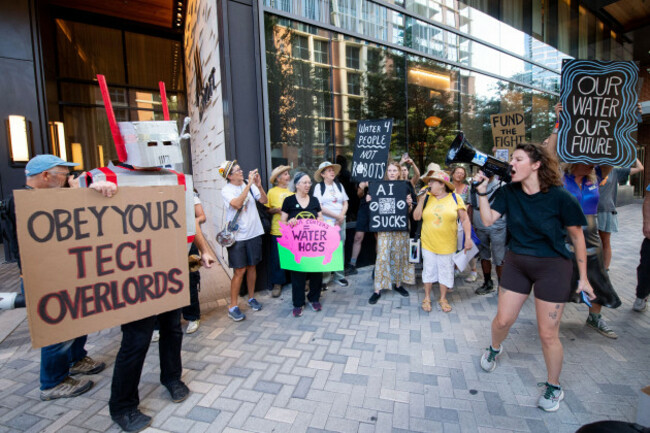
House prices have slumped in data centre adjacent areas in Houston and Dallas because of complaints about noise and air pollution. In Austin, which has 84 data centres within a 20-mile radius of the state capitol, the property market has imploded.
But for all the tax breaks, the disruptions and the soaring electricity bills, between them, they’ve fewer than 1,200 permanent jobs. The tens of thousands of construction workers, most brought in from other areas, came and went, taking the temporary boom in earnings for local long-stay motels and fast-food joints with them.
In Ohio a similar story is playing out. The hinterlands of once great industrial cities like Cleveland are home to 166 data centres with plans for 100 more. Sherrod Brown, a once-popular Democrat who lost his Senate berth in 2024 and is seeking a rematch, has run at least four ads attacking incumbent Republican Jon Husted as “the face of data centres.” Brown’s promise to make operators pay for upgrades their presence demanded is resonating with voters. Senate Republicans have warned that data centres are a “sleeper issue” everywhere.
The Democratic governors of New York, California and Pennsylvania have all imposed moratoriums or regulations, while Republican governors and candidates are promising measures to slow down development and make the data centre owners pay their fair share of water and electricity costs.
It’s unclear what this change of heart means for the industry and whether the pitchfork revolution will burst big tech’s AI bubble.
Trump continues to dismiss concerns as ‘a hoax’ but recent polls suggest a creeping malaise even amongst Republicans; polls indicate that only 47 per cent of registered Republicans strongly approve of Trump, a drop from 71 per cent before the war in Iran.
Most disillusioned Republicans wouldn’t contemplate voting for a Democrat. But they may not bother to vote at all. Low GOP turnout versus high turnout from reinvigorated Democrats and fed-up independents will determine the outcome of the coming elections.
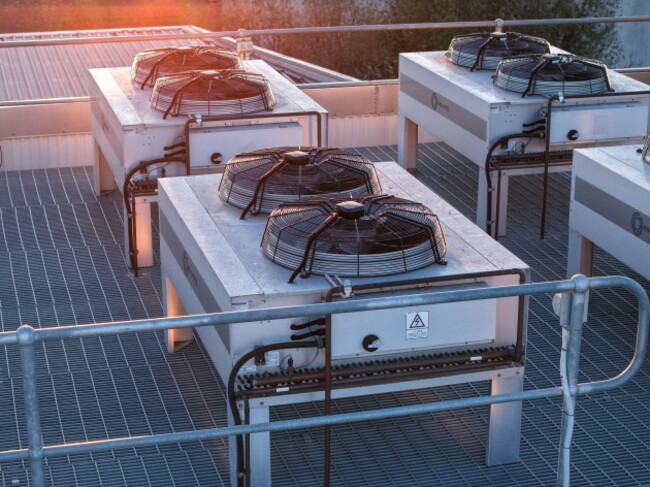
But there are other factors at play here: Trump and Johnson are ignoring one of the main reasons China is poised to eclipse the US. And it has nothing to do with the construction of hyperscale centres. The US has a massive energy shortage problem. Even without data centres draining their resources, big states like California and Texas are no strangers to electricity brown outs and black-outs when a surge in demand for air conditioners during the summer months forces them to power down the grid.
In 2024 alone China invested more than $800 billion (€703.11 billion) in green energy installations, which now account for more than 60% of China’s total installed electricity capacity. China has installed more than 1 terawatt of solar capacity. Solar power has overtaken coal power as China’s main source of energy. Last year it manufactured 16 million electric cars – more than any other country for the 11th consecutive year.
Biden’s advisors factored surging demand for electricity because of the AI infrastructure boom when they unveiled their $1.6 trillion green energy plan which would subsidise the building of a massive renewable energy infrastructure across the US. Trump immediately wiped out more than $1.16 trillion of Biden’s planned investment, cancelling contracts and eliminating tax breaks for the manufacturing and purchase of EVs, solar panels and other clean energy initiatives. In doing so he has hobbled America’s ability to compete with China not just in AI but in a range of manufacturing areas.
Construction is the other big handicap. Most of the promised data centre jobs are generated by the construction of the centres. Hyperscale centres can take more than two years to complete. The smaller ones take as little as six months.
Once they’re up and running, they only require a few dozen specialist staff; network and critical facilities engineers, IT systems administrators, site managers and security staff. Only the latter tend to be recruited locally.
Associated Builders and Contractors which represents around 24,000 contractors, subcontractors and suppliers in the US estimated that it would need to hire an additional 350,000 construction workers to cope with demand. And given Trump’s crackdown on undocumented workers, which account for around one in five of the industry’s labour force, it was a big ask.
An ABC executive privately expressed frustration at Trump’s intransigence on both AI and the ICE crackdown. Here they’re (the White House) saying ‘have at it, go build’ at the same time they’re making it well near impossible (because of deportations).
Marion McKeone is an award-winning journalist, writer and documentary maker.
To embed this post, copy the code below on your site














have your say