Sign in. It’s quick, free and it’s up to you.
An account is an optional way to support the work we do. Find out more.
Sign in. It’s quick, free and it’s up to you.
An account is an optional way to support the work we do. Find out more.
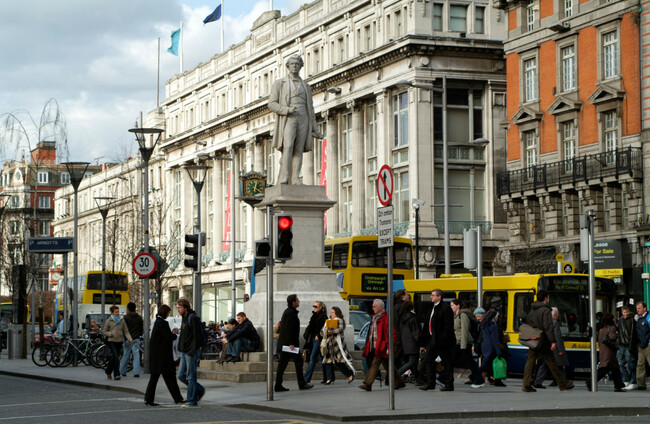

WHEN WE THINK about anti-social behaviour in Dublin, the term “street-involved” describes people whose daily lives involve spending significant time in public spaces — often linked to homelessness or housing instability, reliance on day services, or long-term exclusion from mainstream supports.
They are not a single group, and not all behaviour is the same, but what they share is a greater reliance on public spaces as part of everyday life.
Examples of anti-social and low-level criminal behaviours commonly attributed to this group include gathering in groups, raised voices, fighting, street-based drug use and/or alcohol consumption (Dublin has bye-laws against the latter), low-level drug dealing and aggressive or organised begging.
Their multiple and complex needs do not mean antisocial behaviour should be tolerated; it means that we need to respond to the realities that shape where and how it occurs.
Over the past 25 years working in and around Dublin City Centre, I’ve heard Gardaí refer to a mysterious colleague who never appears on the roster but is familiar to all of them across Dublin — and indeed across Ireland. They call them Officer Rain (in the UK, the phenomenon is known as PC Rain). This colleague is said to be one of the most effective — not because anything has been solved, but because rain reduces how much time people spend in public space.
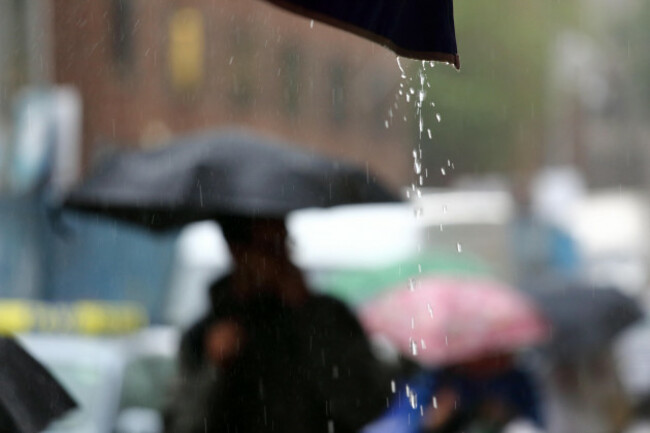
In winter, public spaces empty out; people head home earlier; groups disperse, and time spent outdoors shortens. Antisocial behaviour associated with people who are street-involved does not disappear, but it becomes less visible and less concentrated — not because underlying issues have been resolved, but because cold, darkness and bad weather reduce how long people spend in public spaces. Officer Rain is on the beat.
That does not mean winter is quiet or uncomplicated from a policing perspective. Pressures shift rather than disappear. But one thing happens consistently: reduced visibility means out of sight is out of mind.
Then spring arrives. As the weather improves, people return to public spaces. By summer, Dublin is doing what cities do — busy, shared, social. People linger, meet friends and spend more time outdoors. This applies to everyone, including people who are street-involved.
As summer progresses, the pattern repeats when the sun shines, and visible disorder among people who are street-involved appears to increase — enough to prompt complaints, commentary and unfavourable comparisons with other cities where these things reportedly don’t ever happen.
Media coverage hardens. Political responses follow a familiar script: urgency, reassurance, and calls for more visible enforcement.
What is rarely acknowledged is that nothing sudden has happened. There has been no collapse in standards or values. What has changed is the weather — and with it, how public space is used. Seasonal increases in perceived or actual antisocial behaviour linked to people who are street-involved are not a surprise. And yet each year, many still respond as if caught off guard.
That gap — between what we know and how we respond — is where moral panic creeps in. Due in part to the sheer level of need, we have been unable to address the conditions that shape behaviour — housing insecurity, addiction, mental ill-health and fragmented services — and instead rely on dispersal, enforcement and temporary order. It looks decisive. It feels reassuring. But it does not last.
When winter returns, visibility drops again. The same behaviours recede from view. The same people fade from headlines. And we quietly tell ourselves that things have improved.
They haven’t. They have simply become less visible again.
People who are street-involved are not outside in good weather because they want to cause disruption. Like anyone else, many prefer to be outdoors when conditions allow. The difference is that their options are more limited. Access to indoor, low-threshold, daytime spaces is uneven. Services can be fragmented, time-bound or poorly aligned. The result is predictable pressure on public space — particularly during spring and summer.
‘Capital City,’ the Taoiseach’s Taskforce for Dublin City report, was not just another diagnosis. Crucially, it came with the highest level of commitment to delivery. The time taken to move from report to implementation is not unusual in complex systems — but it can, understandably, lead to a degree of scepticism. The establishment of a dedicated Special Purpose Vehicle acknowledges a long-standing problem: Dublin has never lacked analysis, but it has repeatedly lacked sufficient follow-through.
That is why there is cautious optimism. A structure is now being put in place with a clear mandate to deliver the Taoiseach’s Taskforce and its wider strategy. If it operates with pace and focus, it offers a real opportunity to implement Big Move 5 (chapter five of the ‘Capital City’ report) as intended — as part of a coordinated approach to reducing pressure on public space through better-aligned housing, health and policing responses.
Dublin has produced no shortage of reports recognising these patterns. For decades, those reports have reached the same conclusion: enforcement alone does not work. Problems rooted in addiction, homelessness, mental ill-health and fragmented services cannot be policed away. What distinguishes the ‘Capital City’ report is not novelty, but clarity about where the system is failing.
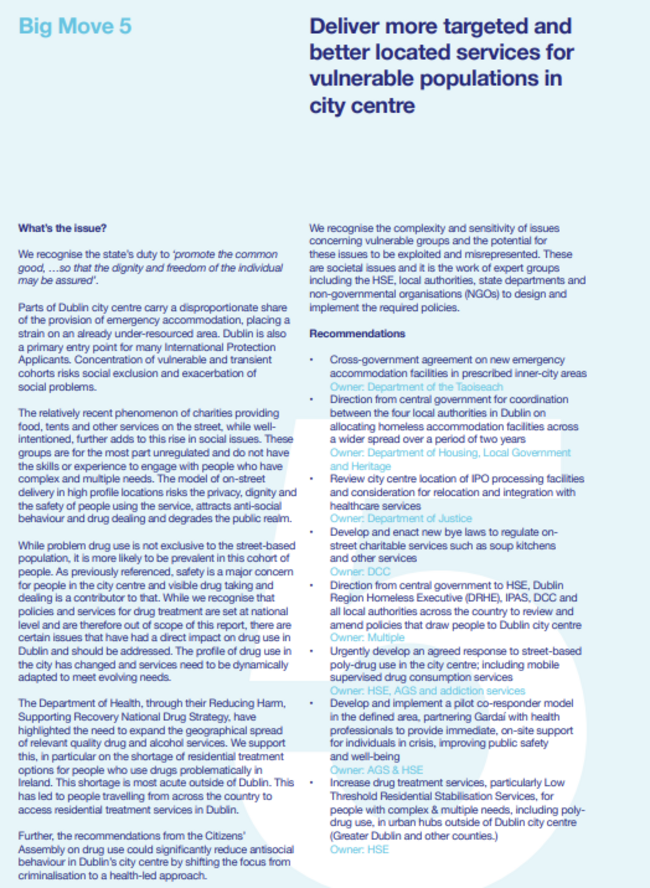
Big Move 5 is explicit that parts of the city centre carry a disproportionate share of emergency accommodation and crisis responses, creating predictable pressure on public space. It also acknowledges that the profile of drug use has changed, with street-based poly-drug use now more visible, while services have struggled to adapt at the same pace.
Rather than defaulting to dispersal or containment, Big Move 5 focuses on system change: a more equitable spread of emergency accommodation across Greater Dublin, closing gaps in low-threshold stabilisation and drug treatment, and deploying health-led responses — including mobile services and co-responder models pairing Garda with health workers. This ensures that people who are street-involved are met with support rather than an endless cycle of visibility and enforcement.
There are also reasons to believe future summers could look different. The focus has now shifted from analysis to delivery, with capacity being put in place to drive the Taskforce’s work. That matters. For too long, Dublin has had no shortage of plans, but no clear engine for implementation.
If this new structure (the Special Purpose Vehicle) does what it is meant to do — align agencies, close service gaps and keep the focus on delivery — it offers a real chance to move beyond the annual cycle of concern, enforcement and reset.
As we look towards 2026, the challenge is not to invent new ideas, but to follow through on the ones we already know work. If Big Move 5 is implemented with intent and pace, Dublin can begin to break the pattern that winter hides and summer reveals.
Tony Duffin is a social policy specialist and public health consultant with over 25 years’ experience working on drug policy, homelessness and harm reduction in Ireland and internationally. He has decades of experience in low-threshold public health responses, previously led frontline services in Dublin city centre, and now works on policy, service development and evaluation in Ireland and internationally.
To embed this post, copy the code below on your site











have your say