Sign in. It’s quick, free and it’s up to you.
An account is an optional way to support the work we do. Find out more.
Sign in. It’s quick, free and it’s up to you.
An account is an optional way to support the work we do. Find out more.
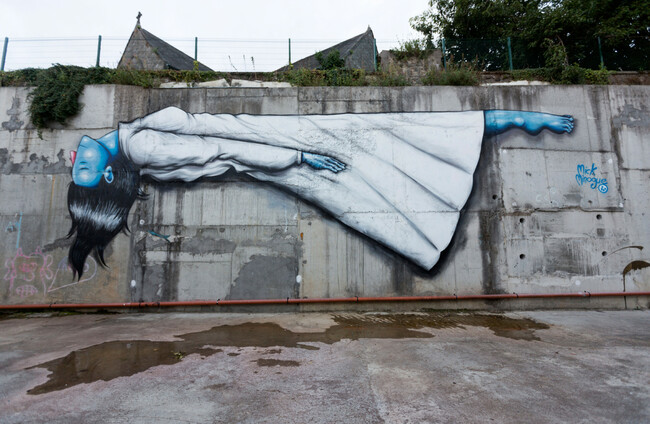

‘But now the wind drops, dust settles;
thereupon
There lurches past, his great eyes
without thought
Under the shadow of stupid straw-
pale locks
That insolent fiend Robert Artisson’
- W. B. Yeats, ‘Nineteen hundred and nineteen’
IN PRE-CHRISTIAN Ireland, four festivals celebrated the changing seasons: Imbolc signalled the beginning of spring and is now celebrated as St Brigid’s Day, Bealtaine marked the start of summer and Lughnasa ushered in the autumnal harvest. Last, but not least, Samhain celebrated the change from the light of summer to the dark of winter.
Samhain was also the time when the barrier between this world and the Otherworld was at it thinnest, allowing spirits to pass through to our realm, where they were appeased with offerings of food and drink.
Traces of Samhain remain in the celebration we know today as Hallowe’en: bonfires, feasting, dressing up and, of course, ghost stories. So, in the words of Bram Stoker’s Dracula, ‘enter freely and of your own will’ and let the Dictionary of Irish Biography introduce you to some of the (alleged!) witches, sorcerers and changelings from our island’s history.
In the last lines of ‘Nineteen hundred and nineteen’, W. B. Yeats conjured an image of the lovelorn Lady Kyteler gifting feathers and cockscombs to the ‘insolent fiend Robert Artisson’.
Yeats knew his history; Alice Kyteler is the first woman known to have been accused of witchcraft in Ireland, in 1324, with ‘Robert Artisson’ the demon she supposedly made offerings to.
Married four times in total, Kyteler was accused of maleficium (the ability to cause harm through occult powers supplied by the devil) by her vengeful stepchildren, who had been disinherited in favour of Kyteler’s firstborn son, William Outlaw, and were convinced that she had used supernatural powers to first beguile and then dispose of her husbands.
After an inquiry by the bishop of Ossory, Richard Ledrede, Kyteler, her son William and ten other Kilkenny men and women were declared sorcerers and heretics.
The group was accused of engaging in rituals that incorporated the skull of a decapitated robber, candles made from human fat and animal sacrifice.
‘Robert Artisson’ was identified as Kyteler’s incubus (that is, that she traded sexual favours with him in return for power and wealth).
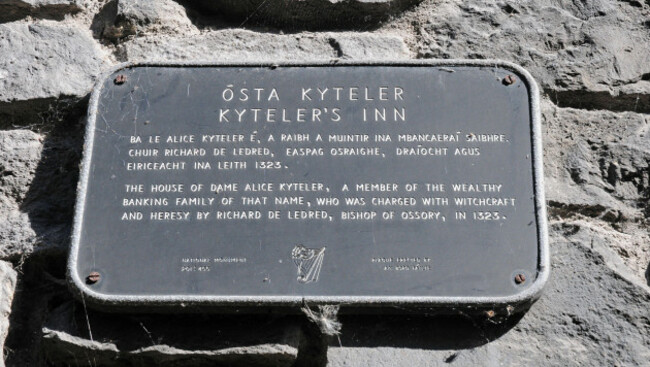
Although Kyteler managed to escape, her maidservant Petronilla de Midia was less fortunate: she was tortured until she confessed to all charges and was then flogged and sentenced to death, becoming the first person in Ireland burnt at the stake for heresy.
Another alleged witch, Florence Newton, was put on trial in Youghal in 1661. Servant Mary Langdon accused Newton of cursing her with a kiss, after which she suffered violent fits and vomited needles, straws and pins.
After several witnesses corroborated Langdon’s story, Newton was imprisoned and then accused of bewitching a man who tried to teach her the Lord’s prayer (it was believed witches couldn’t learn the prayer).
Newton claimed she kissed Jones’s hand in gratitude but on his return home he fell ill and died twelve days later.
On his deathbed he supposedly could muster only enough energy to cry out the name ‘Newton’.
We don’t know the outcome of her trial, though she was probably convicted and either hanged or burned at the stake.
Fifty years later, in March and September 1711, the Islandmagee witchcraft trial took place in Carrickfergus, Co. Antrim. Eight Presbyterian women were accused of bewitching both Ann Haltridge, who died of her enchantment, and then her niece Mary Dunbar.
They were found guilty, and sentenced under the 1586 Irish Witchcraft Act to one year’s imprisonment and four stints in the pillory.
Finally, we have the tragic story of Bridget Cleary from Ballyvadlea, Co. Tipperary. In March 1895, Cleary fell ill with bronchitis and the local doctor and curate were summoned.
The curate came and said Mass, but because the doctor was delayed for several days, Cleary’s husband and father brought the ‘fairy doctor’ Denis Ganey to the house.
Rumours soon began to circulate that the ‘real’ Bridget Cleary had been abducted by fairies and a changeling left in her place.
A group of male relatives and neighbours sought to ‘cure’ her. They doused her with urine and held her over the open fire in the kitchen.
Although pronounced recovered, the following evening Michael Cleary knocked his wife to the ground, violently interrogated her, set fire to her clothes threw oil from the lamp over her, burning her to death. He then buried his wife’s body in a shallow grave some distance from their home.
In the following days, Michael kept up a ‘vigil’ at the nearby ringfort of Kylenagranagh, saying that his wife would ride out from it among a troop of fairies, mounted on a white horse.
When news of Bridget’s disappearance reached the local Royal Irish Constabulary, they quickly investigated and found her body on 22 March 1895.
Michael Cleary was found guilty of manslaughter and spent fifteen years in prison, while Bridget Cleary was buried in Cloneen cemetery by members of the RIC, under cover of darkness, on 27 March; most of her own family were in Clonmel prison at the time.
Hard though it may be to believe, the Witchcraft Act of 1735 remained on the Irish statute books until 2006, when it was finally repealed.
Dr Niav Gallagher is a medieval historian. She joined the DIB team in 2018, researching and writing biographies as well as curating the database of prospective DIB entries. Niav is co-editor of Irish lives in America (RIA, 2021), a collection of fifty biographies of Irish emigrants to the US, with Liz Evers.
To embed this post, copy the code below on your site













have your say