Sign in. It’s quick, free and it’s up to you.
An account is an optional way to support the work we do. Find out more.
Sign in. It’s quick, free and it’s up to you.
An account is an optional way to support the work we do. Find out more.

IN A BBC radio interview in April 1942, John Maynard Keynes recounted a conversation with an architect about plans to rebuild London after the war. The architect was concerned about where the money would come from. Keynes replied that houses are not built with money and asked whether there would be enough bricks, mortar, steel and cement.
The architect replied that there would be plenty of all that, so Keynes asked if there would be enough builders. Again, the architect replied in the affirmative. Finally, Keynes asked if there would be enough architects, conceding that by this point he was ‘trespassing on the boundaries of politeness.’ Even after all this, the architect remained unconvinced, returning to the original question of where the money would come from.
Keynes’s point was that money was not the real constraint at a national level. Houses needed to be built and there was labour available, so the costliest option would have been to leave workers idle. Building would generate economic activity and taxes. And of course, people would get to live in the houses. In a particularly memorable phrase, he concluded that ‘anything we can actually do we can afford.’
The distinction between money and resources is a vital one, particularly because in Ireland, we are in exactly the opposite situation to Britain after the war. As everyone is fully aware, we are awash with windfall tax receipts from the multinationals. In 2014, the corporation tax yield was €4.6 billion. Last year it was €28.1 billion, excluding the receipts from the Apple case.
At the risk of endlessly repeating myself, none of this is sustainable. But that aside, this is exactly the wrong time to be spending the money. It will be almost totally ineffective.
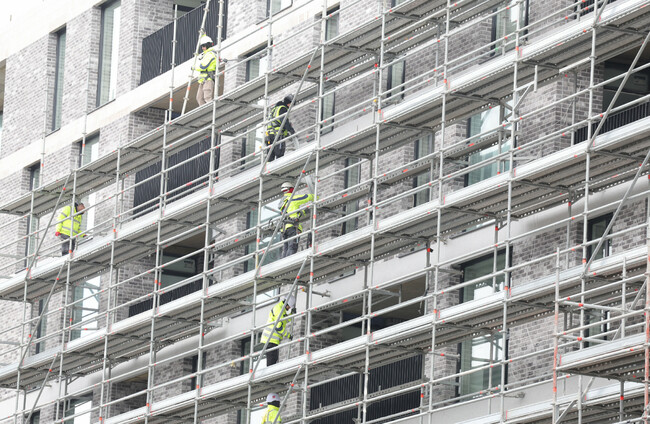
In 2007, there were just over 116,000 people employed in the construction of buildings. By 2013, this was down to just 35,000. This year, it is back up to 81,000, a significant improvement on 2013 levels, but still way below the peak of the last boom. As anyone who has any dealings with the industry will know, it is at capacity.
We could throw as much money into new building projects as we like, but without increasing the number of workers, it would likely just divert activity from other projects. Crucially, it would also push up prices.
The proper time to have built infrastructure and housing here was during the last crash. It would have sustained the industry and been enormously cheaper than doing it now. Similarly, the Fiscal Advisory Council has calculated that Irish infrastructure is about 25% below where it should be for a normal high-income country. This deficit has been accumulated over generations: we have been cutting investment during every downturn since the late 1980s.
People will immediately object that the country had no money during the crash and no way of borrowing more. This is entirely true. But we have abjectly refused to learn the lesson from the last time and have again saved far too little. There is almost exactly the same amount in rainy day funds as when the country entered the bailout. Controlling for inflation and population growth, it is really far less.
Saying we can do so little now is obviously infuriating for hundreds of thousands of people who would like to buy houses that were never built. But pretending that we can do exactly what we want when the tide is in is Ireland’s perennial problem. A lot of our frustrations emanate from this refusal to accept the basic economic reality that building takes resources as well as money. We can either work directly to increase these resources or wait until they become available. Or, of course, we can plough on regardless as we always have in the past.
Unfortunately, the same is largely true for any goods or services we produce at home. Prices have risen dramatically in recent years for several reasons, particularly the Russian invasion of Ukraine and attendant trade sanctions. But another major factor has been that the economy is full of bottlenecks, particularly infrastructure and labour. Any real attempt to reduce prices must tackle these head on. Ironically, given the furore around immigration, approximately 20% of construction workers are migrants. A tighter immigration policy would reduce housing demand. But it would also reduce the capacity of the sector.
There is already plenty of speculation that the Budget will be less ‘generous’ than in recent years.
Instead of thinking about whether Budgets are generous or not, we should finally accept that this is our own money, not something handed to us.
Irish public spending has been pro-cyclical for decades, which has made our booms bigger and crashes deeper. It has also ensured that we get far less for our infrastructural investments. During the last crash, it meant that the construction sector crumbled because state spending evaporated alongside private. If we begin to take these things seriously, we can flatten out the economic cycle and use natural downturns as opportunities to improve our collective lives.
In the same interview, Keynes went on to propose that over twenty years Britain could elevate the dignity of local schools and government buildings to the levels of ancient universities or European capitals, with theatres, concert halls and galleries.
If this sounds expensive, compare it to the cost of leaving tens of thousands of construction workers unemployed for the better part of a decade.
Ciarán Casey is an Assistant Professor in Economics at the University of Limerick. He is author of the ‘Irish Department of Finance, 1959-1999′ and ‘Policy Failures and the Irish Economic Crisis’.
To embed this post, copy the code below on your site















have your say