We need your help now

Support from readers like you keeps The Journal open.

You are visiting us because we have something you value. Independent, unbiased news that tells the truth. Advertising revenue goes some way to support our mission, but this year it has not been enough.

If you've seen value in our reporting, please contribute what you can, so we can continue to produce accurate and meaningful journalism. For everyone who needs it.

Alamy Stock Photo

Ireland's housing targets Too slow, too costly and fuel shocks will make it worse

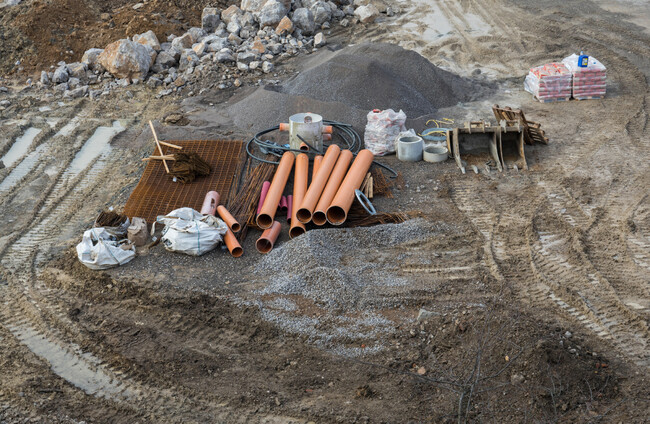
Already slow and expensive, Ireland’s construction sector now has to deal with fuel shocks that promise to delay projects and cut output, writes Dr Paul Davis.

IRELAND’S CONSTRUCTION SECTOR was not in good health before the Middle East escalation; in fact, it is in measurably worse health now.

The question is not whether the current geopolitical shock will affect Irish housing delivery and infrastructure timelines; it already has. The question is whether anyone in a position to act is willing to say so plainly.

The numbers were moving in the wrong direction before the Strait of Hormuz closure disrupted commercial shipping in late February. The CSO’s wholesale price index showed construction materials and wages rising 2.3 per cent year-on-year in January 2026. Concrete blocks and bricks were up 8 per cent.

Chemicals and petrochemicals, the feedstock for insulation, membranes, PVC, and adhesives, were up 21 per cent. The ESRI raised its inflation forecast for 2026 to 3.2 per cent, the highest since the energy crisis of 2022–23, and warned explicitly that conflict-driven construction inflation “could hamper the building of new homes.”

None of this was a surprise to anyone working in the sector. It was, however, apparently a surprise to the policy conversation, which continues to discuss housing targets and infrastructure ambitions as though the cost environment were a background condition rather than the central constraint.

We need to understand that there is a structural feature of construction costs that policymakers consistently fail to internalise. That is, these costs go up easily but always resist coming back down.

After 2008, when house prices collapsed by half, construction costs barely fell. Labour does not un-skill and re-skill freely, and our Supply chains do not reverse. We find that prices by manufacturers stay up once they have been repriced, including energy and input costs. What falls after a shock is activity, not price. You get fewer projects, not cheaper ones.

The impact of fuel cuts

Between 2019 and 2023, construction costs rose by roughly 25 per cent. Almost none of that was given back during the relative stabilisation of 2024–25. The Central Bank noted that Ireland was already “at the higher end of the price spectrum in Europe” for construction costs.

The SCSI’s Tender Price Index acknowledged that the moderate inflation of early 2025 was fragile, and that geopolitical uncertainty had “the capacity to cause fresh supply chain disruption”.

What the current shock does is move the ratchet again. The new floor becomes the baseline for the next disruption. And in a country that imports 79.6 per cent of its energy and all of its oil, every energy-intensive build is structurally exposed.

The timing is asymmetric, and this matters. Contracts already in delivery are locked into yesterday’s cost assumptions. Contractors facing fixed-price agreements will experience margin erosion. They will not collapse visibly; they will deliver defensively. What this means in practical terms is a slower pace, disputed variations and under-resourced sites.

The project gets built, but worse, we get fewer units that run late. Contracts going to tender in the next three to nine months will be priced in today’s risk plus a forward volatility premium. There will be fewer bidders. The cheapest bid should be the most worrying; it will mean that someone has priced the risk away and will claim it back on site over the next three years.

Projects still in design or planning face the starkest problem. We will find that business case costings approved at 2024 prices are already stale. The €275 billion National Development Plan envelope may remain politically intact, but if the same envelope buys less concrete, less steel, and less contractor appetite, real output falls while the ambition stays on the press release.

Large capital projects

The National Children’s Hospital remains the most vivid illustration of what happens when a major public contract meets sustained inflation, design change and contractual dysfunction simultaneously. Originally costed at €650 million, now approaching €2.24 billion with a further €853 million in undecided BAM claims, 3,277 outstanding contractor claims, and an 18th missed deadline. The hospital was supposed to open in 2020. The committee chair now suggests autumn 2027.

MetroLink is entering the procurement market at the worst possible moment. The retrofit programme, intended to insulate Ireland’s homes against energy shocks,  depends on materials whose prices rise every time there is an energy shock. That is not a design flaw, but it is a real tension that nobody in government is addressing.

The discipline of procurement cannot reprice global energy markets or reroute shipping lanes. But it can do several things that are not currently being done well enough.
First, every major public contract should be designed from day one as though a geopolitical or energy shock is possible. This is because in a seven-year infrastructure programme, statistically, there is usually a shock of some sort. That means price variation clauses, shorter fixed-price periods, review triggers linked to materials indices, and supplier financial monitoring so that contracting authorities know when a contractor is in trouble before they stop showing up on site.

Second, the government needs to be honest about prioritisation. The ESRI has said plainly that the economy cannot deliver “so many infrastructure needs in a limited timeframe.” That is polite code for,  you cannot do everything at once at these costs. Pretending otherwise does not produce more houses. It produces more cost overruns.

Third, the NDP needs a public, transparent mechanism for updating cost assumptions in real time. The current practice, in which cost estimates are set at approval and not revisited until a crisis forces reappraisal, is how you get a children’s hospital that costs five times its original estimate and a metro system that has not yet broken ground.

Ireland was already building too slowly and too expensively. The current shock does not create a new crisis. It makes the existing one significantly harder to solve. The least useful response is to pretend otherwise.

Dr Paul Davis is a lecturer at Dublin City University’s Business School. He specialises in supply chain management and procurement.

Readers like you are keeping these stories free for everyone...
A mix of advertising and supporting contributions helps keep paywalls away from valuable information like this article. Over 5,000 readers like you have already stepped up and support us with a monthly payment or a once-off donation.

View 37 comments
Close
37 Comments
This is YOUR comments community. Stay civil, stay constructive, stay on topic. Please familiarise yourself with our comments policy here before taking part.
Leave a Comment
    Submit a report
    Please help us understand how this comment violates our community guidelines.
    Thank you for the feedback
    Your feedback has been sent to our team for review.

    Leave a commentcancel

     
    JournalTv
    News in 60 seconds