We need your help now

Support from readers like you keeps The Journal open.

You are visiting us because we have something you value. Independent, unbiased news that tells the truth. Advertising revenue goes some way to support our mission, but this year it has not been enough.

If you've seen value in our reporting, please contribute what you can, so we can continue to produce accurate and meaningful journalism. For everyone who needs it.

Alamy Stock Photo

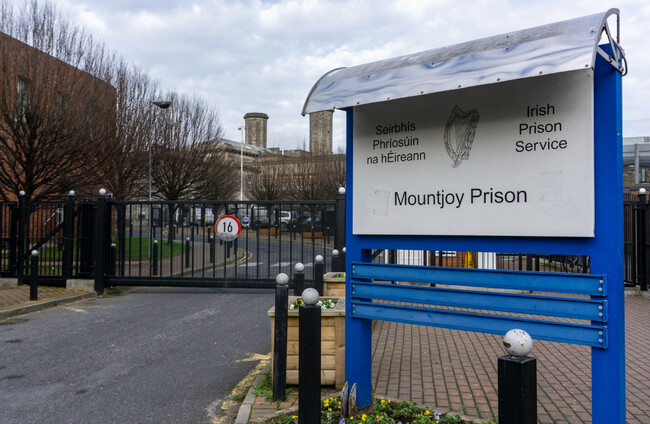
Crime and class Who really ends up behind bars in Ireland?

It’s easy to say ‘lock them up’, but new research exposes how poverty, not just personal choice, is shaping pathways into prison.

I INVITE YOU to imagine an Ireland with no prisons. How does that sit inside you, firstly, as a feeling?

Is it an automatic reaction that this is ridiculous, or a naïve idea? Maybe some people’s first thought is that this is impossible, and where would all the “bad people” go?

What happens if I say a large number of the so-called ‘bad people’ are victims of generations of policies and systems that shaped their experience of life in such a way that prisons are effectively warehouses for underserved and under-resourced communities, and that, without a class system that produces poverty and inequity, the majority of people in prison would never be there? Is it still an impossible task or concept, or even a worthy one?

Now replace that exercise with the suggestion that an Ireland without poverty could be realised. Is there a natural shift in how that feels? The idea of eradicating poverty, from my perspective, has long been the ambition of many across society, regardless of social class. Yet the same people who feel comfortable with the concept of prisons are, on many occasions, the same people who agree with the ambition of an Ireland free from poverty, once, of course, it is not too much at the expense of one’s own power and position.

It’s complicated

So how do we have these conversations side by side or face to face, where we recognise the undeniable link between poverty and prison, and between class and poverty? The data is there, here and around the world, but the conversation can often invoke complex feelings, including fear.

Firstly, I would suggest that it requires us to separate individual behaviour from the structural forces at play that produce the mass incarceration of people from certain communities. I would also suggest avoiding the use of individual transcendence of class systems as evidence of fairness. Think Billy Elliot.

Instead, we should focus on whole class systems and what it will take for entire communities to be free from the consequences and drivers of inequality that ultimately result in the institutionalisation of poverty. I believe we fall into a constant trap in which a working-class individual, through grit and persistence, gains experience outside their peers’ social class, and this is celebrated rather than staying in the collective. These heroes’ stories who leave their class behind are held up as proof that the system works, thus compounding (reinforcing) the idea that the masses simply didn’t avail themselves of the ‘opportunities’ available to them.

The focus shifts from structural inequality to personal success or failure, and this is mirrored in the emphasis on individual behaviour when discussing the drivers of incarceration. The attention given to the individual who transcends class or one who ends up in a prison cell can ease the conscience of a society that continues to reproduce class inequality.

Breaking the class system

Creating this change requires us to confront how class systems operate. The resources of the society are distributed in a grossly unequal manner. A small group controls most of the resources while a large majority fights it out for what’s left. It is important to remember that Ireland once created poorhouses for children whose parents could not afford to care for them. This history reminds us that systems built around poverty are not inevitable; they are constructed and can therefore be dismantled. This may mean a dismantling of one’s own hidden desire to maintain a society that upholds the system that serves them.

Last week, the Irish Penal Reform Trust launched Punishment to Prevention, and while the findings are familiar to our communities and society, now the statistics, evidence and experiences to match the realities are concentrated in one place. I put the report down many times as I sat and read it and thought about the thousands of people who currently sit behind prison walls.

I thought about moral luck, the concept whereby moral judgements are ascribed to people based on the luck and randomness of birth to a particular social class and how this can go on to shape a person’s life. While ending up in prison is not solely determined by class, a point reiterated in the IPRT report, it is the bare truth and clearly evident to say that the majority of people in this moment, and throughout history, who end up in prison are from the social classes and marginalised minorities that are most impacted by unjust structures.

This report by Clare O Connor, socially engaged artist partner Aaron Carey-Sunderland, and peer researcher Robert Cullen takes a closer look at how poverty, deprivation and place shape people’s pathways into, through and out of the criminal justice system in Ireland. The research provides evidence that people from under-resourced communities have a much higher risk of going to prison. Poverty increases the risk of early school leaving, unemployment, trauma, care experience, poor mental health, housing instability and limited access to supports, each of which increases the risk of imprisonment.

As it stands, 70% of people in Irish prisons are early school leavers, with over half being out of school by the age of 15. Take this with the reality that a 1% increase in parents’ experience of poverty leads to a measurable increase in youth offending, and when family economic conditions worsen, offending increases in the same period. What emerges most clearly is a cycle: poverty increases exposure to risk, and once people enter prison, those risks are intensified even more, pushing people further into poverty and creating a vicious cycle of exclusion and victimisation. Despite knowing that prison embeds the cycle of poverty and further criminalisation, 77% of prison sentences are associated with crimes that result in custodial sentences of 12 months or less, with most being from three to six months. Who is this benefiting? Because it is not making our society any safer, and that is, without a doubt, a shared goal of most people from all walks of life.

The illusion of agency

When we talk about agency, we often imagine it as something equally available to everyone. But the reality reflected in this research is very different. Agency is shaped by the conditions people live in. When those conditions include poverty, instability, trauma and exclusion from education and employment, people’s choices are severely limited and what is often framed as individual choice is, in many cases, conditioned by circumstances where there are very few real options, where coping mechanisms such as drug use, and survival strategies to earn money become criminalised in the absence of real alternatives.

Earlier, I spoke of imagining a life in which there was no need to deprive individuals of their liberty. To interrogate that idea, we must allow ourselves to understand what drives offending. This report takes us on a rewind from the overt, literal deprivation of physical liberty to the covert, sometimes hard-to-identify lack of liberty through the constraints of social class and the impact of oppression.

In the words of Ursula K. Le Guin, “We have good reason to be cautious, to be quiet, not to rock the boat. A lot of peace and comfort are at stake. The mental and moral shift from denial of injustice to consciousness of injustice is often made at very high cost”.

Having all the evidence of the injustice of poverty, prison and the class system in one place, as it is laid out in IPRT’s report, is a call to another Ireland. Those within the system and without need to get uncomfortable and make that mental shift from punishment to prevention. It is in that shift where safety and justice will be found.

Lynn Ruane is an independent senator. 

Readers like you are keeping these stories free for everyone...
A mix of advertising and supporting contributions helps keep paywalls away from valuable information like this article. Over 5,000 readers like you have already stepped up and support us with a monthly payment or a once-off donation.

View 36 comments
Close
36 Comments
This is YOUR comments community. Stay civil, stay constructive, stay on topic. Please familiarise yourself with our comments policy here before taking part.
Leave a Comment
    Submit a report
    Please help us understand how this comment violates our community guidelines.
    Thank you for the feedback
    Your feedback has been sent to our team for review.

    Leave a commentcancel

     
    JournalTv
    News in 60 seconds