Sign in. It’s quick, free and it’s up to you.
An account is an optional way to support the work we do. Find out more.
Sign in. It’s quick, free and it’s up to you.
An account is an optional way to support the work we do. Find out more.
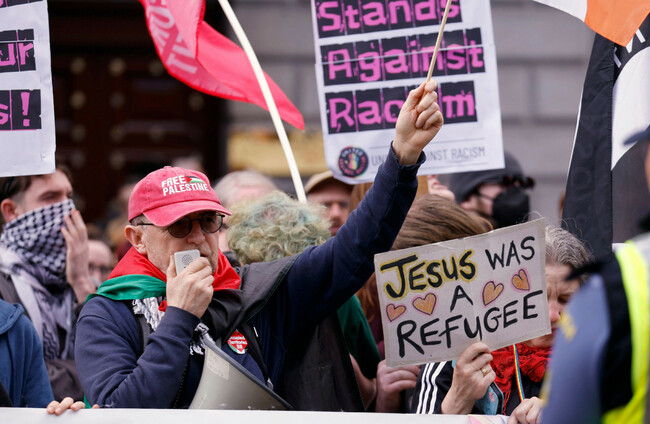

IRELAND ISN’T FULL. There are towns across the country that still haven’t recovered from the famine.
There were 8.2 million of us living on the island in 1841 – so many of us, in fact, that the British government didn’t think it would be too big a deal if a few million starved to death. Our demographics continued to collapse in the years that followed as people moved to places like America, Britain and Australia.
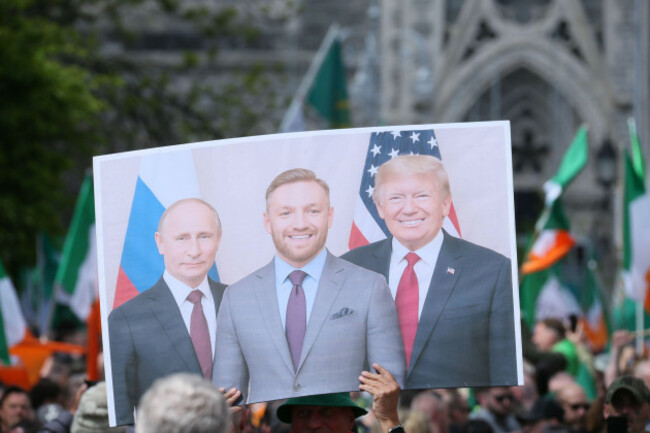
Today, the population of the whole island is still significantly less than it was when we were one of the world’s poorest countries. Now we are wealthier than the wildest poitín-tanged dreams of our ancestors. But rather than have an intelligent conversation about how our resources should be distributed, figures like Conor McGregor seek to spread disinformation and hate.
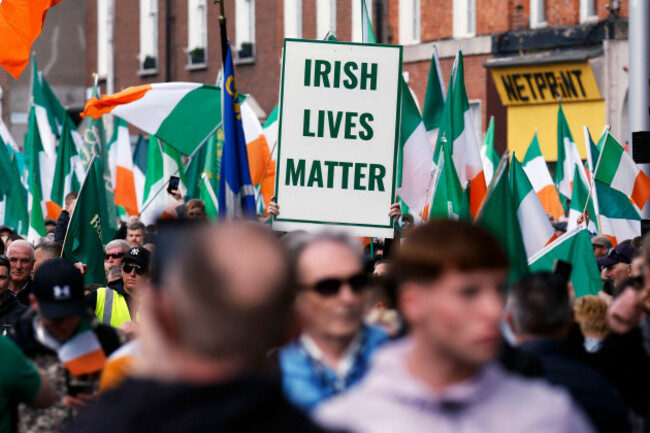
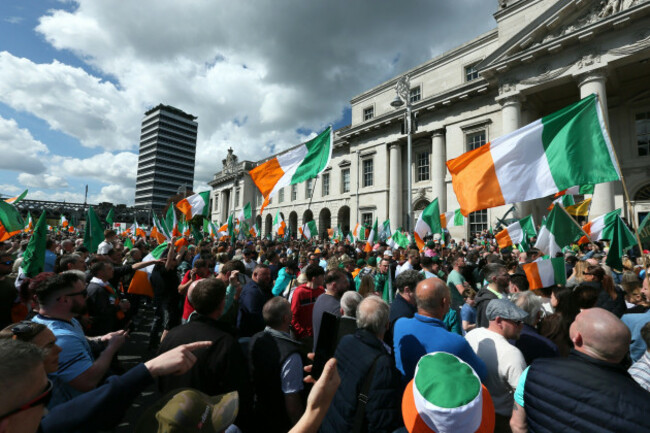
Leaving Ireland to find a better life abroad is one of the most quintessentially Irish things there is. When I saw another anti-immigration protest in Dublin last weekend, I was confounded. Irish people being against immigration is like Brazilian people being against football, or English people being against drinking tea. A classic case of the pot telling the kettle to go back to its own country.
I live in London, where until the 1970s, signs saying ‘No blacks, no dogs, no Irish’ were commonplace. I’m pleased to say that the country has come a long way since then – they absolutely love dogs. Dogs attack children, hump our legs and don’t speak the language, but are more accepted in some pubs than Irish accents.

I was drinking in an East End boozer two weeks ago with my Spanish girlfriend and her friends from Malaga, when an ex-British soldier approached our table to tell me in no uncertain terms that 1) Eamon de Valera was a Nazi and that 2) he wouldn’t stand for ‘Fenian narratives’ in his pub. Furthermore, though his second name was Lynch, he did not consider himself ‘a Paddy’.
As much as we were enjoying this impromptu Ted Talk on the complex nature of cultural identity in modern Britain, I suggested to my group that we get up to leave. Mortally offended, the man called us all ‘Fenian bastards’ and warned me that I’d be shot in my legs as soon as I left the pub.
The surreal irony of a self-hating descendant of Irish immigrants calling a table of Spanish women Fenian bastards is something I’ll never fully recover from. While the bullets to my knees did not manifest themselves, the brute hilarity of the retired soldier’s wacky bigotry has left me with a permanent limp. My girlfriend’s Fenian narratives have not been tolerated in our apartment ever since.
Please, Ireland. Let’s not be like England.
People wanting to move to your country is a good problem to have. We’ve had migration in the opposite direction for centuries now. War and hunger were the principal drivers, but sometimes people just wanted a chance at economic and social opportunities not available to them at home.
For decades, successive Irish governments have looked away while the Middle East has been bombed, gutted and destabilised by Western powers. The timing of the migrant crisis isn’t a coincidence, but a direct consequence of policy decisions made in Washington and London. Those protesting against refugees in Ireland today are no different to those who rallied against the influx of Irish Catholics into America in the 1920s.
After generations of exporting our young people, Ireland is now a wealthy country that is attracting people from all over the world. Yes, it’s true that despite this wealth, our basic services like housing, healthcare and education are faltering. The homelessness numbers in Ireland are worryingly high, and the hopes of young people owning their own homes are slim. Thousands of those young Irish people are moving abroad in search of better incomes and conditions, an irony that cannot be lost on us all, surely. How would we feel if people came out to march against them on the streets of Sydney or Vancouver?
After the 2008 downturn, austerity and Covid, there is, without doubt, a long road ahead to rebuild the many vital services needed for the country to run smoothly, but none of this is the fault of migrants. We must look at our governments for accountability on those issues.
The truth is that we need foreign labour to staff our hospitals, construction sites and offices. It’s also true that immigrants need homes to live in, public transport systems and schools for their kids. Our failure to provide adequate services to cater for the existing population, as well as the excess demand this puts on the system, is our fault, not theirs. Blaming our crap national infrastructure on immigrants is like evangelical Christians blaming hurricanes on gay marriage — it’s lazy, and it’s not a good look.
Thankfully, Ireland’s far-right demonstrators remain electorally insignificant fringe figures. I suspect that if fascism ever does get a foothold on the island, its leader will not wear a three-piece suit and peaked cap and boast of his car collection.
Rather, he or she will have a thistle in their mouth, lambast the ever-escalating price of the chicken fillet roll, and mournfully complain that immigrants just aren’t ‘sound’. That’s the eejit we need to watch out for.
Peter Flanagan is an Irish comedian and writer. You can find him on Twitter @peterflanagan and Instagram @peterflanagancomedy.
To embed this post, copy the code below on your site














have your say