Sign in. It’s quick, free and it’s up to you.
An account is an optional way to support the work we do. Find out more.
Sign in. It’s quick, free and it’s up to you.
An account is an optional way to support the work we do. Find out more.
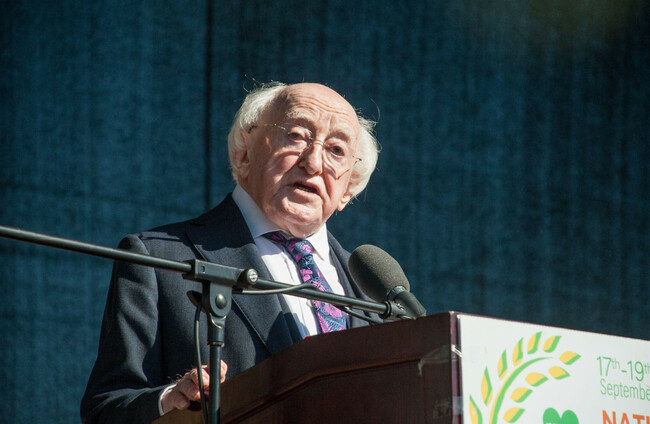

MICHAEL D HIGGINS’ TWO terms as President have been transformative for the office he holds. It has almost become a cliché of political commentary to say that President Higgins has not only crossed an apparent constitutional boundary by his political statements but somersaulted over them.
Given the commentary it has stirred in recent years, we feel it is important to offer a different perspective on whether the Constitution does in fact limit the President’s ability to speak on political matters.
For the most part, the Constitution gives the President ‘ceremonial powers’ – appointing ministers and the judiciary, signing bills into law, etc. Under Article 13.9, these are all carried out on the advice of the Government. In contrast, the President’s reserve powers are exercised at his ‘absolute discretion’.
The most significant of these include refusing a request to dissolve the Dáil on the advice of a Taoiseach who has lost the Dáil’s confidence (Article 13.2.2), and referring a bill to the Supreme Court to test its constitutionality (Article 26).
On the issue of speech, Article 13.7 states that every address to the Oireachtas or message to the nation by the President must be approved by the Government. Aside from this provision, the Constitution contains no other express limitation on presidential speech. Indeed, the practice of the Government reviewing all of the President’s public statements was ended at the insistence of President Robinson upon her election in 1990 on the basis that this was not required by the Constitution.
The requirement for presidential silence came not from constitutional law, but from constitutional convention. Conventions are non-legal political rules of the game which often fill the gaps between written legal provisions. For example, while the Constitution says nothing about the Attorney General (the Government’s chief legal advisor) attending Cabinet meetings, they attend as a matter of convention, presumably because their presence is useful for effective governance.
For a convention to be operable, it must have 1) precedent, 2) belief among all parties concerned that it should be obeyed, and 3) a reason for obeying it. Before Mary Robinson’s election in 1990, there was precedent among Presidents and Governments for a silent Presidency, as well as a belief that Presidents ought to be silent.
Since then, precedent no longer points solely at presidential silence, and it is clear that recent Presidents (including the incumbent) have not felt themselves bound to silence on matters of political controversy. Crucially, the reason for the convention of silence was the view that the proper exercise of the President’s reserve powers mandated the appearance of political neutrality, lest the feeling arise that the President was using them according to their own political bias. However, this reason is undermined by two crucial facts about the Irish Presidency.
Firstly, unlike many other parliamentary democracies, the President of Ireland is not formally part of the ‘executive branch’ (what we generally call ‘the Government’). For example, in Britain King Charles III is the source of executive power; the British government formally exercises executive power on his behalf.
This is also the case in most Commonwealth jurisdictions, even those that became republics. India’s Constitution vests executive power in the President and the cabinet formally advises her on how to exercise it. Of course, the reality is that in all these parliamentary democracies political power rests with the government.
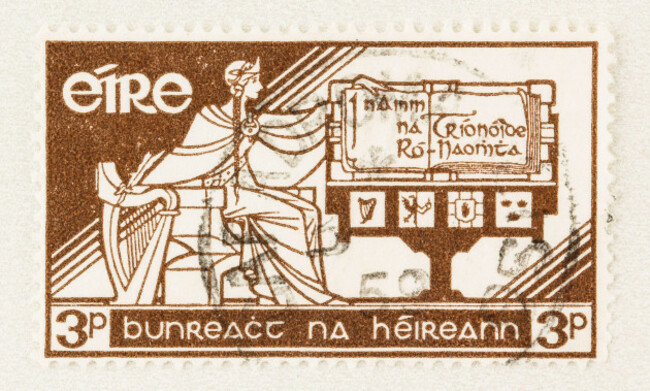
Under this arrangement, a head of state openly criticising government policy would divide the executive branch – a constitutional crisis would ensue. In Ireland, Article 28 of Bunreacht na hÉireann already vests executive power in the Government, not the President. In other words, the Government exercises executive power on its own behalf, not on behalf of the President. No crisis ensues when the President criticises Government policy, as demonstrated by the fact that the wheels of government keep on turning despite President Higgins’ public comments.
It was long thought that the legitimate exercise of the President’s reserve powers mandated the appearance of political neutrality. Essentially, the President was to behave like a judge, constricted by the same need to appear above politics. Unlike a judge, however, the President is not an appointee: he is directly elected by the people.
The general norm for parliamentary republics across Europe is to elect a president by something like a joint sitting of both houses of parliament. Monarchs, of course, lack any democratic mandate. In contrast, the Irish Constitution deliberately creates a process whereby one person receives an unparalleled personal mandate from the people – no one, not even the Taoiseach, receives a mandate of comparable scale or directness. One may reasonably ask what the point of this mandate would be if the person receiving it must remain mute on important issues.
Of course, the desire for an apolitical purely symbolic Presidency is perfectly legitimate. The only point we make is that such a Presidency is not explicitly or implicitly mandated by our Constitution.
If enough of the electorate want the office to return to a more neutral apolitical stance, they are within their rights to vote accordingly this November. That is, after all, the whole point of having a directly elected Presidency.
Seán Rainford is a PhD researcher at Dublin City University researching constitutional law. Dr Jamie McLoughlin researches and teaches in the areas of constitutional law and human rights law at University College Dublin.
To embed this post, copy the code below on your site















have your say