Sign in. It’s quick, free and it’s up to you.
An account is an optional way to support the work we do. Find out more.
Sign in. It’s quick, free and it’s up to you.
An account is an optional way to support the work we do. Find out more.
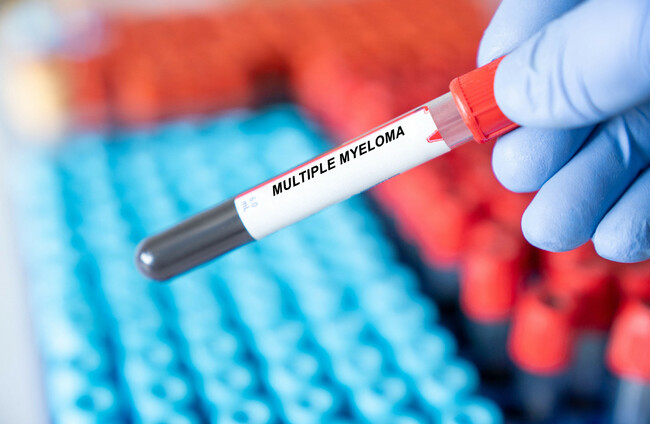

MOST PEOPLE HAVE never heard of myeloma. For patients, that lack of awareness can cost precious time.
Myeloma is a blood cancer where the plasma cells in the body’s bone marrow become abnormal. They begin to multiply uncontrollably and produce a useless antibody called paraprotein (M protein), which is used to diagnose and monitor the disease.
Unlike most cancers, it doesn’t form a lump or tumour. Rather, abnormal cells build up in the bone marrow across multiple sites in the body (hence ‘multiple’ myeloma), including the spine, skull, pelvis and ribs.
Myeloma follows a relapsing-remitting pattern, meaning periods of active disease requiring treatment alternate with periods of remission where no treatment is needed.
This disease begins with ordinary symptoms. Back pain that feels like wear and tear. Fatigue that is often put down to age or stress. Repeated infections that seem like bad luck. Individually, these look common. Together, they can tell a very different story. The purpose of awareness of these symptoms is not to frighten people. It is to help them ask better questions earlier and to help the frontline health workers they turn to first consider whether a straightforward blood test might be warranted.
If someone has persistent or unexplained symptoms such as ongoing bone or back pain, unusual tiredness, repeated infections, unexplained anaemia, kidney problems or fractures that happen too easily, they should feel empowered to speak with their GP and ask whether further investigation is appropriate. That one conversation can matter enormously.
I was diagnosed with multiple myeloma in November 2020. But in some ways, my diagnosis arrived slowly. I had spent five years watching a precursor condition called MGUS (Monoclonal Gammopathy of Undetermined Significance) quietly progress to smouldering myeloma, and eventually to the real thing.
That waiting period was, in a strange way, a gift. It gave me time to read, to understand, and to prepare for what was coming.
Even so, nothing quite prepares you for treatment. The fatigue is relentless. The many months of therapy take something from you, and you rebuild yourself around what remains. What kept me going both physically and mentally was rowing. The water, the rhythm, the discipline of it. You find what roots you and you hold on.
I have made a conscious decision not to fight myeloma. I live alongside it. I would rather use that energy to live my life.
But I was one of the more informed patients. I knew what I was dealing with before I was fully in it. Most people don’t get that runway. Many people with myeloma spend months, sometimes much longer, trying to make sense of symptoms that could easily belong to a dozen other conditions. That gap between the first symptom and the correct diagnosis is not just frustrating. The evidence shows it is genuinely dangerous.
Around 3,000 people in Ireland are living with myeloma today, with approximately 380 new diagnoses each year. The five-year survival rate has risen to 67%. But, projections suggest a 44% increase in cases by 2030, bringing annual diagnoses above 500. That is a growing public health challenge, and awareness is not keeping pace.
The numbers on delayed diagnosis are striking. Research shows that 40% of myeloma patients had symptoms for more than six months before receiving a diagnosis, and in that group, serious complications were common by the time they were finally identified: over half had significant anaemia, nearly half had bone disease, and more than a third had kidney failure.
A Myeloma UK survey found that half of all patients described their diagnosis as delayed, with nearly a third first presenting through an emergency visit. Evidence presented at the ASH (American Society of Haematology) Annual Meeting found that up to half of patients were initially treated for a different condition entirely, most commonly, back pain or sciatica. There is also a survival gap between early and late-diagnosed patients of an estimated 15 to 20 percentage points. That gap is not inevitable. It is, in part, a product of awareness, or the lack of it.
This is why Myeloma Ireland is launching a national awareness campaign this year. The public launch takes place at the Bord Bia Bloom festival through a show garden entitled Rooted in Resilience; its three sections reflecting the descent of diagnosis, the long road of treatment, and the hard-earned uplift of learning to live alongside a chronic illness.
But the campaign extends well beyond Bloom, reaching GPs, physiotherapists, chiropractors and nephrologists; the people patients often turn to long before myeloma is ever considered.
Because awareness cannot stop with patients. It must reach the people they turn to first. Myeloma is currently incurable, and for many, relapses lie ahead. But for a growing number of people, it is a manageable condition, one that can be lived with, worked around, and not allowed to define you. I know that from experience. I also know that earlier diagnosis gives people more options, more time, and a better chance of reaching that place.
Ireland needs to know more about myeloma. Not because everyone should be anxious about every ache, but because awareness gives people a better chance of recognising when something is not right. It gives patients language. It gives families confidence. It gives clinicians another reason to pause and ask whether further investigation is needed.
If this campaign helps even one person ask a question earlier, seek a test sooner, or feel less alone after diagnosis, it will have mattered.
Declan Watson is Executive Director of Myeloma Ireland. Diagnosed with multiple myeloma in 2020, he spent 34 years in management consulting, retiring as a Partner at Deloitte US.
To embed this post, copy the code below on your site












have your say