Sign in. It’s quick, free and it’s up to you.
An account is an optional way to support the work we do. Find out more.
Sign in. It’s quick, free and it’s up to you.
An account is an optional way to support the work we do. Find out more.
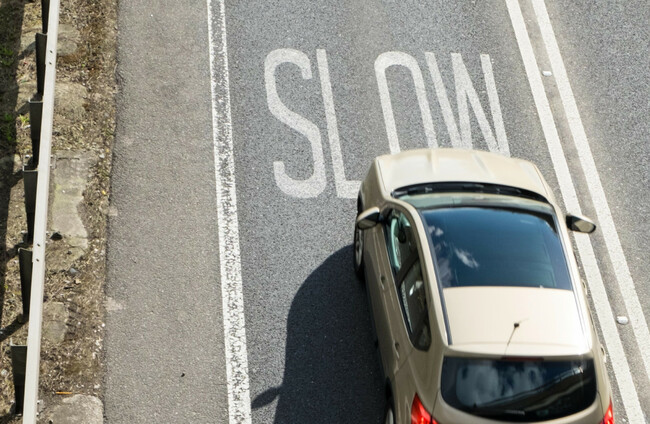

MORE PEOPLE ARE being killed on our roads in recent years after reaching an all time low in 2018, something that has been described as “shocking” by the government. Meanwhile, serious injuries due to collisions have tripled in the last 15 years, which hardly ever gets mentioned.
A pedestrian being hit by a car at 50km/h has a less than 50% chance of survival. However, at 30km/h, this increases to 90% ³ while also reducing the number of collisions in the first place.
Reducing the default speed limit in urban areas to 30 km/h is a virtually cost-free policy that would drastically decrease the likelihood of a pedestrian dying or being seriously injured in collisions.
This has been demonstrated in other countries and is a key action in the government’s Road Safety Strategy – but its rollout is being delayed and weakened down.
Our national legislation sets the default speed limits for different types of roads. 80 km/h on rural regional roads, 60 km/h on rural local roads, 50 km/h on urban roads etc. Local authorities are allowed to vary them on a case by case basis with good reason. For example, on arterial roads.
The change in the default urban speed limit was due to come into effect in the middle of this year.
However, the new government called a halt to that plan. It is instead asking all 31 local authorities to reduce speed limits by assessing tens of thousands of kilometres of roads individually. The government’s position is that this would be more efficient and should now be done as early as 2027.
At a recent briefing held by the Love30 campaign, I questioned an advisor for Minister of State for road transport Sean Canney about why the current 50 km/h default speed limit couldn’t simply be changed to 30 km/h as proposed initially – but no answer was provided.
No one would advocate leaving it to local authorities to change the drink driving limit one-by-one, or implement mandatory seat belt laws. It would be laughable if it wasn’t so serious.
A coordinated national approach would not have taken any power away from councillors – it would simply have changed the default from what it currently is, while still allowing them to vary it.
Standard speed limits across the country would eliminate confusion and let drivers know that once they enter an urban area, the speed limit is 30km/h unless signposted otherwise.
However, speed limits can be controversial, and for this reason, the government has decided to pass the buck by asking under-resourced local authorities to go through an over-complicated process. This will ultimately cost lives and limbs.
This approach to safety marks a worrying step in the wrong direction where political courage is more important than ever, as the recent EU-US trade agreement will fundamentally change things.
At the same time as the government is playing around with crucial speed limit plans, the European Union is set to let American cars onto the EU market without checking they match up with our long-held safety standards.
American manufacturing has been struggling for decades and US President Donald Trump wants more countries to buy American cars.
To achieve this, in the recent EU-US trade agreement, he secured “mutual recognition” of vehicle safety standards. This means that the EU, which has stronger safety standards than the US, is going to let dangerous American vehicles loose on our streets to appease the Trump regime. Those cars will be able to bypass European laws on, for example, emergency braking, size and shape.
While modern vehicle standards have made cars safer for drivers and passengers of the vehicles, larger, heavier and faster cars have made roads more dangerous for pedestrians and cyclists.
One of the newly available cars will be the RAM pick-up. Currently only available through a loophole, the new agreement will make it more readily available and cheaper to buy in the EU.
Cars with higher bonnets have larger blind spots and are more likely to drag pedestrians and cyclists underneath the car in a crash as opposed to over the car.
The bonnet height of the RAM is roughly twice the size of a regular car you’d see in Ireland, creating a blindspot that would leave the driver unable to see the average primary school child.
According to an analysis by transport advocacy group T&E, “pedestrian road deaths in the US are now three times higher than in Europe (after having been roughly the same in 2009)”, largely down to the increase in pick-up trucks, which are three times more likely to kill a pedestrian or cyclist than a normal car.
Shane McGowan joked that in America they had “cars big as bars”. With the RAM pick-up, this becomes a reality, with the 6-metre length being several times the size of the Dawson Lounge’s facade.
Now, pedestrians and cyclists in Ireland will have to pay for Trump’s domestic policy priorities. While geopolitics swirls above our heads and paygrades, we are sleepwalking into much more dangerous roads. That is, unless we take action, like making sure our speed limits are at safe levels.
The government is delaying and delegating cost-free decisions that are politically tricky but necessary. While it dithers, our roads will only become less safe.
Feljin Jose is a Dublin city councillor and the Green Party’s spokesperson for transport.
To embed this post, copy the code below on your site
















have your say