We need your help now

Support from readers like you keeps The Journal open.

You are visiting us because we have something you value. Independent, unbiased news that tells the truth. Advertising revenue goes some way to support our mission, but this year it has not been enough.

If you've seen value in our reporting, please contribute what you can, so we can continue to produce accurate and meaningful journalism. For everyone who needs it.

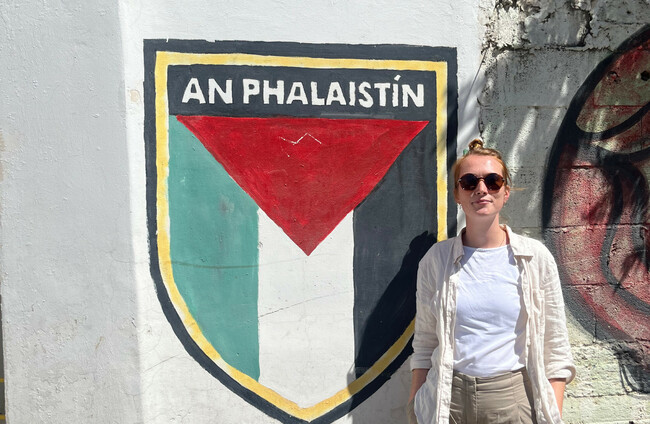
Social Democrats senator Patricia Stephenson next to an Irish mural outside Aida Refugee Camp in Bethlehem. Patricia Stephenson

Opinion Only by visiting the West Bank can you understand what life is like for Palestinians there

Social Democrats senator Patricia Stephenson shares what she experienced on a recent fact-finding mission to the occupied territory.

MEDIA REPORTS OVER the years have given us some insight into the systematic oppression faced by Palestinians at the hands of Israel. However, it was only during my recent trip to the West Bank that I fully came to understand the grim reality of life under this brutal apartheid regime. It’s an experience I won’t easily forget.

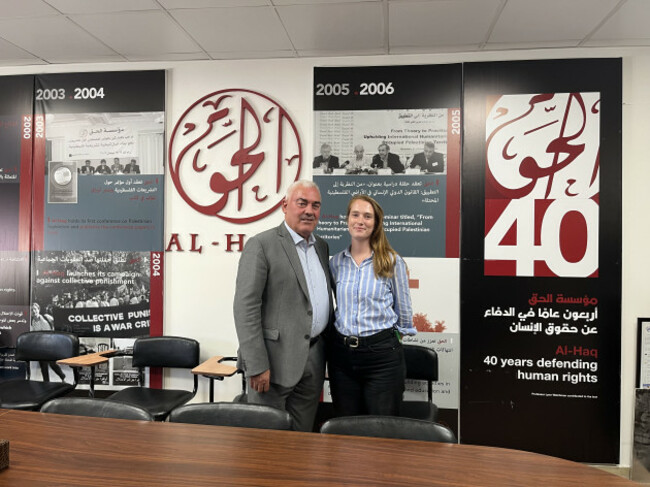
I travelled to the West Bank to see firsthand what life has been like for Palestinians since the genocide began in Gaza almost two years ago. This included a visit to Al Haq, the independent Palestinian non-governmental human rights organisation, which was sanctioned in early September by the US government for its contribution to the International Criminal Court case against Israel. Aided and abetted by Washington, Israel is doing everything in its power to make it impossible for these human rights groups to keep functioning.

My first experience of life under apartheid involved running the gauntlet of multiple checkpoints – where we encountered lengthy queues – to get to my destination. This is par for the course for Palestinian people, with the Israeli authorities intent on making their daily lives as difficult as possible.

I travelled to the Dead Sea, on the border with Jordan, where pay-to-access beach resorts are open to Israelis and tourists, but largely out of bounds for Palestinians. Those with West Bank identifications cannot enter illegally occupied settlements, whereas those with Jerusalem IDs have more accessibility. This is just one of the many tools of apartheid creating fragmentation and hardship within Palestinian communities.

Patricia with Al Haq Executive Director Shawan Jabarin, Ramallah With Al Haq Executive Director, Shawan Jabarin. Patricia Stephenson Patricia Stephenson

Even before 7 October 2023, it was always highly challenging to travel for Palestinians. Families split between places like Gaza and Hebron or Ramallah and Jerusalem could simply not see one another. As the genocide escalated, almost all work and travel permits for Palestinians with West Bank IDs have been denied.

I also travelled to Umm al-Khair, a village in the South Hebron Hills. This is the same community where Awdah Hathaleen, an activist involved in the Oscar-winning ‘No Other Land’ documentary, was shot dead by a settler in July of this year. Awdah was unarmed when settlers came to his village, bulldozed their land and recklessly fired into the crowd. The perpetrator was held for a day, suspected of ‘careless killing’, but later had his gun returned to him by the IDF. While initially placed under house arrest, these bail conditions were eventually dropped.

I spoke with activist Eid Souliman Hathleen, who witnessed it all. After Awdah was killed, the IDF took his body to the hospital and shot tear gas into a crowd of Palestinians to protect the settlers. His body was held by the IDF for 10 days, with the army also demanding his funeral be moved far away from the community to prevent a large gathering. On the day of the funeral, the roads were closed to stop mourners from attending. Even after death, Awdah was treated like a criminal.

Awdah’s murder has had a chilling effect on activists. Violent attacks occur on a weekly basis in the West Bank. It has reached a level where a totally unprovoked daylight killing results in complete impunity and no accountability for extremist, violent settlers.

Later that day, I travelled to Hebron with Breaking the Silence, an organisation of veteran IDF soldiers who oppose Israel’s genocide in Gaza and expansionist apartheid in the West Bank. We were soon approached by settlers who were unhappy with what our guide was telling us about the violence in the city. I then saw two young Palestinian men being aggressively frisked at a checkpoint, with pockets turned out and t-shirts pulled up – a reminder of the daily injustices and humiliations imposed by Israel in a Palestinian city. Later, a drone hovered over us, yet another reminder that we were being monitored and were unwelcome.

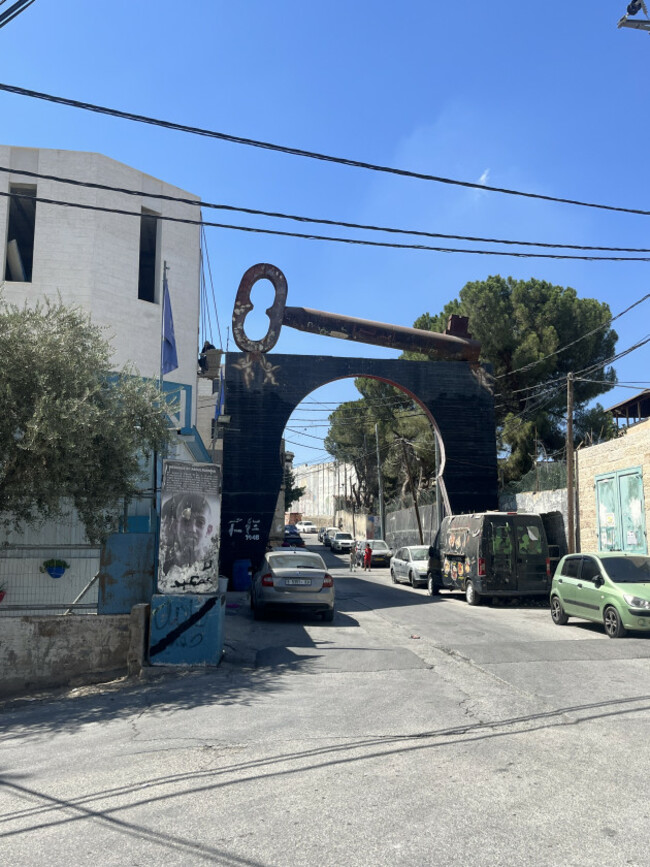
On my third day, I visited Aida refugee camp, which was first established in 1950. The evidence of international solidarity, and in particular Irish support, is marked by murals near the gate of the camp. The camp entrance depicts a large key above the gate, a symbol of refugee resilience. In 1948, those fleeing the Nakba – the mass displacement of Palestinians – took their front door keys, hoping to return. Those keys continue to be handed down from generation to generation, even if their homes are no longer standing.

I was struck by the way everyone introduced themselves. After saying their name, they would also state the village they are from – or, more accurately, the village that their families were forcibly expelled from in 1948 or 1967.

Key is the symbol of refuges who hope to one day return to their homes, outside Aida refugee camp, at the entrance of Aida Refugee Camp Bethlehem, The key is the symbol of refugees who hope to one day return to their homes, outside Aida refugee camp, at the entrance of Aida Refugee Camp, Bethlehem. Patricia Stephenson Patricia Stephenson

While in Aida, I also visited the Lajee Centre, a youth facility from which an annual cultural tour to Ireland is organised. Having met the staff, all of whom are former youth project participants, I am more outraged than ever that the visas for this year’s tour were inexplicably denied by the Irish government. This trip would have offered some respite and hope for children living in refugee camps, where nightly military checks and house raids are regularly conducted.

It was only by being there that I got a full sense of how embedded expansionist ideology is within the architecture of the Israeli state. Throughout my brief time in the West Bank, state sanctioned settler annexation was evidenced across the landscape. Mega highways, only accessible to Israelis, are being built to cut off Palestinian communities from each other, and to offer less extreme settlers a sanitised suburbia to move to. Improved road infrastructure may signify progress in Ireland, but in the West Bank it has more sinister connotations: it is used to divide and conquer.

Israeli expansionism can be seen everywhere. I visited a shopping mall in the Ma’ale Adumim settlement, selling high-end furniture to prospective settlers. The Israeli government know that most Israelis are not happy to lessen their standard of living, so the more polished settlements offer an opportunity for a ‘normal life’ for those not driven by far-right ideologies. Since 2010, there have been 240 new outposts in the West Bank, with over 102 of them post-7 October. 

I wish I could say I returned from my trip with a sense of hope. Unfortunately, the experience has only reaffirmed my belief that Israel will continue its violent incursions into Palestinian territory. We know these settlements are illegal and – much like the horror unfolding in Gaza – that the international community will refuse to take any meaningful action. Without sanctions, and without an economic cost, Israel will continue committing war crimes and stealing land from the Palestinians.

That is why is it is more important than ever for the Irish government to enact the Occupied Territories Bill, to include a ban on goods and services from illegal settlements, without further delay.

While the situation is bleak, the one positive that will remain with me is the unwavering resilience of the Palestinian people living under apartheid and oppression. We must continue to stand with them.

Patricia Stephenson is a Social Democrats senator and the party’s foreign affairs spokesperson. Prior to entering politics, she worked in peacebuilding and conflict prevention. She spent six years in East Africa as an international aid worker, including as an EU diplomat in Uganda.

Readers like you are keeping these stories free for everyone...
A mix of advertising and supporting contributions helps keep paywalls away from valuable information like this article. Over 5,000 readers like you have already stepped up and support us with a monthly payment or a once-off donation.

Close
JournalTv
News in 60 seconds