Sign in. It’s quick, free and it’s up to you.
An account is an optional way to support the work we do. Find out more.
Sign in. It’s quick, free and it’s up to you.
An account is an optional way to support the work we do. Find out more.

THIS WEEK WAS marked by the proliferation of horse shit in Dublin.
A public exposed to bags and bags of the stuff. A mess exposing a failure of administration, organisation and planning that so characterises the approach of those responsible for running the country.
But enough about the government’s approach to the public sector strikes.
Now, if it were up to me, this would be the part of the column where a loud air horn sounds and all the readers go nuts and I run through the crowd getting a bunch of hi-fives for my joke and everyone chants “Carl! Carl! Carl!” Alas, there are cruel limits to the written medium.
No, but seriously folks, there does appear to be an epidemic of horse manure affecting parts of North Dublin since a manure treatment plant in Dublin 8 closed last year. Sinn Féin councillor Séamas McGrattan estimated that over 500 bags of horse manure have been dumped in Cabra alone in the past six weeks. God help whatever poor staffer he sent out to count them.
Asked whether they were going to do anything about it, Dublin City Council said, and I am paraphrasing somewhat here: “No.” It is startling to think that Horse Racing Ireland received €81.2 million in the budget earlier this month and not a single cent of that has been spent on a public restroom for horses. Though, to be fair, if you go around Ireland, there are very few public restrooms for humans either.
The apparent unwillingness of Dublin City Council to accept that they might have a role in keeping the city free of hundreds of bags of literal, and I cannot stress this enough, horse shit, does seem somewhat parallel with the lumbering, lackadaisical way that the government has chosen to address the issue of public sector pay in Ireland during a cost-of-living crisis.
Earlier this year, in the midst of the fuel protests, after the Taoiseach referred to the unforeseen nature of the demonstrations, this column noted: ‘Only in Micheál Martin’s mind is this unashamed unpreparedness an excuse, rather than its own failing. Not only a failing, but perhaps the failing that precipitates all others.’
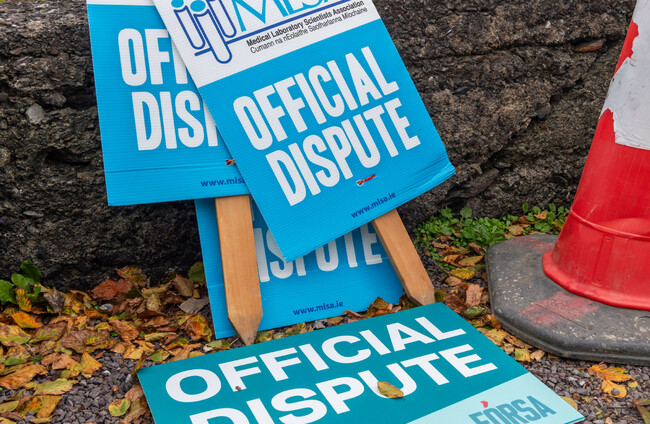
I’m sure I could find some kind of way to rephrase that sentiment, though it feels more appropriate to simply gesticulate in exasperation at the 300,000 workers — many of whom essential to society’s most basic functions — who have been forced to take industrial action because the government tried to ignore another problem. A problem which, in this case, could have been foreseen a year ago. Actually, it could have been foreseen when they wrote the previous public sector pay agreement. There was an end date on the thing, after all. This is how you end up with players leaving on a Bosman.
Instead, the government has been caught on its heels yet again. As was the case during the fuel protests (which were infiltrated, of course, by those with their own anti-immigration agendas), schooling has been cancelled, medical treatments have been delayed or curtailed, and there are few people for whom the ordinary living of life was not impacted in some way or other.
It is admittedly a little funny to think of the strike as a meaningful cause of disruption. What’s there to disrupt, buddy? At times, it feels like it’s disruption all the way down, every day of the year. HSE waiting lists just crossed the million threshold for the first time ever. There is something of a resignation crisis in the Gardaí. As mentioned earlier, there are actual bags of manure being illegally dumped across Dublin and the council is uninterested in the matter.
Don’t get me wrong, the strikers are right to strike and to be heartily commended for it. It’s just sort of that the whole point of a strike is to in some sense withdraw from the social contract, and it’s kind of hard to withdraw from something that’s been treated, by those in power, with all the sanctity of horse toilet paper.
The government’s own cough has softened noticeably, which is fortunate, thanks to the aforementioned waiting list issue and the work-to-rule situation in hospitals. Indeed, they have seemed to scramble for a conciliatory tone this week. Minister for Public Expenditure Jack Chambers has said the €1.2 billion for public sector pay talks announced in the Budget is the “starting point” for discussions, presumably in a bid to reassure the striking workers that it’s worth their while to come to the table, but man, what a funny thing to say about the budget. We spend all year pretending that this set of measures has been painstakingly and meticulously agonised over, the numbers lined up within an inch of their lives, only to declare a week later that some of it is little more than a bargaining position in a negotiation that should have commenced in the spring.
But at the end of the day, people would probably take the annual budget speech a little less seriously if Chambers or Minister for Finance Simon Harris stood up and said “A cheann chomhairle, we will be allocating €1.2 billion in additional funding for public sector pay over the coming year, but to be clear, that plan hinges entirely on the assumption that workers will not engage in so much as one day of striking, at which point we’ll actually have to go back to the drawing board.”
The most recent recorded inflation stats say that prices have increased by 4.1% year-on-year. If you take it back to September last year, inflation was at 2.7% — the highest it had been since March 2024. Over time, this is a lot of inflation. In economic terms, it’s enough inflation to blow up an entire communion season’s worth of bouncy castles, and given the global geopolitical landscape, deflation seems a distant prospect.
The strike, therefore, is not about wanting more cash just for the sake of it. It’s not about the gladiatorial thrill of making Jack Chambers hand over his lunch money. The strikes are simply a symptom of a society beset by a range of crises that are making it miserable to live and work in Ireland. I mean really, who even knew you could spell crisis with an e?
This is a state of affairs that the government and its previous iterations has overseen for a very long time. As any union rep on any picket would have told you this week, their primary concern is a pay deal that simply keeps their heads above water during a tide that only ever seems to rise.
How does it all get resolved? There is the received wisdom in the world of negotiation that says a good deal is when both sides come away unhappy. Of course, there’s every chance they’ll bring in Kieran Mulvey to sort it all out (how did we resolve disputes without him? How will we resolve disputes after he’s gone? Do we have someone who can appoint a new celebrity arbitrator like they do for the Dalai Lama?), but even so, it seems fantastical to imagine the government agreeing to a public sector pay package that could possibly keep pace with the streoidally hulking cost of, you know, buying bread and butter in 2026 Ireland.
Hell, even a bag of horse manure can set you back nearly a tenner these days.
To embed this post, copy the code below on your site













have your say