Sign in. It’s quick, free and it’s up to you.
An account is an optional way to support the work we do. Find out more.
Sign in. It’s quick, free and it’s up to you.
An account is an optional way to support the work we do. Find out more.
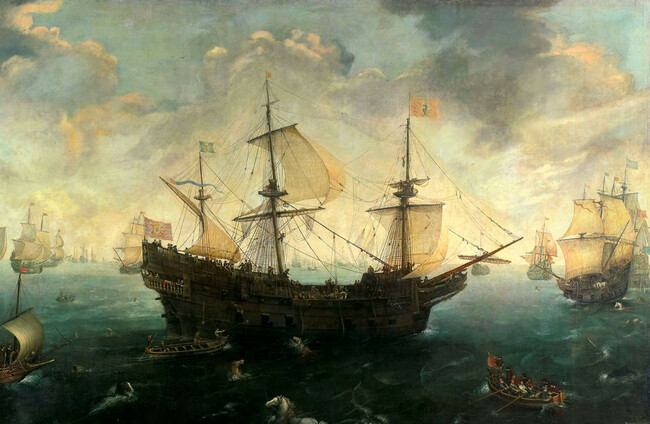

THE SPANISH ARMADA was a hugely important event, a cataclysmic struggle between powerful Spain and England, then a minor country. In my new book on the Armada, using new information, I set out clearly what happened, both internationally and in Ireland – and at the same time, dispel some myths.
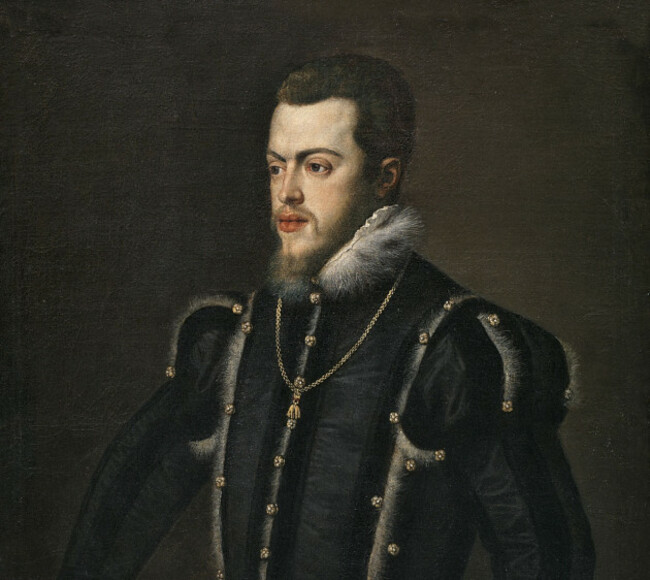
Since Elizabeth I ascended the throne, relations between England and Spain had soured, marked by English attacks on Spanish treasure fleets. After Philip II of Spain had inherited the Portuguese crown in 1580, Elizabeth supported the pretender Dom António.
In 1585, the Queen agreed to back the rebellion in the Spanish Netherlands. This crossed a line for Philip, as the Low Countries were vital to his empire. Planning to strike at England’s heart, he decided to invade and replace Elizabeth with a Catholic (and Spanish-friendly) ruler.
A large invasion fleet and army were assembled at Lisbon. The Armada set sail in late May 1588, aiming for the coast of Margate to establish a beachhead and protect the Spanish Army of Flanders for its invasion.
The Armada sailed along the English Channel, anchoring off Calais on 6 August. The harrying English fleet had caused no significant damage. Bad news followed: the army in Flanders was not yet ready. Then came the game changer. The English sent in fireships that night, causing the Armada to scatter and lose its defensive formation.
On 8 August, a great battle erupted. English ships swarmed in, attacking the Spanish rearguard at odds of ten to one. Spanish casualties were high, and two galleons ran aground on the Dutch coast. However, despite expending nearly all their powder and shot, the English managed to sink just one ship.
Afterwards, the Armada regained its formation and because of the continuing southerly wind, they decided to take the long route north around the British Isles to return to Spain.
Continuous storms beset them as they sailed west into the Atlantic. Many ships lost sight of the main group and were driven towards the dangerous coasts of Scotland and Ireland. Finally, on 21 September, the Armada flagship and a small number of ships arrived off Santander. In the following weeks, other Armada vessels returned home.
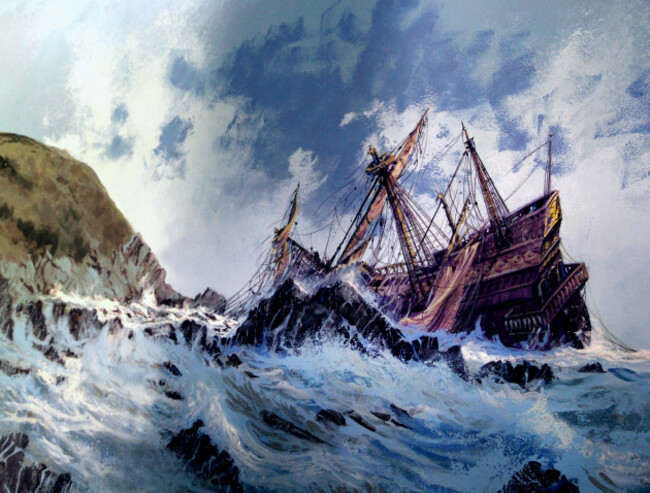
The exceptional stormy weather caused shipwrecks, mainly along the Atlantic coast of Ireland, where 24 Armada vessels met their end. The hardship did not end there: the English authorities in Ireland, fearful that they would ally with the Gaelic lords, ordered the execution of all Spaniards. This resulted in the slaughter of around 1,500 survivors by English soldiers or their Irish proxies.
Many myths abound about the Armada. Up to recent times, the perception in Britain has been that the Armada events were a glorious triumph, with the English navy decisively smashing the Armada fleet. However, in reality, just one Spanish ship was directly sunk by English cannon fire.
The rest were lost due to accidents and, principally, shipwreck. Of the 128 vessels that set out, the most up-to-date estimate is that 91 ships eventually made it back to Spain. It is a tribute to the mariners, and to the solid build of Spanish and Portuguese ships, that over two-thirds of the fleet managed to return after encountering such horrendous challenges.
This is a popular myth which tells of the ‘Black Irish’, those with black hair, supposedly descended from Armada survivors. Alas, it is not true – the survivors were slaughtered or, if they were lucky enough to evade capture, tried to gain passage to Scotland. In reality, there had been centuries of Spanish fishing and trade with Ireland. In addition, recent genetic studies indicate that Ireland was settled by migrants from northern Spain after the last ice age.
It was a close call for England. With better planning, the Army of Flanders could have sailed out to get within the Armada defensive formation and continue to Margate. Once landed, these, the best troops in Europe, could have reached the gates of London within a week. England would have probably kept English; we most likely would have maintained Irish, and Spanish would now be the world’s lingua franca. However, sending in the fireships at Calais became the pivotal moment after which the Armada was to meet with failure.
Michael B. Barry, author of 1588, the Spanish Armada and the 24 Ships Lost on Ireland’s Shores. The book is shortlisted for TheJournal.ie Best Irish-Published Book of the Year. Click here to cast your vote for the Irish Book Awards.
To embed this post, copy the code below on your site















have your say