Sign in. It’s quick, free and it’s up to you.
An account is an optional way to support the work we do. Find out more.
Sign in. It’s quick, free and it’s up to you.
An account is an optional way to support the work we do. Find out more.
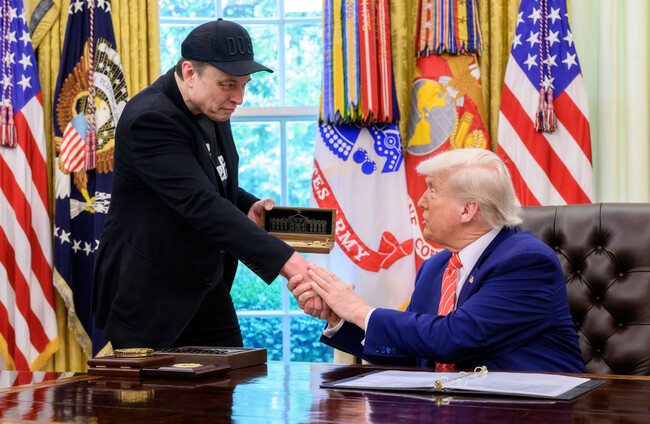

DONALD TRUMP HAS warned countries who tighten their regulations on social media companies that they could be hit with substantial tariffs in retaliation.
The EU’s Digital Safety Act (DSA) has the objective of improving the safety of the online environment by compelling tech giants to tackle illegal content, including hate speech and child sexual abuse material.
Reports in August suggested that the Trump administration had instructed US diplomats in Europe to launch a lobbying campaign to build opposition to the DSA in an effort to have it amended or repealed.
Trump posted on social media recently: “I put all countries with digital taxes, legislation, rules or regulations on notice that unless these discriminatory actions are removed, I, as president of the United States, will impose substantial additional tariffs on that country’s exports to the USA, and institute export restrictions on our highly protected technology and chips.”
Which is more important – the financial health of the US tech sector resulting from restrictions on illegal content, hate speech and child sexual abuse material or the health of a whole generation of children who have unrestricted access to this material?
One country is leading the field in protecting children against access to online content.
From 10 December, new laws will apply in Australia to platforms that meet the government’s definition of “age restricted social media platform”, which has the sole or significant purpose of enabling social interaction with two or more users, and which allows users to post material on the service.
The prime minister, Anthony Albanese, has said that the covered platforms include, but are not limited to, Facebook, Instagram, Snapchat, and YouTube. The platforms will be required to take reasonable steps to deactivate accounts for users under 16, prevent children registering new accounts, check ages, and also to prevent workarounds to bypass the restrictions.
An e-Safety commissioner will determine which platforms should be exempt from restrictions.
It is expected that age restrictions will follow a similar path for age assurance to that launched in the UK in July that includes options such as: allowing banks and mobile providers to confirm age of user; asking sites to upload a photo that is then matched with photo ID; or use of facial age estimation technology. Artificial intelligence may also be used to determine user age.
Platforms that do not take reasonable steps to comply with the ban will risk facing a fine of up to $49.5m that will be determined in the federal court.
Australia has decided that protecting children online is “manifestly too important for us not to have a crack”, according to Australian communications minister Anika Wells.
Tánaiste Simon Harris said in May that serious consideration should be given to banning under-16s from using social media, similar to the law due to be implemented in Australia in December, describing the high numbers of young children using social media as a “ticking time bomb”.
“Very serious consideration should be given to the idea of having to be 16 before you are on social media and aligning that with the digital age of consent in Ireland which is also 16,” Harris said in response to a Dáil question from Independent TD Paul Gogarty.
American social psychologist Joanthan Haidt has captured the public imagination by arguing that smartphones are to blame for young people’s unhappiness. They spend about five hours a day on social media, making their lives more sedentary and solitary.
Haidt, the author of The Anxious Generation, suggests that young people are coming of age in a “confusing, placeless, ahistorical maelstrom of 30-second stories curated by algorithms designed to mesmerise them”.
At the same time young people have much less free time to explore the world and much less independence to engage with their peers as they are ferried around from activity to activity in contained car bubbles.
What we fail to acknowledge fully is that while the private sector is valuable and while it’s sometimes the solution, it is also often part of the problem. Examples of this abound.
Cigarette manufacturers who push smoking in non-western countries and vaping in high- income countries.
Factories that produce industrial emissions that pollute the air and damage lungs with no incentives to worry about what happens next.
Fossil fuel emissions from cars that contribute to climate warming.
Ultra processed foods that make massive profits for the food industry who do not have to pay for the health impacts to individuals, communities and populations that succumb to obesity and chronic disease that starts in childhood.
Professor and Chair of Global Health at the University of Edinburgh and author of How Not To Die (Too Soon), Devi Sridhar writes that “the problem is that companies push a certain product to make money, but the health cost of these products is borne by individuals, the community, the healthcare system and the public sector”.
“The cost is born by families losing loved ones and hospitals trying to save the dying,” Sridhar says.
“Factories producing harmful emissions don’t bear the cost of dirty air: that’s families losing loved ones and hospitals dealing with a rise in asthma emissions. The same goes for ultra-processed foods and the impact and child obesity, chronic disease in later life, and reduced life expectancy.”
The same goes for a whole generation of children exposed to harmful content online including pornography, online grooming, and addictive algorithms that target them with content it is almost impossible to turn off.
In fact, the tech industry benefits from the harms it inflicts with huge profits accruing from the amount of time and material viewed online.
Americans, including Trump, have a high regard for freedom. The US constitution, through its Bill of Rights, particularly the First Amendment, guarantees freedom of religion, speech, the press and the right to assemble peacefully and petition the government.
But what about those who want freedom to travel with or without a car, freedom from a diet dominated by ultra-processed food, or a country that refuses to protect children from illegal inappropriate content and addictive algorithms on social media?
“Public health (and associated policies and legislation has too often been framed as something that takes away,” writes Sridhar, “rather than taking steps to protect freedoms to live a long and healthy life”.
At a time when we need visionary leadership prioritising health over profit, we get heads of government prioritising profit over science.
It’s not just Donald Trump. The list includes Ron deSantis, Jair Bolsonaro, Rishi Sunak, Boris Johnson, while in New Zealand, former prime minister Jacinda Ardern’s efforts are being usurped by her replacement who is reversing some of her policies.
Examples include former UK prime minister Rishi Sunak’s efforts to frame reducing air pollution as an ‘anti-car agenda’ tied to Labour; or before him, Boris Johnson’s attempts to lift Covid restrictions against scientific advice in 2020 and to encourage people into offices when the risk of infection was high.
We cannot allow fear of Trump’s threats to dilute our approach to protecting children online. Anthony Albanese has thrown down the gauntlet to the tech industry – we should look to science public health over profit as we consider our next move.
Dr Catherine Conlon is a public health doctor in Cork
To embed this post, copy the code below on your site













have your say